Alternatives and comparisons
Data ownership in inspection software, the questions that matter
Your reports are liability protection, your library is a career of judgment. What owning that data means in practice, and how to audit any vendor's exit door.
By Owen Murray, founder of InspectorKit · Updated July 6, 2026
Every inspection you perform produces two assets. The fee, which clears in days, and the data, which protects and compounds for decades. The industry's software has gotten very good at holding the second asset on your behalf, and holding is doing quiet work in that sentence. This guide is about converting on your behalf into in your hands, whatever platform you use.
What the data actually is, itemized
Data ownership sounds abstract until you list what an inspection business accumulates.
The report archive is liability armor. When a claim or a callback question surfaces years later, the exact language of your findings is the difference between a five-minute email and a legal problem. An archive you cannot reach because a subscription lapsed is armor in someone else's closet.
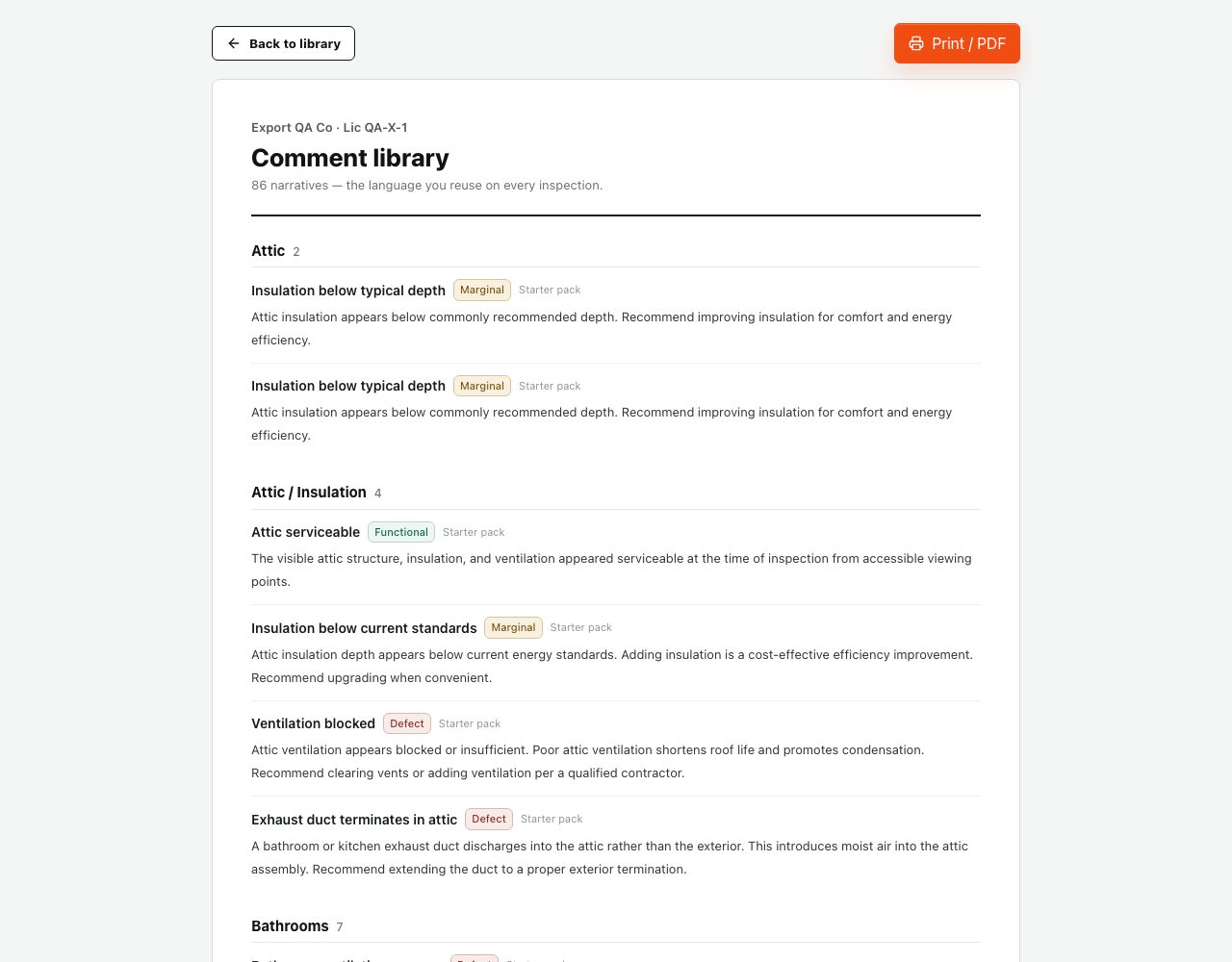
The comment library is a career of judgment, compressed. Every carefully worded narrative encodes lessons, phrasing choices, and liability instincts. It is the asset that makes your tenth year faster than your first, and it is exactly the asset platforms are least motivated to make portable, since it is the switching cost that keeps renewals automatic.
The template encodes your process. Walk order, item coverage, helper notes, the operational memory of how you inspect. And the client history, addresses and dates, is the referral and re-inspection ledger a business runs on.
None of this is exotic. All of it should exit any platform as ordinary files, and the distance between should and does is what this page audits.
Retention policies, read before you need them
Between ownership and export sits the quieter question of how long a platform keeps anything at all. Vendor terms typically reserve rights to purge data after cancellation windows, downgrade dormant accounts, or change retention rules with notice you will not read. None of that is scandalous, storage costs money, but it means the platform's memory and your liability timeline are different lengths, and the gap is yours to carry. A report from year two of your career can matter in year nine. No subscription tier is priced for that, and no vendor's lawyer wrote their retention clause with your E&O renewal in mind.
The audit, run it on your current vendor today
Five questions, answerable in one session while your login works and your mood is calm.
Can you bulk-download report PDFs, or only one at a time through six clicks each? At two hundred reports, per-report clicking is a de facto export ban. Does your comment library leave as text in any form? Does the template export, or would leaving mean reconstruction from screenshots? What do the terms say happens to access after cancellation, thirty days, ninety, immediately? And is any of it gated behind a plan tier, because data ransom by pricing tier is the tell that ownership was never the vendor's model.
Write the five answers down, with dates. The exercise costs twenty minutes and converts a vague unease into a specific list, and specific lists are negotiable at renewal in ways vague unease never is. They also make excellent questions for any new vendor's sales chat, this one included.
The InspectorKit answers, since the standard cuts both ways
A page like this on a vendor's site earns its credibility by answering its own questions in public.
Reports export as print-ready PDFs from every published report page, permanently. The comment library and template each export as clean lettered documents from their own pages, one button each, documented in the export guide. Nothing is plan-gated because the core purchase is the only tier. And the structural incentive runs the right direction, since a one-time purchase leaves the vendor nothing to gain from making departure painful. The exit door being easy is, strangely, the strongest reason customers stay.
The same incentive logic explains the industry's other direction. Subscription vendors monetize retention, so friction at the exit is not a bug in their model, it is margin. And when the model further monetizes your report traffic itself, per the whose-report-is-it breakdown, your data has become the product twice over.
Formats worth insisting on
Exports are only as good as their formats, so hold the outputs to a simple standard, files that open in twenty years without the vendor existing. PDF for reports, since it is the archival format courts and insurers already speak. Plain documents for the library and template, readable by anything with a screen. Be suspicious of proprietary bundles that only re-import into the same platform, which are backups in the sense that a key locked inside the house is a spare. The export formats here are PDF and printable documents for precisely this reason, chosen so the files outlive every party to the transaction, including the software.
The quarterly ritual that makes vendors irrelevant
Auditing the vendor matters less than making yourself audit-proof, so end with the habit.
Once a quarter, on a calendar reminder that survives busy seasons, export three things into a folder that lives with your tax records. The quarter's report PDFs. The current comment library document. The current template document. Fifteen minutes, and the state of your business's memory stops depending on any company's roadmap, retention policy, acquisition, or outage, including this company's.
Inspectors advise clients daily to keep their own copies of important documents. The advice was always good. It just also applies to the person giving it, and the version of you fielding a callback question in 2031 will be grateful the 2026 version took it.
Common questions
Legally, who owns the reports I write on a platform?
You authored them and your client paid for them, and none of that guarantees you convenient access after cancellation. Terms of service govern access mechanics, which is why the practical test is whether you can bulk-export today, not whose name the legal theory favors.
How long should an inspector keep old reports?
Longer than feels necessary. Statutes of limitation vary by state and claim type, and a callback question five years out is common enough that most E&O guidance treats report retention as career-length. Your retention policy should not depend on a vendor's.
What is the minimum viable export habit?
Quarterly, three things. Report PDFs for the quarter, the comment library document, and the template document, into the same folder as your tax records. Fifteen minutes, four times a year, and no vendor event can strand your business.