Alternatives and comparisons
Lifetime deals on inspection software, how to tell real from gimmick
The word lifetime carries offers it cannot always cash. A diligence checklist for pay-once inspection tools, applied hardest to the one selling it.
By Owen Murray, founder of InspectorKit · Updated July 6, 2026
Lifetime is the most abused word in software pricing. It has been stapled to deal-site promotions that died in eighteen months, to licenses that quietly excluded every update, and to real products that honored it for decades. The word tells you nothing. The structure underneath tells you everything, and this guide is the structural inspection, written by someone selling a pay-once tool and therefore obligated to pass his own checklist in public.
Why the word went bad
Deal marketplaces industrialized the lifetime offer in the 2010s. The playbook was simple, a young startup needs cash, sells thousands of lifetime licenses at a steep discount, and hopes to convert those users to future paid tiers. Sometimes it worked. Often the flood of non-renewing users became a cost center the startup eventually resented, and the lifetime crowd found their features frozen, their support deprioritized, or their product sunset.
Inspectors evaluating pay-once tools inherit that history's stink, unfairly but understandably. The fix is not trusting the word harder. It is inspecting the structure the way you inspect a house, system by system.
The structural checklist
Five systems, each checkable before you pay.
The revenue system first. Ask what the vendor earns from a customer after the one payment, and the healthy answer is add-ons priced at real recurring costs, extra seats and compute-hungry features, per the shape visible on InspectorKit's own billing page. A vendor with zero post-purchase economics is betting everything on perpetual new-customer growth, which is the exact bet the deal-site casualties made.
The cost system second. Lifetime hosting of your reports costs the vendor money forever, so lean infrastructure is not a nice-to-have, it is what makes the promise keepable. Small, focused products with modest server bills survive on one-time pricing. Sprawling platforms with sales teams do not, which is why none of them offer it.
The exit system third, and heaviest. If the vendor vanished tomorrow, what do you hold? The honest answer must be your files, reports as PDFs, template and comment library as documents, exported by you, today, with working export paths rather than roadmap promises. Real lifetime offers make themselves survivable. Gimmicks make themselves indispensable.
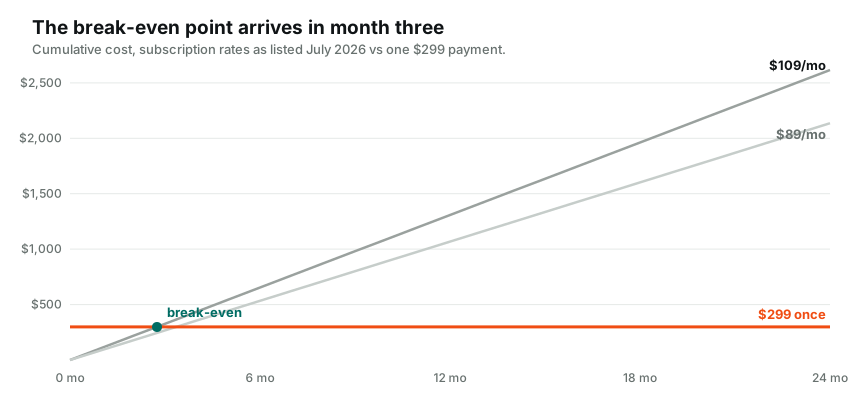
The terms system fourth. Read what the payment covers in plain language. InspectorKit's version is stated on its plans page, the core tool with a 500 reports per month ceiling, no renewal, add-ons optional. Whatever you evaluate, vague scope is a warning, and the buyer's guide carries the full break-even arithmetic once scope is clear.
And the human system last. Email the vendor a hard question before buying, something like what happens to my data if the product shuts down. Time the response, weigh its directness. A founder who answers plainly is showing you the support and the culture you are buying into. A wall of boilerplate is showing you the same thing.
Reading the update question honestly
The classic lifetime-deal failure is the frozen product, so ask about updates with precision. What you want to hear is that the core tool's improvements ship to everyone, because maintaining forked versions costs a small vendor more than shipping one good product. What you should accept is that genuinely new cost-bearing services may arrive as paid add-ons. What should end the conversation is any suggestion that security fixes or basic maintenance belong to a future tier. InspectorKit's own changelog is public for exactly this inspection, a running record of what shipped and to whom, and any pay-once vendor should be able to point at the equivalent.
Founding pricing, the variant worth understanding
InspectorKit's $299 is founding pricing, which is a specific structure worth distinguishing from a discount promotion.
Founding pricing means early customers pay less because they arrive before the social proof does, and their terms are permanent. The price can rise for later buyers as the product accumulates features and reputation, and the founding cohort keeps what they bought. It is the opposite of a cash-raising blowout, the volume is deliberate, each sale is profitable, and the early buyers become the product's proving ground and its loudest critics, which a one-person company actually depends on.
That structure is also checkable. Public terms, a real 60-day guarantee that costs the vendor money if the product disappoints, and exports that work from day one. Run this page's checklist against it, ask the hard question by email, and judge the response like the inspector you are.
The two-sided guarantee test
A refund policy is the vendor betting their own money on the product, so test its terms like a structural member. The window must be long enough for evidence from real inspections. InspectorKit makes that window 60 days. The refund must be unconditional beyond asking, since satisfaction reviews and retention calls are refusal mechanisms wearing customer-service clothes. And the data must survive the refund, meaning your exports work before, during, and after, which InspectorKit states plainly in its billing terms. A guarantee passing all three is doing what a guarantee is for, moving the risk of the promise onto the party making it.
The math that makes diligence worth an evening
Skeptical diligence has a payoff worth stating plainly. Every subscription alternative runs $79 to $109 monthly, $3,200 to $5,200 across four years per the market table. A sound pay-once tool at $299 returns the diligence evening at roughly a hundred-to-one ratio, and an unsound one caught by the checklist costs you nothing but that evening.
The word lifetime deserves your suspicion. The structure behind a good one deserves your evening. Inspect accordingly, and buy the way you would want your own clients to buy a house, eyes open, systems checked, and paperwork in hand before the wire transfer.
Common questions
What does lifetime actually mean legally?
Usually the product's lifetime, not yours, which is why the diligence below focuses on structure over promises. A vendor whose economics work without your renewal, and whose exports work today, is offering something the word can support.
Why do software companies even offer lifetime pricing?
Three honest reasons and one bad one. Early customers fund and prove a young product, ownership pricing attracts buyers subscriptions repel, some founders simply prefer selling tools to renting them, and the bad reason is a cash crunch dressed as a promotion. The checklist separates them.
Does InspectorKit's founding price rise later?
The plan is that founding buyers keep their terms permanently and the price can rise for future buyers as the product matures. That is the standard shape of honest founding pricing, you are early, you pay less, you keep what you bought.