Alternatives and comparisons
What home inspection software really costs in 2026
Every major platform's verified pricing in one table, the add-ons and seat fees that inflate it, and the four-year totals vendors never put on the pricing page.
By Owen Murray, founder of InspectorKit · Updated July 6, 2026
Every vendor's pricing page answers the same narrow question, what does a month cost. Nobody volunteers the number that actually matters, what does this tool cost across the years you will run your business on it. This page is that missing table, with every figure verified against public pricing as of July 2026.
The market in one table
Solo inspector pricing, no add-ons, as publicly listed.
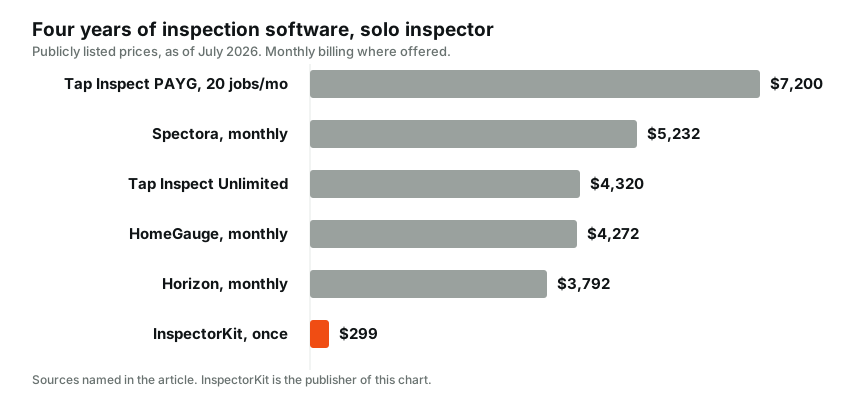
| Platform | Model | Listed price | 1 year | 4 years |
|---|---|---|---|---|
| Spectora | Subscription | $109 per month | $1,308 | $5,232 |
| Tap Inspect Unlimited | Subscription | $90 per month | $1,080 | $4,320 |
| HomeGauge | Subscription | $89 per month | $1,068 | $4,272 |
| Horizon | Subscription | $79 per month | $948 | $3,792 |
| Tap Inspect PAYG at 20 jobs | Per report | $7.50 per report | $1,800 | $7,200 |
| InspectorKit | One-time | $299 once | $299 | $299 |
Annual billing shaves the subscriptions modestly. Spectora lists $1,090 per year and Horizon $799, which still lands their four-year totals at $4,360 and $3,196. The shape of the market is unmissable. Rentals cluster between $3,200 and $5,200 per four-year cycle, per-report pricing beats them only at hobbyist volume and punishes success, and ownership sits an order of magnitude below everything.
Disclosure, since this table lives on a vendor's site. InspectorKit is my product, the one-time line in the table. The other numbers are the vendors' own published prices, named and dated so you can check every one.
The costs that never make the headline price
The listed price is the entry fee. Four multipliers do the quiet damage.
Per-inspection add-ons meter your success. Spectora's Advanced add-on runs $4 per published inspection, which at 25 monthly jobs is another $1,200 a year on top of the subscription. Anything priced per report deserves the per-report math treatment before you commit.
Seat fees tax growth. Adding an inspector costs $99 monthly on Spectora and $45 on Tap Inspect's team plan. The hire that grows your business also grows the vendor's invoice, permanently.
Price creep compounds. Subscriptions reprice upward over time, and each increase applies to your entire future. A $10 monthly bump is $480 across the next four years, approved by default the day you decide switching is too much hassle. Consolidation makes this easier for vendors, as the Spectora and HomeGauge situation shows.
And exit friction is a cost you pay once, at the worst time. Platforms that make leaving awkward convert your archive into leverage at renewal. Whatever you buy, confirm the export story while you are happy, not while you are negotiating.
What the money buys, honestly
Fairness requires this section. The big subscriptions bundle real value beyond the report writer. Scheduling automation, online agreements, payment collection, CRM touches, agent portals. An inspector who genuinely runs their operation on that layer is buying software plus back office, and the rent argument weakens accordingly.
The catch is how few solo inspectors actually use the layer they pay for. The honest exercise takes five minutes. List the bundled features you touched in the last month, price the standalone equivalents, a calendar and an invoicing app are typically free to cheap, and see what your subscription is really paying for. For many solo operators the answer is the report writer, which is the one thing that did not need to be rented.
The ownership model, priced for contrast
InspectorKit costs $299 once because the report is the product. Builder with one-tap conditions, editable template, a comment library with a field-tested starter pack, photo annotation, a summary that builds itself, offline operation for dead zones, branded delivery by web and PDF, re-inspections, and exports for everything. The genuinely recurring costs of running a platform, like extra team seats, are optional add-ons rather than everyone's problem, a structure the buyer's guide unpacks in detail.
Break-even against any subscription in the table lands inside four months. After that, the difference compounds in your favor for as long as you inspect, and a five-year career keeps roughly four to six thousand dollars that the rental models would have collected.
The career-length view
Four years is the honest evaluation window, but careers run longer. Stretch the table to ten years and the subscription band runs from roughly $9,500 at Horizon's annual rate to over $13,000 at Spectora's monthly rate, before a single price increase, and the industry has never gone a decade without price increases. The one-time line stays $299. No projection tricks, just the same multiplication carried forward.
First-year inspectors deserve the reverse advice. When cash is tight, the temptation is per-report pricing because month one is nearly free. Month one is also when you have the fewest jobs to spread any cost across. A one-time purchase near the price of a single inspection fee, backed by a real guarantee, is the rare case where the cheap option and the owned option are the same thing.
How to use this page
Three steps, in order. Pull your last twelve months of software spend, including add-ons and per-report fees, and put your real annual number next to the table. Then judge deliverables, yours against the sample report, on a phone, like an agent. Then test the challenger on real inspections with the 60-day guarantee as your safety net.
Prices drift, so the table carries its date. The method does not drift. Multiply by four years, count what you own at the end, and let the arithmetic argue with the marketing.
Common questions
Why do four-year totals matter more than monthly prices?
Because inspectors keep report software for years, and monthly framing is designed to make rent feel small. Four years is a realistic tool lifespan, and it is where a $109 month quietly becomes a $5,232 decision.
Are these prices guaranteed to be current?
They were verified against each vendor's public pricing as of July 2026 and are dated for that reason. Subscription prices drift, usually upward, so treat the table as a snapshot and the method as the durable part.
What is the cheapest way to run a real inspection business?
At real volume, ownership beats every rental model on pure arithmetic. The qualifier is that the tool has to actually do the job, which is why the deliverable and the field workflow get tested before the spreadsheet wins the argument.