Report writing craft
Inspection narrative examples, the three-part structure that holds up
Twelve worked narratives across every condition, the observation-implication-recommendation discipline behind them, and weak-to-strong rewrites you can steal.
By Owen Murray, founder of InspectorKit · Updated July 6, 2026
A finding is what you saw. A narrative is what you saw, made useful to a stranger and defensible in a dispute. The gap between those two sentences is where report writing lives, and it closes with one repeatable structure plus a library of worked examples. Both are below, free to steal, because they are the same discipline the starter pack ships with.
The structure, observation, implication, recommendation
Every strong narrative answers three questions in order. What did you observe, factually, in the past tense, without diagnosis. What does it mean for the person reading, the risk or consequence in plain terms. And what should happen next, which trade, what action, how urgent.
Damaged or poorly sealed flashing was observed at the front roof plane. This condition increases the chance of water intrusion. Recommend correction by a qualified roofing contractor.
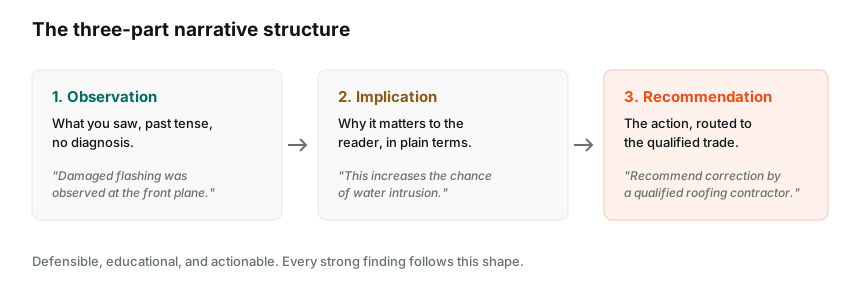
Three sentences, no drama, no hedging past what honesty requires. The observation is defensible because it claims only what was visible. The implication educates without terrifying. The recommendation routes action to the right professional without promising outcomes. That shape survives angry sellers, skeptical agents, and, should it ever come to it, opposing counsel.
Twelve worked examples across the conditions
Defect, plumbing. Active moisture was observed at the supply piping below the kitchen sink. Ongoing leakage can damage the cabinet base and adjacent flooring. Recommend repair by a qualified plumber.
Defect, exterior. Wood rot was observed at the base of the rear door trim. Deterioration will continue while the wood remains exposed to moisture. Recommend repair or replacement of affected trim and correction of the moisture source.
Safety, electrical. GFCI protection was not present or did not respond to testing at the exterior receptacles. Ungrounded fault conditions at these locations present a shock hazard. Recommend evaluation and correction by a qualified electrician.
Safety, stairs. The handrail at the basement stairs was loose at its mounting points. A handrail that fails under load can contribute to a fall. Recommend securing or replacing the handrail.
Marginal, roof drainage. Debris was observed in the gutters at the time of inspection. Restricted drainage can direct water toward the foundation. Recommend cleaning and verifying that downspouts discharge away from the structure.
Marginal, HVAC. The air filter was significantly soiled. Restricted airflow reduces efficiency and can shorten equipment life. Recommend replacing the filter and adopting a regular replacement schedule.
Marginal, grading. Soil appears to slope toward the structure along the rear foundation wall. Negative grading can direct surface water toward the foundation. Recommend improving grading to direct water away from the structure.
Functional, water heater. The water heater was operating as intended at the time of inspection, with no visible leakage at connections or relief piping. No action is recommended at this time.
Functional with a note, attic. The visible attic structure and insulation appeared serviceable from accessible viewing points. Access was limited by stored items at the north end. Recommend maintaining clear access for future service.
Not inspected, honest version. The crawlspace was not inspected due to standing water at the access point. Recommend re-inspection after the area is dry and accessible.
Defect, appliance adjacent. A bathroom exhaust duct discharges into the attic rather than the exterior. Moist air introduced into the attic assembly promotes condensation and can degrade framing. Recommend extending the duct to a proper exterior termination.
Safety, fuel systems. Corrosion was observed at the gas supply connector at the range. Compromised connectors can leak. Recommend evaluation and replacement by a qualified professional.
Notice the family resemblance across all twelve. Past-tense observation, plain-language consequence, trade-routed recommendation, and a complete absence of guarantees, cost figures, and diagnosis beyond the visible.
Weak to strong, three rewrites
Theory lands harder as before-and-after, so here are the common failure modes repaired.
Weak, roof looks bad, needs work soon. Strong, granule loss and cupped shingles were observed across the south-facing roof plane. These conditions indicate advanced wear. Recommend evaluation by a qualified roofing contractor to determine remaining service life. The rewrite replaces judgment-as-vibes with observable facts and routes the crystal-ball question, how long will it last, to the trade equipped to answer it.
Weak, furnace is old and will probably die. Strong, the furnace was operating at the time of inspection. Based on the data plate, the unit is near the typical end of its service range. Recommend budgeting for replacement and servicing per the manufacturer's schedule. Age is a fact, death is a prophecy, and the rewrite reports the fact.
Weak, minor issue, some outlets do not work. Strong, receptacles at the east bedroom wall did not respond to testing. Non-functional receptacles may indicate wiring faults upstream. Recommend evaluation by a qualified electrician. The word minor was doing dangerous work in the weak version, pre-settling a question the electrician has not seen yet, and the liability-safe language guide covers a full inventory of words like it.
Voice consistency, the tell of a real professional
One more layer separates good narratives from a good report, the narratives agreeing with each other. Tense stays past for observations. The recommendation verb stays in a small family, recommend repair, recommend evaluation, recommend monitoring, matched to how settled the need is. Trades get their standing titles, a qualified electrician, a qualified roofing contractor, every time. When forty findings speak in one voice, the document reads as one professional's considered judgment, and when they lurch between registers, it reads as a rushed evening. A curated library is what holds the voice steady at scale, which is the deeper reason the reuse question in the FAQ answers itself.
Making the structure automatic
Discipline you have to remember is discipline that fails at 4 pm on the fourth house. The fix is mechanical. Save every narrative that survives a real job into your comment library with its condition attached, and the structure arrives pre-built on every future insert, leaving only the house-specific edits. Inspectors who work this way stop writing narratives from scratch within a season, and their language quality becomes a floor instead of a daily performance.
The twelve examples above are yours. Paste them into your library today if they fit your voice, edit them where they do not, and let the structure do its quiet work on every report you send from here on.
Common questions
How long should a narrative be?
Two to four sentences carries almost every finding. One sentence of what you observed, one of why it matters, one of what to do about it. Length past that usually means two findings sharing one narrative, which deserve splitting.
Should narratives name repair costs?
No. Cost estimates convert your observation into a promise you cannot keep and a liability you do not need. Recommend evaluation or correction by the qualified trade and let the trade price its own work.
Is it lazy to reuse narratives from a library?
It is professional. Attorneys reuse clauses, doctors reuse protocols, and inspectors reuse refined language because refined language protects everyone. The judgment is in matching the narrative to the house and editing the specifics, not in retyping the same sentence four hundred times a year.