Report writing craft
Liability-safe report language, the words that protect and the words that expose
An inventory of the phrases that create inspector liability, their safe replacements, and the three writing rules that survive depositions.
By Owen Murray, founder of InspectorKit · Updated July 6, 2026
Every inspector's report has two futures. In the common one it guides a purchase and gets filed away. In the rare one it gets read aloud, slowly, by someone paid to find the sentence you wish you had written differently. Liability-safe language is writing for both futures at once, and it is mostly a matter of knowing which words expose you and swapping them out, once, in your standard language.
The exposure words, an inventory
Certain words make promises your inspection cannot keep. Here is the working list, with replacements.
The roof is fine, or in good condition, promises a future. Replace with what you observed, the roof covering appeared serviceable at the time of inspection, from the access method you used. Fine is a verdict. Appeared serviceable at the time is an observation with a timestamp.
No leaks, or no problems found, certifies an absence you cannot certify. Replace with no visible evidence of moisture intrusion was observed at the time of inspection. You inspected surfaces on a day, not the inside of walls across a year.
Minor, as in minor electrical issue, pre-settles the magnitude before the specialist has looked. A dead receptacle can be a loose wire or an overheated junction, and minor testifies against you if it is the second one. Report the observation and route the sizing to the trade.
Meets code, or code violation, claims an authority most inspectors do not hold and standards of practice explicitly disclaim. Replace with current-standards framing, protection was not observed at locations where current standards call for it, and let jurisdiction questions belong to jurisdictions.
Estimates of repair cost convert your report into a pricing document that a contractor's real invoice will contradict. Recommend the evaluation, skip the number, always.
And the silent one, the missing limitation. Every area you could not access is a sentence you must write, the crawlspace was not inspected due to standing water at the access point. Undocumented limitations read later as things you missed, and documented ones read as professional scope.
The three rules under the inventory
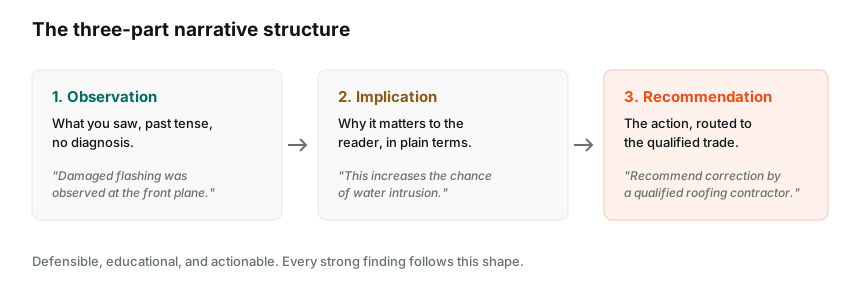
Rule one, report observations, not certainties. Past tense, visible evidence, at the time of inspection. The grammar itself builds the boundary, since was observed claims exactly what happened and nothing more. This is the observation leg of the three-part narrative structure, doing double duty as legal armor.
Rule two, route judgments to the qualified trade. Your expertise is identifying conditions. Prognosis, sizing, and repair belong to the roofing contractor, the electrician, the plumber, and the phrase recommend evaluation by a qualified professional is not a dodge, it is an accurate description of how expertise divides. Reports that respect that division survive scrutiny, and reports that play every trade at once supply the contradiction disputes are built from.
Rule three, keep the summary and the body in exact agreement. Disputes mine the gap between your summary entries and your full narratives, and any daylight, a defect in the body softened to a note in the summary, or the reverse, reads as either confusion or concealment. Writing the summary note in the same moment as the finding closes the gap mechanically.
The photograph as co-author
Language discipline extends to what your photos claim. An annotated photo that circles the exact condition documents your observation. The same photo captioned with a diagnosis, failed flashing, does quietly what your narratives were carefully not doing loudly. Keep captions observational and let the annotation circle carry the pointing, per the pairing habits in the photo guide. In a dispute, images and words get read together, and they should testify identically, the condition as seen, the implication as stated, the judgment as routed. A report speaks with one voice or it argues with itself.
Calibration is protection too
Liability thinking usually pushes inspectors toward alarm, flag everything as serious and let the buyer sort it out. That instinct backfires twice. Inflated findings train agents to discount your reports, and a documented pattern of calling normal wear a defect undermines your credibility as a witness to the findings that were serious. The marginal-versus-defect calibration is therefore part of the same protective discipline, honest severity, consistently applied, is what makes your one safety finding land with full weight.
The same goes for the safety label itself. Spend it on findings where you can name the injury mechanism, and the label testifies powerfully. Spend it on everything worrying, and it testifies to nothing.
The disclaimer is not the protection
A tempting shortcut deserves closing off. Boilerplate disclaimers, the two pages of limitations at the report's end, feel like armor and function mostly as decoration, because disputes turn on the specific finding language, not the general conditions. A narrative that overpromised is not rescued by a paragraph forty pages away that disclaims everything. The protection lives in the sentences that describe the house, which is why this guide spent its words there. Keep the standard limitations your association recommends, and never let their presence relax the discipline in the findings themselves, where every reader, friendly and otherwise, actually reads.
Making safe language automatic
Nobody drafts deposition-proof prose at 4 pm on the fourth house, and the good news is nobody has to. The protection lives in your standard language, refined once and reused forever.
Audit your twenty most-used narratives against the inventory above, one evening's work. Align them with your association's or carrier's published guidance while you are there. Load the results into your comment library with conditions attached, and every future report assembles itself from language that has already been through the review your worst-case future requires.
Then the field work stays what it should be, observation and judgment, while the words, the part that gets read aloud slowly someday, arrive pre-armored on every insert. The best time to write for a dispute is years before it exists, in a comfortable chair, once.
Common questions
Does careful language mean vague language?
The opposite. Vague language creates liability because it can be read as anything. Safe language is precise about what you observed and disciplined about what you did not, which makes it more useful to the buyer, not less.
Can wording really matter that much in a dispute?
Disputes are conducted almost entirely through your written words, read months later by people who were not there. The report is usually your only witness, and it testifies exactly as well as it was written.
Should I run my language past my E&O carrier?
Carriers and associations publish reporting guidance, and aligning your standard narratives with it once is cheap insurance. Load the vetted versions into your library and the alignment repeats itself automatically.