Report writing craft
A home inspection report example, dissected section by section
What a professional report actually contains, why the summary leads, how findings are structured, and a real published example you can pick apart.
By Owen Murray, founder of InspectorKit · Updated July 6, 2026
Every inspector has seen a report that made them wince and a report that made them raise their game. The difference is rarely the inspecting. It is the document's architecture, and architecture can be learned from a worked example faster than from any theory. This page dissects one, section by section, and the example is fully public. Open the sample report in another tab and read along, because a vendor's claims about reports mean nothing next to the report itself.
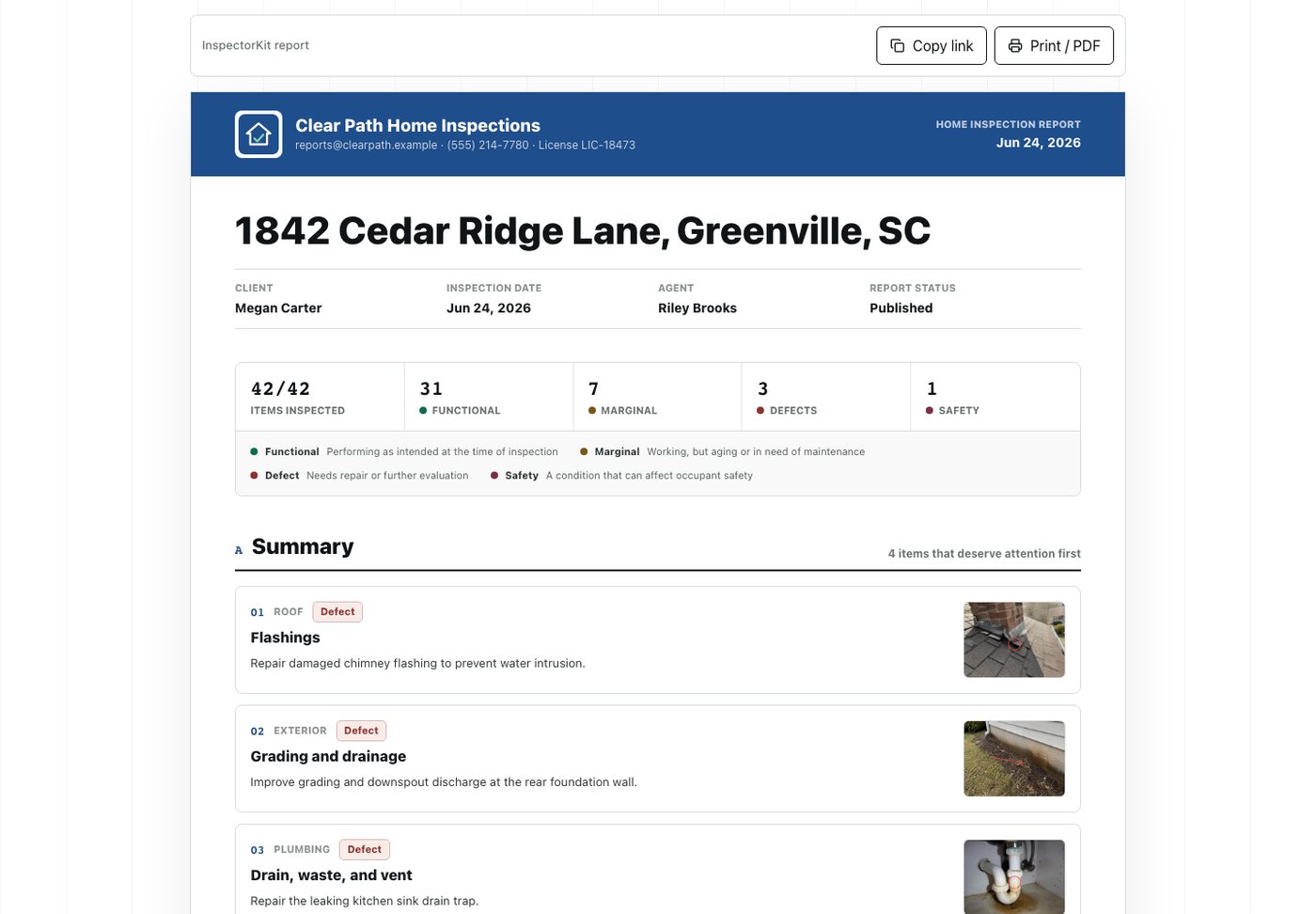
The cover, five seconds of trust
The top of a report has one job, establishing whose work this is and what work it was. The example leads with the inspection company's brand band, the property address in large type, and the transaction facts, client, agent, date, and report status, in a scannable grid.
Notice what is absent. No software vendor's logo, no portal chrome, no advertising, a hygiene point covered at length in the whose-report-is-it audit. The buyer paid for a professional's judgment, and the first screen should say exactly one name, the professional's. Your branding setup controls every element on this screen, which takes three minutes and pays on every report forever.
The scorecard, orientation before detail
Immediately under the cover, the example shows the counts, items inspected, functional, marginal, defects, safety. Four numbers that orient every reader before any prose begins.
The scorecard does quiet psychological work. A buyer confronting 42 items and 300 photos panics. A buyer seeing 42 inspected, 31 functional, 7 marginal, 3 defects, 1 safety reads a manageable story, most of this house works, here is the short list that needs attention. Orientation is a gift to the reader, and readers who feel oriented trust the author.
The summary, the page that gets read
Agents will tell you plainly, they read the summary and skim the rest. Buyers behave the same way. So the summary page is the report, as far as most readers are concerned, and the example treats it accordingly.
Each summary entry carries the item name, its condition label, and the short-form note, one sentence of what and one of what-to-do. Repair damaged roof flashing to prevent water intrusion. Add GFCI protection at required locations. No hedging, no paragraph-long restatement, just the finding compressed to its actionable core. The craft of writing these lines gets its own treatment in the summary guide, and the mechanical part is automatic, since a well-built tool assembles the summary from your findings as you work rather than demanding a second writing pass at the desk.
The findings, where the real writing lives
Below the summary, the example walks system by system, roof to garage, each item carrying its condition, its narrative, and its photos.
Read the roof covering defect closely, because it demonstrates the three-part discipline every strong narrative follows. Observation first, damaged or poorly sealed flashing was observed. Implication second, the chance of water intrusion. Recommendation last, correction by a qualified roofing contractor. That structure, covered exhaustively in the narrative examples guide, is what separates a defensible professional finding from a worried note, and it repeats through every finding in the example.
The photos sit with their findings, not in an appendix, and the marked ones carry a drawn circle on the exact problem area. A layperson cannot find a flashing gap in a roof photo unaided. The circle is the difference between evidence and decoration, per the photo craft guide.
The condition legend, the report teaching itself
Between the scorecard and the findings, the example includes a small legend, one line per condition label defining what functional, marginal, defect, and safety mean in this document. It reads as boilerplate and functions as infrastructure. Buyers arrive with no shared vocabulary, and the legend installs one in fifteen seconds, which is why the same labels can then carry severity through forty findings without a single scary adjective helping them. A report that defines its terms once gets to use them with precision everywhere, and precision is what the anxious reader actually needs.
The delivery, the part clients actually experience
A report's format is also its delivery story. The example is a web page that opens on any phone with no login, because that is how buyers and agents actually read, forwarded links at dinner time. The Print / PDF button on the same page produces the file version for records and lenders, print-tuned so page breaks respect findings.
From the inspector's side, the example went out through the send flow, under the business's own name with replies routed back to the inspector. Delivery is the last impression the report makes, and it should match the document's professionalism end to end.
What the example deliberately leaves out
Reading a good report also means noticing its restraint. The example contains no repair cost estimates, because pricing belongs to contractors and promises age badly in writing. No code citations, since standards-of-practice inspections report conditions, not compliance verdicts. No fear adjectives, no terrible or dangerous doing the findings' work for them, because the observations carry the weight and the labels carry the urgency. And no filler photography, every image earns its place by proving a finding rather than padding a page count. Professional restraint is invisible until you look for it, and then it is most of what professional means.
Using the example as a bar
The practical exercise takes ten minutes. Open the sample next to your own most recent report, on a phone, and compare five things. Whose name dominates the first screen. Whether a stranger could grasp the house's condition in three minutes. Whether your narratives follow the observation, implication, recommendation shape. Whether your photos prove or merely accompany. And whether the whole document reads like the work of the professional you are.
Where your report wins, keep everything. Where the example wins, the gap is your cheapest available upgrade, and every piece of it is craft, not talent, which means it copies.
Common questions
How long should a home inspection report be?
As long as the findings demand and no longer. A typical three-bedroom produces 40 to 60 inspected items, a handful of defects, and a summary a buyer can read in three minutes. Padding for impressiveness helps nobody and buries what matters.
Should reports be web pages or PDFs?
Both, from the same source. The web version is what gets opened on phones, forwarded to agents, and read at dinner. The PDF is the file for records, lenders, and clients who want a copy. A modern report should not force the choice.
What makes a report look professional at a glance?
Three things in the first five seconds. Your branding instead of a vendor's, a summary that surfaces what matters, and photos that sit with their findings, marked so a layperson sees what you saw.