Report writing craft
Inspection photos that hold up, evidence habits for the field
The two-shot discipline, data plate habits, lighting in hostile spaces, and the photo mistakes that turn evidence into decoration.
By Owen Murray, founder of InspectorKit · Updated July 6, 2026
Inspection photos have one job, proving the finding to someone who was not there. A buyer at dinner, a contractor pricing repairs, or in the rare bad future, a stranger reading your report aloud in a dispute. Photos either hold up under those readers or they decorate the scroll, and the difference is a handful of field habits that cost seconds each.
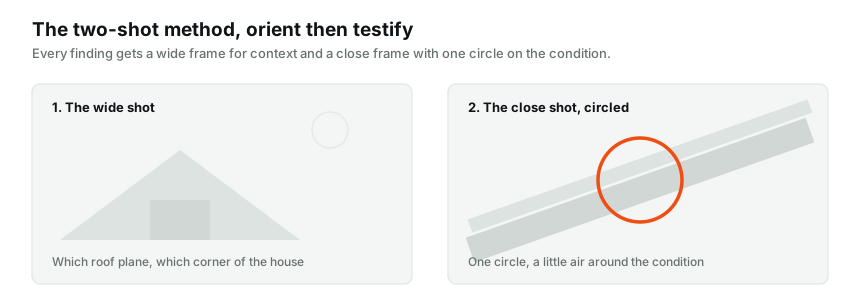
The two-shot discipline
Every finding worth photographing gets exactly two frames as the default. The wide shot places the problem, enough of the room, roof plane, or wall that any reader knows where they are. The close shot shows the condition itself, filling the frame, focused, with the annotation circle marking the exact spot.
The pairing answers the two questions every photo reader has, where is this and what am I looking at. One without the other fails predictably. A close-up of a crack with no context becomes which wall was this within a week, and a wide room shot with an invisible defect somewhere in it proves only that a room existed.
The third shot is the exception, not the rule. A scale reference at a foundation crack, per the foundation photography guidance, or a moisture meter reading in frame where the number carries the finding. If you cannot say what the third shot proves that the first two do not, it is scroll padding.
Data plates, the always shot
Water heater, furnace, air conditioner, panel. Every data plate gets photographed straight-on and legible, every job, before you photograph the equipment itself. Model, serial, and capacity answer half the questions any future reader has, from the buyer's warranty registration to the age question in your own narrative.
Straight-on matters more than it seems. Angled plate shots glare and blur exactly where the serial number lives, and future-you, checking a recall three years from now, will either thank or curse present-you based on five degrees of camera tilt.
Light, the crawlspace problem
Attics, crawlspaces, and mechanical closets are where the most consequential findings live and the worst photos happen. Three habits fix most of it.
Bring the light, since phone flash at close range flattens and glares. A headlamp or a handheld work light, positioned off-axis from the camera, gives conditions texture and depth. Anchor the location, because dark-space photos are unusable without a recognizable reference in frame, the hatch, the chimney, a labeled duct run. And shoot the vantage first, one frame from your access point showing what was visible from where, which quietly documents the scope sentence your attic narrative is about to make.
The affirmative photo, underrated on purpose
Evidence habits skew toward problems, and a small set of clean-condition photos earns its place in every report. The panel interior with tidy wiring, the dry water heater connections, the clear crawlspace corner. Each takes seconds, documents what was true on inspection day, and quietly protects you against the later claim that a condition existed when you were there. The discipline is selectivity, a handful of affirmative frames on the systems that generate disputes, not a gallery of everything fine. Think of them as the photographic version of the affirmative narrative lines your report already carries.
The mistakes that surrender evidence
Shooting the repair instead of the problem, the fresh sealant without the gap it covers, proves someone caulked, not what needed caulking. Shooting through obstacles, screens, glass, railing bars, when two steps would clear the line of sight. Letting the flash bounce off the moisture you are trying to document, when an angle change makes the sheen legible. Cropping so tight that the finding loses its edges, since a stain needs surrounding clean surface to read as a stain. And the quiet one, not shooting the clean condition when a claim later might need it, the empty electrical panel interior, the dry basement corner, thirty seconds of affirmative evidence on systems that matter.
Weather, glare, and the outdoor frames
Exterior photography fights the sky. Harsh midday sun blows out roof planes and buries defects in contrast, so shoot roofs early in the walk when angles allow, or from the shaded side first. Overcast days are quietly the best photography weather an inspector gets, and worth exploiting on the days they coincide with a rough roof. Rain-wet surfaces read darker and can mimic staining, which deserves a narrative timestamp when conditions could confuse a later reader, photographed during light rain. None of this is art-school fussiness, it is making sure the condition in the frame is the condition, not the weather wearing its costume.
Placement is half the proof
A perfect photo in the wrong place is half wasted. Photos belong with their findings, in the report body, so every reader sees evidence and explanation in one glance, the architecture visible throughout the worked report example.
This is a workflow property as much as a document one. Photos shot into a camera roll for later sorting arrive at the kitchen table as a matching puzzle, and mismatches are how the garage photo ends up under the attic finding. Photos attached to the finding at capture time, the way the builder's photo flow works, cannot mismatch, and the evening sorting session simply stops existing. The habit is the feature.
The field checklist, compressed
Wide then close on every finding. Circle the close shot. Data plates straight-on, every unit, every job. Bring light to dark spaces and anchor the frame. Two shots default, third only with a reason. Attach at capture, never sort later. And before publishing, flip through the report once asking of each photo, what does this prove, retiring any image without an answer.
Photos built on those habits do their job for every reader, from the dinner-table buyer to the deposition nobody plans for. Evidence first, decoration never, seconds each.
Common questions
How many photos should a report have?
As many as the findings demand and few enough that each one matters. Every defect and safety item photographed, data plates always, context shots where orientation helps, and no six-angle repeats of one stain.
Phone camera or dedicated camera?
The recent phone in your pocket, used well, beats the camera left in the truck. Modern phone cameras handle everything inspection photography needs, and the photo landing directly on the finding beats any image quality argument.
Should photos be in the report or an appendix?
With their findings, always. A photo appendix forces every reader to cross-reference, and photos separated from their findings lose most of their evidentiary value. Placement is half the proof.