Report writing craft
Foundation and structure narratives, high-stakes language done carefully
Cracks, settlement, foundation moisture, and framing findings. The most consequential narratives in inspection work, informing without diagnosing.
By Owen Murray, founder of InspectorKit · Updated July 6, 2026
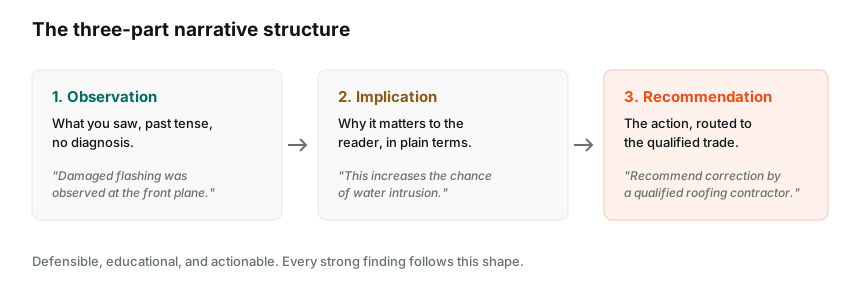
No section of a report is read more anxiously than the foundation. Buyers fear the word, sellers dispute it, engineers get hired over it, and your narrative sits in the middle, needing to be honest enough to protect the buyer and precise enough to survive the professionals who follow you. The good news is that foundation language rewards discipline more than any other, because the three-part structure was practically invented for exactly this stakes level.
Cracks, the vocabulary of description
The core skill is describing cracks without diagnosing them, and description has a concrete vocabulary, location, orientation, width, pattern, displacement.
Hairline vertical, the common one. Hairline vertical cracking was observed in the poured concrete foundation wall near the northeast corner. Cracking of this width and orientation is common in cured concrete and often related to shrinkage. Recommend sealing to resist moisture entry and monitoring for change.
Notice the shape. The observation is measured, the context sentence says common without saying harmless, and the recommendation is action plus monitoring, not a verdict. Common in cured concrete is as far as your role reaches, and it is genuinely useful information.
Step cracking in masonry. Step cracking was observed in the block foundation wall at the rear, following the mortar joints, with cracks up to approximately a quarter inch. Step cracking in masonry can be associated with differential settlement. Recommend evaluation by a structural engineer or qualified foundation contractor.
Horizontal, the serious pattern. Horizontal cracking was observed at mid-height along the north basement wall, with slight inward displacement measured at the crack line. Horizontal cracking with displacement can indicate lateral soil pressure on the wall. Recommend evaluation by a structural engineer.
The escalation across those three is carried entirely by observed detail, width, pattern, displacement, and the recommendation's specificity follows the evidence. That is calibration doing its work at the section where calibration matters most, per the severity discipline.
Settlement, reported through its symptoms
Settlement is a conclusion, and your report deals in its observable symptoms. Doors that will not latch, sloping floors, cracked finishes above openings, separations at trim. Write the symptoms, cluster them, and let the pattern speak.
Interior doors at the second-floor hallway did not latch, and diagonal cracking was observed in the finish above two door openings on the same wall line. A noticeable slope was present in the adjacent floor. These conditions, occurring together, can be associated with structural movement. Recommend evaluation by a structural engineer.
The phrase occurring together is the professional observation, three symptoms on one wall line is a pattern, and patterns are what engineers are hired to explain. A report that clusters symptoms geographically hands the engineer a head start and hands the buyer an honest picture, all without the inspector once claiming to know what the foundation is doing.
Moisture at the foundation, the handoff finding
Foundation moisture findings complete the water story that grading and drainage begins, and the coupling belongs in the narrative.
Efflorescence and staining were observed on the interior foundation wall at the northeast corner, below the exterior downspout noted in the drainage section. Moisture migration through the foundation is consistent with the exterior discharge conditions observed. Recommend correcting exterior water management and monitoring the interior wall.
Cross-referencing your own findings is the mark of a systems reader, and it also concentrates the buyer's attention on the cheap fix, the downspout, before the expensive fear, the foundation.
Crawlspaces and framing, the visibility discipline
Under the house, what you could see is half the finding.
The crawlspace was accessed at the north entry and inspected from the access point and central areas. Moisture staining was observed at the sill plate near the west wall, and one floor joist showed surface deterioration at its bearing point. Recommend evaluation and repair by a qualified contractor, and correction of crawlspace moisture conditions.
Access limitations get their own sentences, always. Portions of the crawlspace were not accessible due to ductwork and clearance. That sentence is scope documentation, and the liability inventory counts the undocumented limitation among the most expensive silences in report writing.
Monitoring language, the honest middle path
Between fix it now and it is fine lives the monitoring recommendation, and foundation sections lean on it more than any other. Used precisely, it is a genuine professional tool, recommend sealing the crack and monitoring for change in width or length, with a photographed baseline in this report for comparison. The baseline clause converts monitoring from a shrug into a protocol, since your annotated photo with a scale reference is the measurement future observers compare against. Used lazily, monitor this, with no baseline and no criteria, the word is just deferral wearing a clipboard. The difference is one clause, and the clause is the craft.
Photographing for the professionals who follow
Foundation photos serve two audiences, the buyer who needs to see it and the engineer who needs to measure it. Shoot wide for location with a corner or window anchoring the frame, close for the condition with the annotation circle, and include a scale reference at cracks, a coin, a tape, anything dimensioned. The engineer who can pre-size the problem from your report writes a better-informed evaluation, and your report becomes the document that made everyone downstream smarter, which is exactly the reputation a foundation section should build.
Load these narratives into your library, keep the vocabulary of description sharp, and the most feared section of the report becomes the one where your professionalism is most visible.
Common questions
Can I call a crack structural or not structural?
Describe the crack, its width, pattern, location, and any displacement, and route the structural judgment to a structural engineer or qualified contractor. The adjective structural is a conclusion your one-visit observation cannot carry.
When does a foundation finding go to an engineer versus a contractor?
Displacement, active movement indicators, or patterns suggesting ongoing settlement point to an engineer's evaluation. Isolated shrinkage-type cracks with no displacement typically route to monitoring or a qualified contractor. When genuinely unsure, the engineer recommendation is never wrong.
How do I keep foundation findings from blowing up deals?
Precision. Panic comes from vagueness, and a narrative that states exactly what was observed, with measurements and photos, gives everyone something concrete to evaluate instead of something shapeless to fear.