Report writing craft
Grading and drainage narratives, writing the water story
Negative grading, downspout discharge, foundation moisture, and the connected water findings. Field-ready language for the system that damages houses slowly.
By Owen Murray, founder of InspectorKit · Updated July 6, 2026
Water is the patient adversary of every house, and grading findings are where you document its strategy before the damage argues for itself. These narratives matter disproportionately because the conditions look boring, dirt near a wall, a downspout ending nowhere, and their consequences are foundation repairs with five-figure invoices. The writing has to carry the significance the photos undersell, and it has to do it without prophecy.
The core finding, negative grading
The workhorse narrative, in the three-part discipline.
Soil appears to slope toward the structure along the rear foundation wall. Negative grading can direct surface water toward the foundation. Recommend improving grading to direct water away from the structure.
Two craft notes on those three sentences. Appears to slope is deliberate, since you observed a visual grade, not a survey, and the verb holds that boundary. And the recommendation names the outcome, water directed away, rather than the method, because regrading versus swales versus drains is a contractor's decision made with tools you did not bring, per the liability-safe routing rule.
Severity calibrates on consequence. Slope alone, marginal. Slope plus efflorescence on the interior foundation wall, or staining at the sill plate, or measurable moisture, and the finding crosses to defect, with the interior evidence written as its own coupled finding.
Window wells and hardscape, the supporting cast
Two supporting findings round out the exterior water section. Window wells that hold debris or lack covers collect exactly the water the grading sends them, and the narrative is quick, debris and standing-water staining were observed in the north window well. Accumulated water at the well can enter at the window frame. Recommend cleaning, and consider covers. Hardscape counts too, since a driveway or patio pitched toward the structure is negative grading in concrete, written the same way with the same outcome-focused recommendation. Sloped surfaces of every material obey the same physics, and your section reads stronger when it treats them as one family.
Downspouts, the cheapest big finding in the report
Downspout discharge findings are the rare combination of trivially cheap to fix and genuinely consequential, which makes their narratives worth extra clarity.
The downspout at the northeast corner discharges at the foundation without an extension. Concentrated roof discharge at the foundation promotes soil saturation and can contribute to moisture entry. Recommend extending discharge a minimum distance away from the structure.
Splash blocks earn their own line when present but useless. The splash block at the front downspout was displaced and sloped toward the structure. A displaced splash block returns concentrated discharge to the foundation. Recommend repositioning to direct water away.
These pair naturally with the gutter findings upstream, and cross-referencing the roof drainage narratives inside one water story, gutters to downspouts to grade to foundation, reads to clients as systems thinking, because it is.
The evidence findings, where water already won
When moisture has entered, the narrative shifts from prevention to documentation, and precision matters most exactly here.
Efflorescence. White mineral deposits consistent with efflorescence were observed on the interior foundation wall at the northeast corner. Efflorescence indicates moisture migration through the masonry. Recommend correcting exterior water management and monitoring the area.
Staining without present moisture. Staining consistent with past moisture was observed at the basement floor perimeter. No elevated moisture was detected at the time of inspection. Recommend correcting exterior drainage conditions and monitoring.
That second structure, evidence of past, none present today, is among the most valuable sentences in your repertoire. It documents honestly, avoids certifying the absence of a problem, and connects the interior observation to the exterior cause you wrote up two sections earlier. Houses flood in the gap between inspectors who noted the stain and inspectors who explained it.
Active moisture. Elevated moisture readings and active seepage were observed at the base of the foundation wall below the rear downspout. Ongoing moisture entry can damage finishes and, over time, the foundation assembly. Recommend evaluation by a qualified contractor and correction of exterior water management. Active water is a defect on arrival, and when structural symptoms accompany it, the foundation narratives guide takes the handoff.
Photographing the invisible
Grading findings fail in photos more than any other finding type, because slopes flatten and moisture hides. Three habits fix the evidence problem.
Shoot slopes from the side and low, with the foundation line in frame as the reference the eye reads against. Shoot the downspout story as a pair, the termination point wide, the soil condition at discharge close, with the annotation circle on the saturation or staining. And shoot interior evidence with a location anchor in frame, the corner, the window, the utility that places the wall, since interior moisture photos without context become unusable the moment anyone asks which wall.
Seasonal honesty, the inspection-day caveat
Water findings carry a time-of-year asterisk that belongs in your language. A dry July crawlspace says little about April, and the narrative can hold that truth without hedging into uselessness. Conditions were dry at the time of inspection. Staining patterns suggest seasonal moisture. Recommend observing the area during sustained wet weather and correcting exterior drainage proactively. That construction reports today accurately, flags the seasonal question honestly, and hands the buyer a concrete monitoring task, which is more useful than either false reassurance or vague worry, and considerably more defensible than both.
The water story, assembled
The strongest version of this whole section is not any single narrative but their connection. Gutter debris upstream, discharge at the foundation, grade toward the wall, efflorescence inside, four findings, one story, each narrative pointing to the next like the water does.
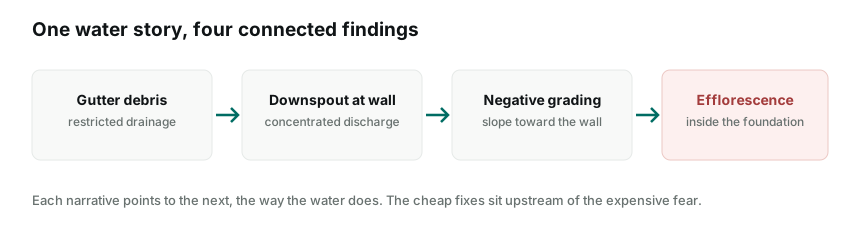
Load the language above into your library, keep the couplings in your habits, and the boring dirt-near-wall findings start reading like what they are, the most cost-effective warnings your report delivers. The buyer who extends a downspout because your narrative made the story legible saved four figures on your two sentences, and that is the trade this section exists to make.
Common questions
Is negative grading a defect or marginal?
Usually marginal when it is a slope without visible consequence, and a defect once evidence of moisture entry or damage exists. Grade the finding on what the water has done, not only on what it might do.
How do I photograph a slope?
From the side, low, with a reference line the eye can read, the foundation itself, a wall base, or a level tool in frame. Straight-down photos flatten slopes into invisibility, which makes the finding deniable.
Should I recommend a specific fix like regrading or French drains?
Recommend the outcome, directing water away from the structure, and route the method to a qualified contractor. Prescribing specific drainage solutions from a one-visit inspection is prognosis, not observation.