Report writing craft
Roof defect narratives, worked examples for every common finding
Coverings, flashing, penetrations, and drainage. Field-ready roof narratives with the marginal-versus-defect calibration that keeps reports fair.
By Owen Murray, founder of InspectorKit · Updated July 6, 2026
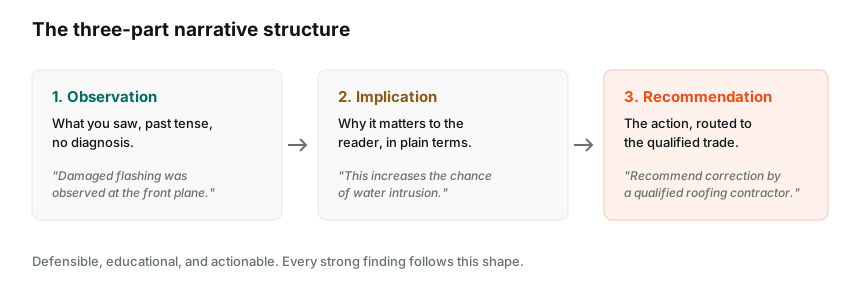
Roof findings carry more consequence per sentence than almost anything else in a report. The repairs are expensive, the water damage compounds quietly, and the buyer's negotiation often pivots on your exact wording. Which makes the roof section the best place in the whole report to have language you trust already loaded. This guide is that language, organized by finding type, in the observation-implication-recommendation shape the narrative structure guide establishes.
Coverings, the wear spectrum
Covering findings live on a spectrum from cosmetic to urgent, and the narrative's job is placing the house honestly on it.
Early wear, marginal. Granule loss was observed in localized areas of the south-facing roof plane. Granule loss at this level is consistent with normal weathering. Recommend monitoring and routine maintenance.
Advanced wear, marginal leaning defect. Widespread granule loss, cupping, and brittle shingle edges were observed across multiple roof planes. These conditions indicate advanced wear and reduced remaining service life. Recommend evaluation by a qualified roofing contractor to assess remaining life and budget accordingly.
Failure, defect. Cracked and missing shingles were observed at the ridge and south plane, with exposed underlayment in two areas. Exposed underlayment permits water intrusion. Recommend repair or replacement by a qualified roofing contractor.
The calibration rule underneath all three, wear that is performing is marginal, wear that has stopped performing is a defect, and the marginal-versus-defect guide treats the boundary at length. The roof is where inspectors most often inflate marginal to defect out of caution, and inflation has a cost, since a report that cries defect at normal weathering teaches agents to discount your findings.
Flashing, where roofs actually leak
Ask any roofer where roofs fail and the answer is penetrations and transitions, which is why flashing narratives earn their own precision.
Chimney flashing. Damaged or poorly sealed flashing was observed at the chimney base. Compromised flashing at this location is a common source of water intrusion. Recommend correction by a qualified roofing contractor.
Sidewall transitions. Step flashing at the roof-to-sidewall transition was obscured by a continuous bead of sealant. Sealant applied over flashing is a temporary measure that can conceal deterioration. Recommend evaluation by a qualified roofing contractor.
That second example carries a pattern worth generalizing. Sealant over everything is the roof's most common cover-up, and the narrative that names it, temporary measure, can conceal, positions you as the professional who saw through it without accusing anyone of anything.
Plumbing boots. The rubber boot at the plumbing vent penetration was cracked at the collar. Deteriorated boots permit water entry along the vent pipe. Recommend replacement of the boot.
Penetrations, skylights, and the accessories
Skylights. Staining was observed at the interior finish below the skylight, and the exterior curb sealant showed gaps. These conditions suggest past or ongoing moisture entry at the skylight assembly. Recommend evaluation and resealing by a qualified contractor, and monitoring of the interior finish.
Note the coupling of an interior observation with its exterior cause. Roof narratives get their authority from connecting what the buyer can see, the ceiling stain, to what you found above it, and the photo pairing habit makes the connection visual, wide shot for location, close shot with the circle for evidence.
Satellite and solar anchors. Fastener penetrations from a removed satellite mount were observed at the east roof plane without visible sealing. Unsealed penetrations permit water entry. Recommend sealing or shingle repair at the affected locations.
Drainage, the handoff finding
Gutter findings sit at the boundary between the roof section and the grounds, and the strong move is writing them as a system.
Debris and overflow. Debris was observed in the gutters, with staining at the fascia below the front eave consistent with overflow. Restricted gutters direct water to the fascia, the foundation, and the areas below. Recommend cleaning, verifying slope to the downspouts, and confirming discharge away from the structure.
That narrative deliberately points downhill, because water always does, and the grading and drainage guide picks up the story where the downspout ends. Cross-referencing your own sections this way, roof drainage to grading, attic moisture to bathroom venting, reads to clients like what it is, an inspector who sees the house as connected systems.
Age, spelled carefully
Every roof narrative eventually faces the age question, and the safe pattern is worth engraving. State the evidence, the covering appears to be in the later portion of its typical service range based on wear patterns and, where known, documentation. Decline the prophecy, no remaining-years number, no it should last language. Route the planning question, recommend evaluation by a qualified roofing contractor to assess remaining service life and budget accordingly. Buyers deserve the budgeting signal, roofers deserve the prognosis question, and your report deserves to never contain a number the weather can falsify.
The roof section's quiet rules
Three habits keep every roof narrative honest. Name your access method when it limited you, walked, ladder at eaves, ground with binoculars, drone, because the method is part of the observation. Route every service-life and cost question to the roofing trade, since your job is the condition, theirs is the prognosis and the invoice. And resist the adjective urge, no scary, no terrible, no fine, because the observations carry the weight and the adjectives only carry risk.
Load the examples above into your library, adjust them to your voice and your region's roof types, and the roof section stops being the part of the report you compose and becomes the part you conduct.
Common questions
Should I estimate remaining roof life in the narrative?
State age and observed wear as facts, then route the service-life question to a roofing contractor. A number you commit to in writing is a promise the weather has not agreed to keep.
What if I could not walk the roof?
Say so, plainly, with the method you did use. Observed from the ground with binoculars, from the eaves on a ladder, by drone. The limitation is part of the finding, and documented limitations protect you better than silent ones.
One photo or several for a roof defect?
Two as a habit. A wide frame that places the problem on the roof plane, and a close frame that shows the condition itself, with the annotation circle on the close one. Location plus evidence, every time.