Solo inspection business
How software fees quietly eat inspection profit, the per-job math
What subscription report software costs per inspection at real solo volumes, why low months hurt twice, and the ownership math that fixes the margin.
By Owen Murray, founder of InspectorKit · Updated July 6, 2026
Every inspection you perform has a bill of costs attached before you earn anything, fuel, insurance, drive time, and, on most software models, a slice of rent for the report tool. That slice is the only one that is pure pricing-model choice, and looking at it per job instead of per month changes how it reads.
Per month, $109 looks like a phone bill. Per job, it depends entirely on how many jobs the month held, and that dependence is where the damage hides.
The division nobody runs
A flat monthly fee divided by monthly volume is the software cost baked into each inspection, and the number moves violently with volume.
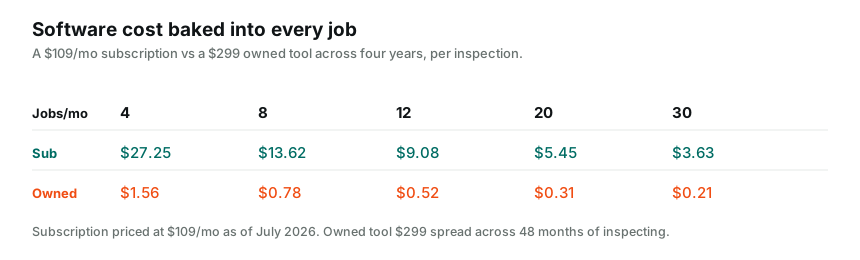
At thirty jobs a month the subscription costs a few dollars per inspection and genuinely does not matter. At eight jobs it is over thirteen dollars each. At four jobs, a real number for part-timers and for anyone's January, it is more than twenty-seven dollars per inspection, and the tool has quietly become one of the larger per-job costs in the business.
The owned column is what the same division looks like without the subscription. A $299 tool spread across four years of even modest volume prices each inspection in coins, and the spread only improves the longer you inspect. Software is not consumed by use. Pricing that pretends otherwise is a decision someone made, and it is a decision you are allowed to decline.
Why low months hurt twice
The subtle cruelty of flat fees is their timing. They are calibrated to feel small in good months and they do not shrink for bad ones, which means the per-job cost peaks exactly when the business is weakest.
A slow February with four inspections pays the same software bill as a stacked June with twenty-six. The February version works out to real money per job, stacked on top of insurance and licensing lines that also held still while revenue dropped. Fixed costs are what make slow months dangerous, the full cost anatomy walks through why, and the software line is the one fixed cost that a single purchasing decision can remove from the equation permanently.
Seasonality is not a hypothetical for inspection work. Winter slowdowns, rate-spike freezes, and local market cycles all produce four-job months in otherwise healthy businesses. A cost structure that punishes those months is a structural weakness, not a moral failing, and it is fixable.
The pay-as-you-go trap, briefly
The apparent escape from flat fees is per-report pricing, and at very low volume it genuinely is cheaper. The trouble is the slope. Every job carries its fee forever, so the model becomes more expensive per month as the business succeeds, crossing the flat-fee line around a dozen jobs monthly and never looking back. Growth on that model means your software bill grows with your success, a percentage claimed from every additional inspection.
Both rental models share the deeper property. The cost repeats. Four years of a $109 subscription is $5,232, four years of busy pay-as-you-go can run higher still, and the accumulation math compounds these into numbers that would never survive a purchase-decision conversation if they arrived as one invoice.
The margin view, what this does to your fee
Price an inspection at $450 and walk the costs. The software slice at low volume can be five or six percent of the fee, which sounds survivable until you remember margins are computed after all the fixed lines, not before one of them. In a business where the owner's take is what remains after insurance, fuel, licensing, and the truck, a recurring twenty-seven dollar claim on a slow month's job is coming directly out of the last and most personal line.
The reframe that clarifies decisions, every recurring fee is a permanent claim on future margin, accepted in exchange for not paying once. Sometimes that trade is right, insurance is correctly a subscription because the coverage is ongoing. Report software has no equivalent ongoing cost to justify the structure. The tool you used in March is the tool you use in April, and the one-time-payment model exists because some of us think the pricing should admit that.
The add-on stack, where quoted prices go to grow
The advertised subscription is also rarely the paid subscription. Mainstream tools price the headline seat and then meter the rest, extra templates, additional users, texting features, premium support tiers, payment collection with its own percentage. Each addition is small, each is justifiable in isolation, and the stack routinely pushes the real monthly line 20 to 40 percent above the quoted one. The per-job math above used clean list prices. Real invoices are usually worse, which means the margin claim per inspection is usually worse too. When auditing your own line, use the bank statement, not the pricing page, because the bank statement remembers the add-ons.
Fixing the line, once
The practical path is one decision. Move the report tool from the rent column to the owned column, and the per-job software cost collapses to noise at every volume, in every season, for as long as you inspect. InspectorKit is $299 once, which is the arithmetic in the chart above rather than a promotional claim, and the switching process is a weekend, not a project.
Then hold the line generally. Each new subscription proposed to the business is a new permanent claim on per-job margin, and the question it must answer is not whether it helps but whether it helps more than its perpetual slice costs. Most cannot. The businesses that stay profitable at solo scale are the ones that noticed.
Common questions
Is $109 a month really a big deal against a $450 inspection fee?
Not as a percentage of one busy month, which is exactly how it stays invisible. The damage shows in the per-job view at low volume, in slow seasons where the fee holds still while jobs drop, and in the four-year total, which reaches five thousand dollars and up. Small recurring numbers are how margins erode without a single alarming invoice.
Do per-report pricing models fix this?
They move the problem. Pay-as-you-go feels safe at four jobs a month and becomes the most expensive option in the market as volume grows, since every additional inspection carries its own fee forever. The models flip somewhere around a dozen jobs a month, and growing inspectors cross that line fast.
What should software actually cost per inspection?
As close to zero as the market allows. Software is not a consumable, nothing is used up when you publish a report. An owned tool spread across a few years of normal volume lands in the range of a quarter per inspection, which is what the economics of software actually look like without a subscription attached.