Alternatives and comparisons
How inspection software fees quietly add up, a compounding story
Nobody feels $109 a month. Everybody would feel $13,000. The psychology of drip pricing, the yearly review ritual, and what the rent could have funded instead.
By Owen Murray, founder of InspectorKit · Updated July 6, 2026
No inspector ever quit a platform over a single monthly charge. $109 disappears into a business card statement between fuel and insurance, weightless. That weightlessness is not an accident. It is the entire design, and this page is about learning to feel the weight before the weight becomes five figures.
The psychology of the drip
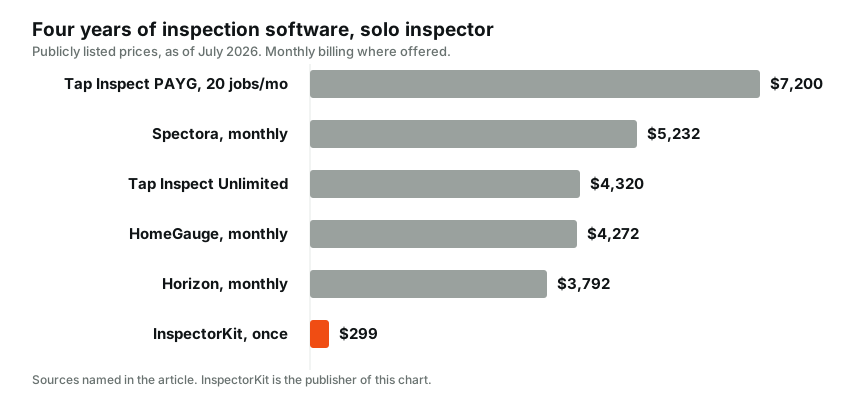
Subscription pricing works because humans evaluate costs at the granularity they are billed. A $5,232 software line item would trigger a procurement discussion in any business. The same amount, dripped $109 at a time across four years of monthly statements, triggers nothing at all. Each charge is too small to fight and too regular to notice.
The industry knows this. It is why every pricing page anchors on the month, why annual plans are framed as a discount rather than a commitment, and why cancellation always costs more attention than renewal. None of it is fraud. All of it is friction engineering, and the friction points one direction, toward you still paying in 2030.
The countermeasure is embarrassingly simple. Multiply by twelve, then by four, before any software decision, and write the product of that multiplication at the top of the comparison. The market-wide table does exactly this for every major platform, and reading costs in four-year units is the single habit that reorders the whole decision.
A working inspector's actual drip, itemized
Follow a composite but realistic solo inspector through a year of small charges, each individually reasonable.
The report platform at $109 monthly is $1,308. The per-inspection add-on at $4 across 200 yearly inspections adds $800. A scheduling or CRM extra at $30 monthly, common once the platform's bundled version proves thin, adds $360. Year total, about $2,468, none of it ever decided as a $2,468 decision.
Across four years that inspector spends nearly $10,000 on report-adjacent software, and here is the sentence worth sitting with. At no point did the business approve a five-figure software budget. It approved a series of $30 to $109 conveniences, each defaulting to renewal, and the five figures assembled themselves in the dark.
The upgrade ratchet, drip pricing's quiet sibling
Fee creep has a partner pattern worth naming. Platforms rarely raise the headline price alone. They add tiers, move features upward, and let yesterday's included become tomorrow's add-on. The subscription you evaluated three years ago is often not the product you are paying for today, and each small restructuring resets nobody's attention because no single change crosses the threshold of a decision. The countermeasure is the same audit, plus one habit, keeping the original signup screenshot in your records folder so the drift has a baseline to be measured against.
What the rent could have funded
Opportunity cost makes the drip concrete, so price the alternative uses of roughly $1,300 a year.
That is a year of respectable local advertising in most markets, the kind that produces actual inspections. It is two or three pieces of serious equipment, a thermal camera fund building toward the real thing. It is an E&O deductible cushion, a slow-January buffer, or simply margin, the thing small businesses die without. Software is a tool cost, and tool costs deserve to compete against other tools, not to win by default through billing invisibility.
The owned alternative reframes the comparison in one line. $299 once for the report workflow, then those $1,300 annual decisions return to your control, every year, permanently. The three-definitions cheapest guide runs the full ranking if the reframe earns your skepticism.
The annual audit, a thirty-minute ritual
Whatever you conclude about any single vendor, adopt the ritual. Pick a date, the same one every year, and inventory every software charge the business pays.
For each line, write three things. The true yearly cost, monthly times twelve plus add-ons. The last-ninety-days usage, honestly, from memory of actual work rather than intentions. And the exit readiness, whether your data from that tool is exported and in your own files as of today. Then rank the lines by yearly cost against usage, and let the bottom of the list defend itself or die.
Most inspectors running this audit the first time find a subscription surviving on pure inertia, and many find their largest line, the report platform, is also their least examined. The audit does not tell you to switch anything. It tells you what you are actually paying, which subscription design works hard to keep untold.
Where the drip is honest, for balance
Some monthly fees survive every audit, and naming them keeps this page fair. Charges tied to metered costs someone else really pays, telecom, insurance, hosting for a high-traffic site, are rent on real infrastructure. Even within inspection software, an add-on priced at a true recurring cost, like an extra team member's seat, is the honest shape of subscription pricing. The audit's target was never recurring billing itself. It is recurring billing for things that do not recur, of which the industry's report writers, built once and rented forever, are the textbook case.
Noticing is the whole battle
There is a moment, and most owners who switched describe some version of it, when the drip becomes visible. A slow month where the charges stand out on a thin statement. A renewal email at a bad time. A colleague mentioning what they paid once, total, ever.
Whenever that moment arrives, the response is not rage-canceling anything. It is the audit above, the four-year multiplication, and one honest question per line item, would I buy this again today at its true price? Tools that survive the question deserve their renewal. Tools that do not have been renting space in your margins on the strength of your attention being elsewhere.
Attention is exactly what a solo business runs on. Spend thirty minutes of it a year on the software stack, and the compounding starts working for the only party it never seems to favor, the person doing the inspections.
Common questions
Is this just an argument against all subscriptions?
No. Subscriptions that fund genuinely ongoing services are honest structures. The argument is against unexamined subscriptions, the ones that renew on autopilot years after anyone checked whether the bundle still earns its rent.
What is the single most effective habit from this page?
The annual software audit. One calendar reminder, thirty minutes, every tool listed with its yearly total and its last-ninety-days usage. Most inspectors who run it once find at least one subscription that survives on inertia alone.
What does switching actually save, realistically?
Against the market's flagship at monthly billing, an owned report tool saves about $1,000 in year one and roughly $1,300 every year after, using July 2026 listed prices. Your own number depends on your current stack, which is what the audit reveals.