Alternatives and comparisons
The cheapest home inspection software, by three honest definitions
Cheapest this month, cheapest at your volume, and cheapest over a career are three different rankings. Verified 2026 prices sorted all three ways.
By Owen Murray, founder of InspectorKit · Updated July 6, 2026
Cheapest is a slippery word in software. The plan that costs least this month, the plan that costs least at your workload, and the plan that costs least across your career are usually three different products, and vendors pick whichever framing flatters them. So here are all three rankings, with verified public prices as of July 2026, and you can pick the definition that matches your situation.
Definition one, cheapest to start this month
Ranked by what leaves your account in the first thirty days.
Tap Inspect's pay-as-you-go leads on paper. Reports are sold in blocks of 20 for $150, so a new inspector running three jobs spends about $22.50 in fees, though the block purchase itself is $150 up front. Horizon follows at $79 for the month, HomeGauge at $89, Tap Inspect's unlimited tier at $90, and Spectora at $109. InspectorKit is $299 once, which makes it the most expensive first month on this list and the last month it ever costs anything.
Month-one pricing is the framing subscriptions are built on, because it makes rent look small. It is the right framing for exactly one buyer, someone genuinely unsure they will still be inspecting in the fall. If that is you, per-report pricing is a rational way to test a career, and the Tap Inspect breakdown covers its mechanics honestly.
Definition two, cheapest at your actual volume
Now hold the tools against a working calendar. At ten inspections a month, pay-as-you-go runs $75 monthly, already close to the flat subscriptions. At fifteen jobs it crosses all of them. At twenty five jobs it costs $187.50 a month, which is more than double the most expensive subscription, and per-report pricing quietly becomes the least cheap option on the market.
The subscriptions bunch between $79 and $109 monthly regardless of volume, which is their virtue and their ceiling. They never get more expensive as you grow, and they never, ever get cheaper. Their four-year band lands between $3,792 and $5,232 paid monthly, or $3,196 to $4,360 on annual billing, per the full cost landscape table.
A one-time purchase ignores volume entirely. $299 covers three reports a month or thirty, this year and every year, with a monthly ceiling of 500 reports that no solo operation approaches.
Definition three, cheapest across a career
This is the definition the word cheapest should mean for anyone building a real business, and the ranking inverts completely.
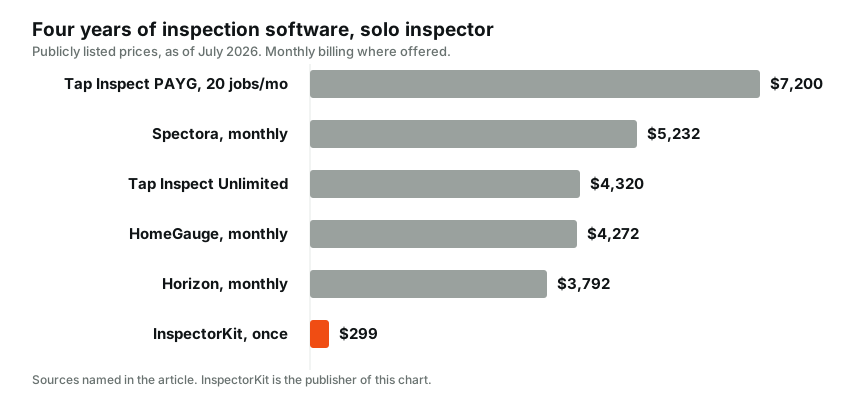
| Tool and plan | 4-year total | 10-year total |
|---|---|---|
| InspectorKit, one payment | $299 | $299 |
| Horizon, annual | $3,196 | $7,990 |
| HomeGauge, monthly | $4,272 | $10,680 |
| Tap Inspect unlimited | $4,320 | $10,800 |
| Spectora, monthly | $5,232 | $13,080 |
| Tap Inspect PAYG at 20 jobs | $7,200 | $18,000 |
Ten-year figures assume prices never rise, which has never once been true of this industry, so read them as floors. The gap between the owned line and everything else is the actual cost of the word subscription, and it funds a lot of marketing that repeats the word affordable.
The costs that hide outside the invoice
Software prices are the visible spend. Two invisible ones move the cheapest ranking further than most line items. Migration time is the first, since every tool change costs a weekend of setup and a few slower jobs, which argues for choosing something you can keep for years rather than the cheapest thing to leave. Deliverability is the second. A report that looks bargain-grade costs referrals you never see, and agents decide in seconds whose reports make them look good in front of clients. Cheap that reads cheap is expensive.
Where cheap goes wrong
Two failure modes deserve warnings, because chasing cheapest badly costs more than paying full rent.
The first is free-tool poverty. Word templates, spreadsheet checklists, and generic PDF makers cost nothing and consume evenings. No comment library, no photo pinning, no summary that builds itself, no professional web delivery for agents. Inspectors who bill their own time honestly conclude the free stack is the most expensive option they ever ran, an hour of formatting per report at any reasonable hourly value dwarfs every price in the tables above.
The second is cheap-tool churn. Buying the lowest sticker, fighting the tool for two months, then re-buying and re-learning something better costs two migrations and a stretch of embarrassing reports. The fix is judging the deliverable before the price. Open the sample report, put it next to what you send today, and only then let price rank the survivors.
A one-year budget picture for a starting inspector
Concreteness helps, so price a realistic first year. Twelve months of the cheapest flat subscription runs $948. A first year of pay-as-you-go at growing volume, say five rising to twelve jobs a month, lands around $700 to $900 in fees plus prepaid blocks. The owned route is $299 in month one and zero after. All three numbers buy working software, and only one of them appears again in year two. New inspectors watching every dollar should notice which line item is the only one that behaves like their ladder and their flashlight, bought once, used for years.
The cheap test that costs nothing
InspectorKit's answer to the cheapest question is structural. One payment near the fee of a single inspection, a 60-day money-back guarantee that keeps the purchase reversible, and a product whose entire working loop proves itself in ten minutes and one real job.
Run your own numbers with the three definitions above, and be honest about which definition your business lives in. A career is a long time to pay monthly for a word like affordable.
Common questions
What is genuinely the cheapest option for a brand-new inspector?
For the first sixty days, per-report pricing wins on cash flow. From roughly month three onward, a one-time purchase is cheaper than everything, permanently. Pick based on whether you are testing a career or starting one.
Is cheap software worse software?
Price and quality correlate loosely here. The most expensive platform is expensive because of bundled business features, not report quality. Judge the deliverable directly, every serious tool publishes samples, and judge yours against the sample report linked below.
What about just using Word or a PDF template?
Free on the invoice, expensive in evenings. Manual formatting, photo wrangling, and no reusable comment system typically cost hours per report. If your time bills at anything, the spreadsheet era ends quickly.