Solo inspection business
Inspection volume for a solo inspector, the honest capacity math
How many inspections one person can actually sustain per week, where the ceiling really comes from, and when raising prices beats adding jobs.
By Owen Murray, founder of InspectorKit · Updated July 6, 2026
Ask how many inspections a solo inspector can do and the arithmetic answer is easy, two a day, five days, ten a week, five hundred a year. The arithmetic is also wrong, because it counts walking hours and ignores everything else the job is. The real ceiling is set by report time, drive time, weather, and the referral consequences of the days you overreach, and an honest capacity model is worth more than an ambitious one.
What a job actually costs the calendar
A booked inspection consumes more than its walk. There is the drive out, the buffer for the client who wants to walk along and ask questions, the walk itself, and then the part the arithmetic forgets, the report. On a finish-on-site system that is a ten-minute driveway close. On a collect-and-assemble system it is ninety evening minutes that the calendar never sees but the family does.
Model the slot honestly, three to four hours door to door for a standard residential job with the close included, and the theoretical week reshapes itself immediately.
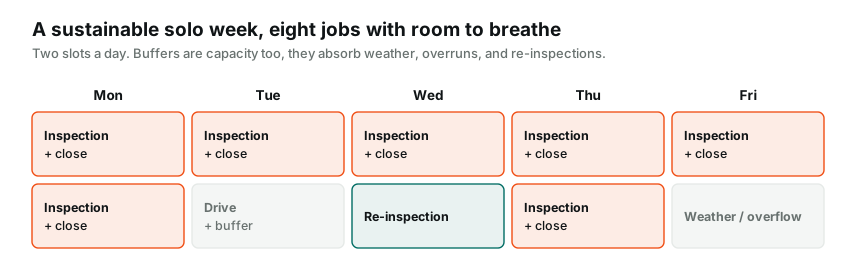
The sustainable week, drawn out
The grid above is what a strong, durable solo week tends to look like. Seven full inspections, a re-inspection slotted into a half-space, and two buffers that are not empty, they are capacity insurance. Weather reschedules land there, the inspection that ran long spills there, the same-day re-inspection request that agents love you for fits there.
The buffers are the part high-volume ambition always deletes first, and their deletion is where the trouble starts. A bufferless week has no shock absorber, so the first disruption cascades, Thursday's overrun pushes Friday, Friday's report defers to Saturday, and the schedule is now borrowing against the weekend and the marriage. Eight to nine engagements a week with real buffers beats ten without, every month of the year.
Seasonality then does its work on the average. Spring stacks, January does not, and a practice that sustains seven a week through the busy season while the slow season runs four is a healthy 250 to 400 jobs a year. Those are the honest numbers behind a thriving one-person shop.
Where the ceiling actually binds
Push volume past sustainable and the failure is not dramatic, it is sequential, and it always hits the same three places in order.
Turnaround goes first. The deferred report is the release valve of an overbooked day, and turnaround is the metric agents watch, so the damage lands directly on the referral channel. Report quality goes second, because reconstruction at midnight is where wrong-bedroom errors live. And the referral flywheel goes third, quietly, as the agents who valued your reliability recalibrate.
The cruel structure of it, overbooking borrows from exactly the assets that generate future bookings. Volume bought at that price shrinks the business it was supposed to grow, which is why the repeat-business engine and the capacity model are the same conversation wearing different clothes.
Price, the other lever
Every solo inspector at capacity faces the same fork, add jobs or raise the fee, and the fee is the under-used arm.
A booked-solid calendar is information. It says demand exceeds supply at the current price, and the textbook response is not to manufacture more supply out of evenings and weekends, it is to let the price find the demand. A modest fee increase on a full calendar typically trims the most price-sensitive bookings, keeps revenue level or better on fewer jobs, and hands back the hours. Repeat until the booking pressure eases, and the practice arrives at fewer, better-paying jobs with buffers intact and same-day reports effortless.
The hire, by contrast, is a step change in everything, insurance, liability, management, and the brand question of whose eyes and whose writing carry your name into reports. It is the right move for some practices eventually. It is rarely the right first response to being busy, and the fee test costs nothing to run first.
Protecting the number you picked
Whatever weekly number you settle on, the calendar will test it, and the test arrives as a friendly voice. The agent you like has a rush closing, the client can only do Saturday, the week that was full finds a ninth slot because saying no felt expensive. Capacity discipline is mostly the skill of declining warmly, offering the next real opening instead of manufacturing one, and trusting that a reputation for reliable quality outlasts any single accommodated emergency. The inspectors who burn out rarely decided to overwork. They just approved one exception a week for two years. Write the number down, tell your booking process about it, and let the calendar defend it so you do not have to relitigate it call by call.
Efficiency, the honest volume upgrade
There is one more way to raise volume that does not touch quality, and it is the unglamorous one, shrink the non-walk costs of each job. Tight territory discipline keeps drive time from eating slots. A field workflow that closes reports in driveways returns ninety minutes per job compared to evening assembly. A mature comment library and honest batching trim the walk's writing overhead to nearly nothing.
Stack those and the same forty-hour week holds more inspections at the same quality, which is the only kind of volume increase with no referral bill attached. Capacity, it turns out, was never really about how fast you walk a house. It was about how much of the job the workflow gives back.
Common questions
Can a solo inspector really do two full inspections a day?
Yes, sustainably, if and only if each report closes at its own house. Two inspections that each end with a driveway publish are a full day. Two inspections that both defer their reports to the evening are a collision, and the collision is where quality and the schedule both fail.
What is a realistic annual number for a healthy solo practice?
Somewhere in the 250 to 400 range for a full-time practice with seasonal swing, which is seven jobs a week averaged across a year that includes slow months. Inspectors advertising numbers far above that are either teams, cutting the walk short, or writing reports in a way that will not survive scrutiny.
Is it better to add a second inspector or raise prices?
For most solo practices, prices first. A hire doubles your insurance exposure, adds management overhead, and puts your name on reports you did not write. A fee increase tests demand instantly and reversibly. Grow price until booking pain actually persists, then have the hiring conversation.