Report writing craft
Re-inspection reports done right, scope, language, and workflow
How to run repair re-inspections, the verified and not-corrected language that protects you, and the duplicate-report workflow that makes them fast.
By Owen Murray, founder of InspectorKit · Updated July 6, 2026
The re-inspection is the shortest job in inspection work and the easiest to get wrong, because everything about it invites casualness. The visit is quick, the client is friendly, the deal is almost closed, and the temptation is to treat the report as a formality. Then a verified repair fails in March, and the two paragraphs you wrote in November become the most scrutinized writing you produced all year.
Run re-inspections with the same discipline as full inspections, at a fraction of the effort, and they become one of the best revenue-per-hour services a solo inspector offers.
The scope is the repair list, say so
A re-inspection verifies specific corrections from the original report, usually the negotiated repair list from the purchase agreement. That sentence, or your version of it, belongs at the top of the report itself.
Stating scope does two jobs. It tells every reader what the visit was and was not, and it fences your liability to the items actually examined. A re-inspection report that opens without a scope statement reads like a very short full inspection, and a very short full inspection is exactly the interpretation a future dispute will reach for. The limitations discipline from full reports applies double here, precisely because the document is small enough that readers assume it covers more than it does.
The three outcomes and their language
Every item on the repair list resolves to one of three findings, and the wording for each is worth standardizing in your library.
Verified. The repair was observed complete and appears functional. Say what you observed, the new flashing was installed at the front roof plane and appears properly sealed, and let the observation carry the verification. Avoid warranty words, professionally repaired, fixed correctly, good as new, because they promise things a visual look cannot promise.
Not corrected. The condition observed at the original inspection remains. State it flat, without editorializing about the contractor or the seller, and re-route the original recommendation. The reader can do the arithmetic.
Partially corrected or altered. The messiest category, and the one where careful observation language earns its keep. Describe what was done and what remains, the receptacle was replaced but GFCI protection is still not present at this location, and recommend the remaining correction. Partial repairs are where re-inspection disputes concentrate, because someone paid for a fix and the report says the problem is not gone. Pure observation, zero verdict, is the posture that survives.
The duplicate workflow, five minutes of setup
Mechanically, a re-inspection should never start from a blank report. Start from a copy of the original, findings intact, and work the repair list item by item, updating each finding with its outcome and a fresh photo beside the original one.
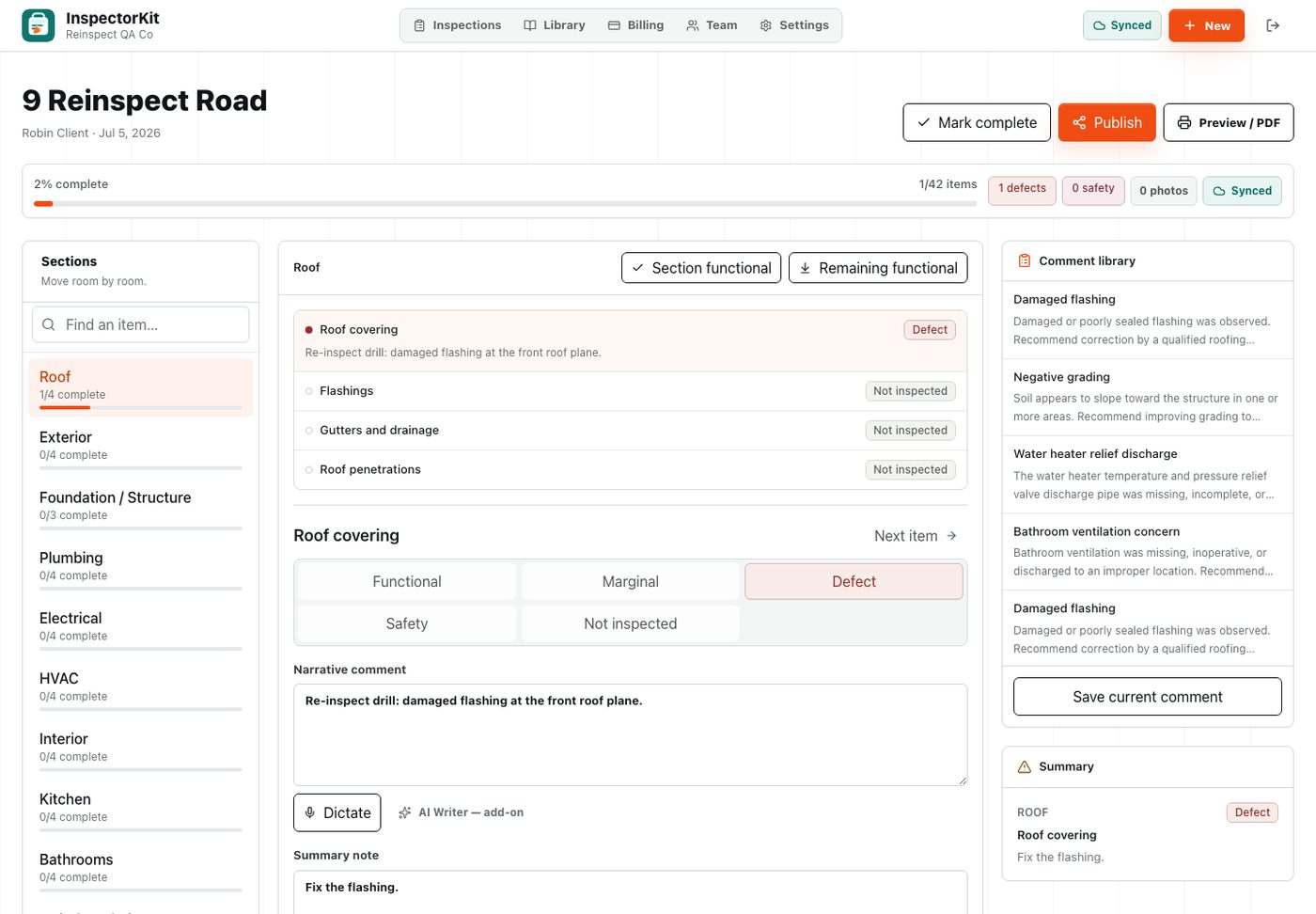
InspectorKit builds this in, the re-inspect flow duplicates any published report into a new inspection with every finding carried over, so the original narrative, condition, and photo ride along as the baseline. The before is already on the page when you arrive, and the visit becomes pure verification, walk the list, observe, update, shoot the after photo. Most re-inspections publish from the driveway in well under an hour, including the writing.
The before-and-after pairing matters beyond convenience. A verified item whose finding shows the original photo next to the repair photo is self-documenting evidence, and it reads as rigor to the agents deciding who to call for the next one.
Access and receipts, the two questions to ask at booking
Two logistics questions save most re-inspection headaches, and both belong in the booking conversation rather than the driveway.
Ask whether the repairs are actually finished. A surprising share of re-inspections get scheduled off a contractor's promise rather than a completed job, and arriving at a half-done repair list wastes the visit and forces an awkward partially-corrected report nobody wanted. Confirm completion with the person who can see the house, not the calendar.
And ask for the repair receipts or invoices up front. You are not auditing the paperwork, but knowing a licensed electrician did the panel work tells you what you are verifying, and the receipt detail often names exactly what was replaced. When the paperwork and the observable condition disagree, the report documents the observable condition, and the disagreement itself is worth a neutral sentence.
Pricing and positioning
Re-inspections price as a partial service, commonly somewhere between a third and half of the full inspection fee depending on list length and drive time. The number matters less than the framing. Priced too cheap, the visit reads as a favor and gets treated like one. Priced as a real service with a real report, it reads as verification worth paying for, which it is, since your signature on the after is what lets the deal close.
The strategic value mirrors pre-listing work. Agents are the repeat customer, and an inspector who turns re-inspections around same-day, with before-and-after evidence in a clean report, becomes the default call for a service most inspectors treat as an errand.
Delivery, same rigor, same speed
Publish and send the report to client and agent the day of the visit, exactly like full inspections. The closing timeline around a re-inspection is usually measured in days, so same-day delivery is not a nice touch, it is the service. The agent version leads with the summary, and a re-inspection summary is beautifully short, verified items, remaining items, done.
Keep the whole thing inside your normal system, the same field-entry habits, the same library language, the same delivery flow. The re-inspection is a small report, not a lesser one, and the inspectors who treat it that way get paid like it.
Common questions
Should a re-inspection cover the whole house again?
No. The scope is the agreed repair list from the original report, and the report should state that scope plainly. A full re-walk at a partial-visit price invites full-inspection liability, and wandering beyond the list turns a verification visit into a second inspection nobody ordered.
What if I spot a new problem outside the repair list?
Document it as a new observation, clearly separated from the verification items, and recommend appropriate evaluation. You cannot unsee a safety issue, and silently ignoring one is a worse position than noting it outside scope. The separation is what matters, verification items and new observations must not blur.
What does verified actually mean in the report?
That the repair was visually observed complete at the visit, nothing more. The language should confirm the observable condition, repair appears complete and functional, rather than warranting the work. Whether the fix holds for ten years is the contractor's warranty, not your report.