Report writing craft
Writing reports faster on site, the driveway-finish system
The workflow that ends kitchen-table report nights. Field entry habits, library leverage, bulk moves, and the order of operations that finishes at the house.
By Owen Murray, founder of InspectorKit · Updated July 6, 2026
The kitchen-table report night is not caused by slow writing. It is caused by deferred writing, the choice to walk the house collecting raw material and assemble the document later. Every hour at the table is reconstruction, what was that third bedroom outlet again, which photo goes with which stain, and reconstruction is the tax this system eliminates. The report gets built where the findings are, and the driveway becomes the finish line.
The core inversion, enter at the finding
The single change that matters most, every finding gets entered the moment it is found. Tap the item, set the condition, get the narrative in, attach the photo, circle it, next. Thirty seconds at the finding, using information your eyes are currently holding, replaces three minutes of evening reconstruction using information your memory has been leaking since lunch.
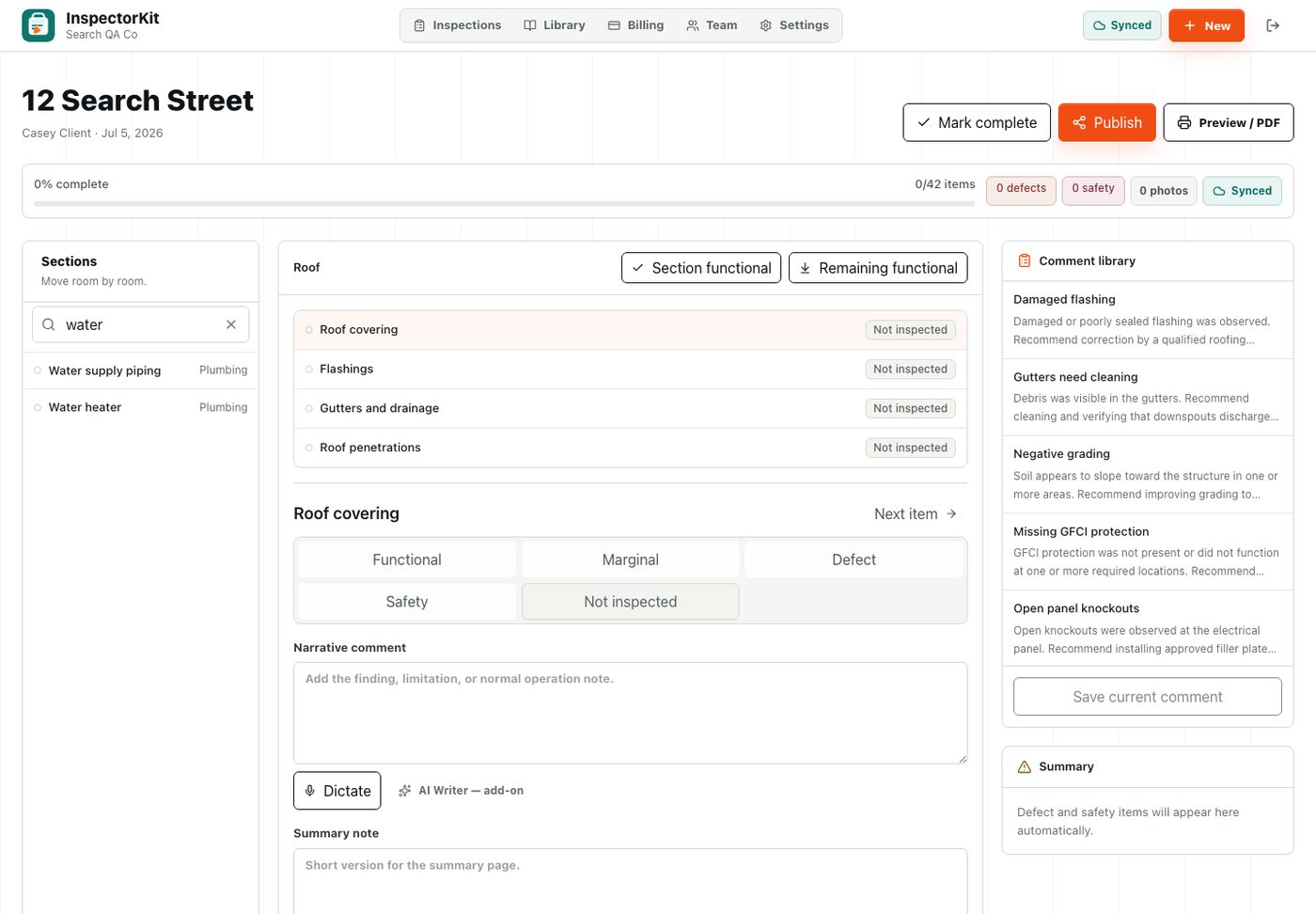
This is a mobile-workflow requirement before it is a discipline. The tool has to make field entry faster than note-taking or the inversion collapses, which is why the builder's design, one-tap conditions, the library one thumb away, photos landing on the item, is the load-bearing wall of the whole system.
Library leverage, the writing you already did
Composed narratives are the expensive part of report writing, and composition is exactly what a mature comment library deletes. The flashing defect you have written forty times exists as one refined entry, inserted in a tap, edited for the house in ten seconds. The three-part structure arrives pre-built, the liability-safe wording arrives pre-vetted, and your on-site writing shrinks to the genuinely novel findings, which on most houses number three or four.
The compounding habit rides along. When a house forces a fresh narrative, write it properly once, then save it back to the library before leaving the item. This job paid for the writing, and every future job collects the interest.
Dictation covers the remaining gap. For the finding with no library match, talking the observation into the narrative field and cleaning it up beats thumb-typing paragraphs, especially with a flashlight in the other hand.
Batch the clean items, honestly
Most items in a real house are functional, and tapping forty of them individually is how software wastes an afternoon. The two bulk moves, marking a section functional and marking everything remaining functional, exist for the end of a section and the end of the walk, once the findings are recorded. They only touch untouched items, so nothing you flagged gets overwritten, and the calibration stays honest because you walked the section before batching it.
The order of operations matters. Walk, record findings as you meet them, then batch the section's remainder before leaving the room. Section by section, the report stays current with your feet, and the progress bar tells you exactly what is left everywhere.
The summary that writes itself alongside
The evening's other big task, assembling the summary, disappears when summary notes get written with their findings. One extra line per finding, at the moment of entry, and the summary page exists in full by the time you reach the truck, built from entries written at peak attention instead of end-of-day fumes.
Finding things fast, the search habit
Speed leaks in the hunting moments, the thirty seconds spent scrolling sections for the water heater item while standing at the water heater. The find box above the section list exists for exactly this, two or three letters and a tap beats any amount of scroll memory, especially on a customized template whose layout is still settling in. The same habit rescues the out-of-order discoveries every real house serves up, the garage finding noticed from the kitchen window, typed into search before the thought evaporates. Fluent inspectors treat search as the default navigation for anything not directly in front of them, and the scroll as the exception.
The driveway close, ten minutes
The finish sequence, run from the vehicle. Sweep the item list for anything still unset, which the progress counts surface instantly. Read the assembled summary once on the phone screen, the ninety-second quality gate. Fix the one entry that always needs it. Publish, and send to the client and agent before starting the engine, with the delivery templates doing the words.
Ten minutes, and the job is delivered, not pending. The client gets the same-day report that becomes the referral story, and the evening gets returned to whoever was supposed to own it.
The interruptions, planned for
Real jobs interrupt. The buyer wants to walk along and ask questions, the agent calls twice, the seller hovers. The system survives interruptions specifically because entry happens at the finding, since a report that is current to the last item you touched can pause anywhere without losing state. The buyer-in-tow variant even improves the work, narrate what you are entering as you enter it, this goes in as a defect with a photo, you will see it in the summary, and the client walkthrough becomes the same motion as the documentation. What kills interrupted jobs is deferred assembly, where every interruption widens the gap between what you saw and what you will have to remember. Enter at the finding and interruptions cost seconds instead of accuracy.
What the system asks of you
Honestly, two things. A tool whose field loop is genuinely fast, which is testable in ten minutes on the practice run, and two weeks of habit-forming while enter-at-the-finding replaces collect-and-assemble. The first three jobs feel slower because the walk absorbs work the evening used to hide. The fourth job, the driveway close happens, the table stays empty, and the system stops being a system and becomes how you work.
The report was always going to take the same number of sentences. The only question was whether they got written once, at the house, or twice, the second time from memory, at night, forever.
Common questions
Is finishing on site realistic for a full inspection?
For a standard residential job, yes, and the inspectors doing it are not faster typists. They enter findings as findings happen, lean on a comment library, and batch the clean items, which moves the work into moments that already existed during the walk.
Does speed compromise thoroughness?
Speed done wrong does. The system here changes when writing happens, not how carefully. The same three-sentence narratives, written at the finding instead of reconstructed from memory at 9 pm, usually come out more accurate, not less.
What is the single biggest time sink to fix first?
The photo sorting session. Photos shot to a camera roll for later matching cost more evening time than all the typing combined. Attach photos to findings at capture and that entire task disappears.