Report writing craft
Electrical defect narratives, safety language that holds its weight
Panels, branch wiring, GFCI and AFCI protection, and service equipment. Field-ready electrical narratives and the discipline behind the safety condition.
By Owen Murray, founder of InspectorKit · Updated July 6, 2026
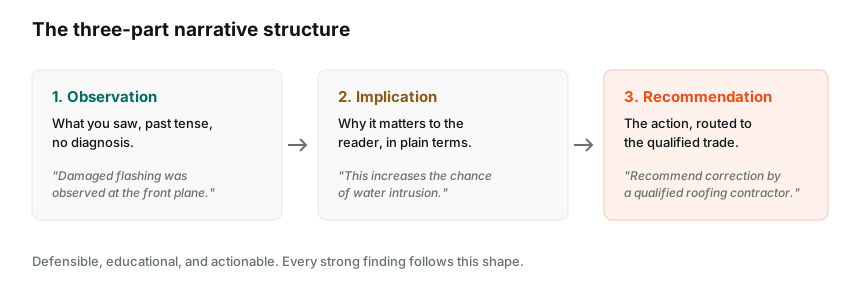
Electrical findings are where report language earns its keep, because the stakes are shock and fire, the buyer cannot see any of it, and the seller's electrician will read your words with a red pen. The narratives below hold up under all three audiences, following the observation-implication-recommendation discipline from the structure guide, with the safety-condition calibration electrical work demands.
Service equipment and panels
Panel narratives set the tone for the whole electrical section, so they get maximum precision.
Double-tapped breaker. Two conductors were observed terminated under a single breaker lug at the main panel. Most breakers are not rated for multiple conductors, and this condition can result in loose connections and overheating. Recommend correction by a qualified electrician.
Open knockouts. Open knockouts were observed at the panel enclosure. Openings in the enclosure permit contact with energized components. Recommend installing approved filler plates.
Corrosion at service. Corrosion was observed at the service entrance conductors and meter base. Corroded connections degrade over time and can overheat. Recommend evaluation by a qualified electrician.
Legacy panel brands. The main panel is a brand and era with a documented history of breaker performance concerns, as identified on the data plate. Recommend evaluation by a qualified electrician familiar with this equipment. Note the shape, the brand identification is a data-plate fact, the history is attributable, and the judgment is routed. Naming equipment honestly without playing expert witness is a line electrical sections walk constantly, and the liability-safe language inventory maps it in full.
Branch wiring, the hidden system
Branch wiring narratives report what surfaces show while respecting how much stays hidden.
Non-responsive receptacles. Receptacles at the east bedroom wall did not respond to testing. Non-functional receptacles may indicate wiring faults upstream of the device. Recommend evaluation by a qualified electrician.
Reversed polarity. Reversed polarity was indicated at two receptacles in the kitchen. Reversed polarity can energize portions of connected devices not designed to carry power. Recommend correction by a qualified electrician.
Exposed junctions. An uncovered junction box with exposed splices was observed in the basement ceiling. Exposed splices present shock and fire pathways. Recommend installing a cover and securing connections, by a qualified electrician if any correction is needed at the splices.
Amateur work, the diplomatic version. Wiring additions of non-professional quality were observed in the garage, including unsecured cable runs and an unlisted splice method. Recommend evaluation of these additions by a qualified electrician. The phrase non-professional quality does the work that handyman special wants to do, without the sneer that reads badly in a dispute.
GFCI and AFCI, the modern-standards findings
Protection findings are the electrical section's most frequent entries, and they deserve language calibrated to house age.
Missing GFCI, straightforward. GFCI protection was not present or did not respond to testing at the exterior and garage receptacles. Ungrounded fault conditions at these locations present a shock hazard. Recommend evaluation and correction by a qualified electrician.
Missing protection in an older home, calibrated. The home predates current requirements for AFCI protection, and such protection was not observed. While typical for the construction era, current standards reflect documented fire-reduction benefits. Recommend considering an upgrade during any future electrical work. The calibration matters, since flagging a 1978 house for lacking 2020s protection without the era context reads as either ignorance or alarm-farming, and agents notice both. The full treatment, including test-button etiquette and the tripped-circuit conversation with sellers, lives in the GFCI and AFCI guide.
The safety label, spent like currency
Safety is the strongest word in your report, and it holds value only if you spend it precisely. The test is mechanism, not mood. If you can name the pathway from condition to injury, shock at a wet-area receptacle, fire at an overheating connection, a fall at a failed handrail, the label is earned. If the honest sentence is this is wrong and should be fixed, with no injury pathway, the finding is a defect, and calling it safety anyway devalues every real safety finding in the document.
One writing habit enforces this automatically. Make yourself state the mechanism in the implication sentence, presents a shock hazard, can overheat, permits contact with energized components. If the mechanism sentence will not write, the label was wrong.
The occupied-house courtesy notes
Electrical testing in occupied homes generates the report's most awkward moments, and two sentences of narrative practice keep them professional. When furniture or storage blocked access, write the limitation plainly, receptacles behind stored items at the garage west wall were not tested due to access. When testing affected something, document the restoration, the tripped circuit was reset and affected equipment restored to operation. Both sentences protect everyone, the occupant from mystery, the buyer from silent gaps, and you from the later question of why a receptacle nobody could reach went unmentioned.
Making the section repeatable
Electrical findings recur more predictably than any other system, the same dozen conditions in endless combinations, which makes the section the highest-return place to build library depth. Load the narratives above, add your region's quirks, aluminum branch circuits, knob and tube remnants, whatever your housing stock serves up, and tag conditions accurately so safety language surfaces when safety findings do.
Then let the structure carry the weight it was built for. Observation you can defend, mechanism you can name, recommendation routed to the trade. Electrical sections written that way survive every reader they will ever meet, including the one with the red pen.
Common questions
When does an electrical finding rate safety instead of defect?
When the condition can plausibly injure an occupant in normal use. Shock and fire pathways rate safety. A dead receptacle with no hazard indication is a defect. The label describes the risk to people, not your level of concern.
Should I open the panel cover?
Follow your standards of practice and your own competence, and document whichever choice you made. Panel interior observed with cover removed, or panel cover not removed due to paint seal, are both defensible sentences. Silence about method is the indefensible option.
Can I say a panel brand is dangerous?
Report what is observable and route the judgment. The panel brand and model are facts. Documented failure history is attributable to published sources. The recommendation belongs to a qualified electrician, and your narrative should end there.