Report writing craft
GFCI and AFCI narratives, protection findings without the alarm
The most repeated safety findings in inspection work, written with era calibration, test-button etiquette, and language that educates instead of frightens.
By Owen Murray, founder of InspectorKit · Updated July 6, 2026
No findings repeat across a career like protection findings. Thousands of GFCI tests, hundreds of missing-protection write-ups, the same conditions in endless houses, which makes this the single highest-leverage place to have language exactly right. Get these narratives calibrated once and a meaningful fraction of your safety writing is permanently solved, in the three-part structure that carries everything else.
Why these findings earn extra care
Protection devices are the rare finding where your report directly touches life safety statistics rather than property value, and the writing should quietly respect that. Ground faults in wet locations are a documented shock mechanism, arc faults are a documented ignition source, and the devices exist because both mechanisms injured people at scale before the requirements arrived. None of that drama belongs in your narratives, which stay in the same calm three-part shape as everything else. All of it belongs in your consistency, testing every device every time, writing every absence every time, because these are the findings where routine is the ethic.
The core findings, written out
Missing GFCI at required locations. GFCI protection was not present or did not respond to testing at the exterior receptacles and the garage. Ungrounded fault conditions at these locations present a shock hazard. Recommend evaluation and correction by a qualified electrician.
Non-responsive test button. The GFCI device at the master bathroom did not trip when tested. A protection device that does not respond to its test function cannot be relied upon to interrupt a fault. Recommend replacement by a qualified electrician.
Won't reset. The GFCI device at the kitchen counter tripped during testing and would not reset. This can indicate a failed device or an active fault on the protected circuit. Recommend evaluation by a qualified electrician.
Protection present and working, the finding nobody writes. GFCI protection was present and responded properly to testing at all wet-area locations checked. Buyers notice affirmative findings, agents appreciate them, and a report that records what passed reads as balanced rather than hunted. One functional line per protection system is cheap credibility.
Era calibration, the difference between finding and lecture
The same missing protection reads differently in a 2019 build and a 1972 ranch, and your narrative should know the difference.
Modern construction, straightforward. The home's construction era falls within current protection requirements, and GFCI protection was absent at the exterior receptacles. Recommend correction by a qualified electrician. In a recent build, absence is a deficiency, plainly.
Older housing stock, calibrated. The home predates requirements for AFCI protection, and such protection was not observed. While typical for the construction era, current standards reflect documented fire-reduction benefits from these devices. Recommend considering an upgrade during future electrical work.
The calibrated version does three things the flat version cannot. It tells the truth about the era, so the seller's electrician has nothing to correct you on. It still delivers the safety information, because the buyer's family does not care what year the house was built. And it frames the upgrade as opportunity rather than deficiency, which keeps the negotiation sane. Era context is the difference between educating and alarm-farming, and agents know which inspectors do which, per the calibration economics in the marginal-versus-defect guide.
Test-button etiquette, documented
Testing trips things, occasionally inconveniently, and the paper trail is your friend.
Note what you tested and how, protection devices were tested using their integral test functions. When a trip kills power to something notable, a freezer circuit, an aquarium, note the trip, the reset, and the restoration. And when a device will not reset, write the finding and leave the circuit as the electrician needs to find it, documented. The inspector who quietly skips testing to avoid awkward moments is trading the buyer's shock protection for social comfort, and the report should never have to hide that trade because it never happened.
The one preparation habit worth having, mention device testing in your pre-inspection communication, so occupied-house surprises arrive pre-explained and the reset conversation happens before the freezer instead of after it.
The ungrounded three-prong cousin
Protection findings travel with a sibling worth loading in the same library session. Three-prong receptacles that test as ungrounded present a related deception, the appearance of a ground path without the reality. The narrative shape holds, three-prong receptacles at the den tested as ungrounded. Ungrounded receptacles do not provide the protection their configuration implies for connected equipment and occupants. Recommend evaluation by a qualified electrician, noting that GFCI protection is an accepted correction method in many cases. That last clause, naming the accepted fix without prescribing it, is exactly the calibrated helpfulness the rest of this guide practices.
Where each protection lives, as a memory aid
Your narratives sharpen when the locations are reflexive. GFCI belongs where water and grounding paths meet, bathrooms, kitchens serving counters, exteriors, garages, unfinished basements, laundry, and near pools and spas. AFCI belongs where arc faults start fires, the living and sleeping spaces, per modern standards. Your template's helper text can carry the location checklist so the walk itself prompts the checks, and your library carries the narratives above so the write-up takes taps instead of composition.
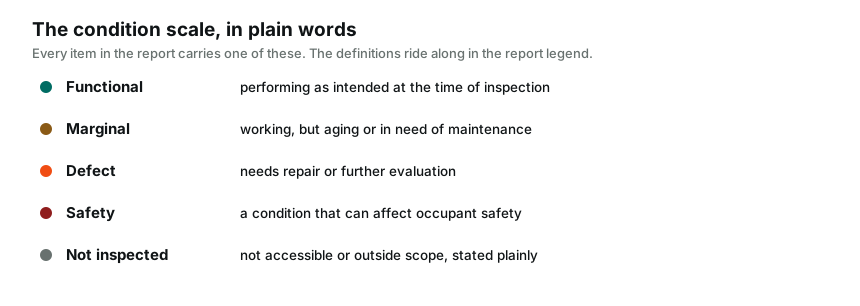
Load them with conditions attached, safety for the shock-mechanism findings, and the label arrives correctly every time, which is precisely how the safety word keeps the weight the electrical narratives guide insists it deserves. Protection findings are repetitive, and repetition is exactly what a library was built to dignify.
Common questions
Is missing GFCI always a safety finding?
At the locations where shock risk is the reason the protection exists, wet areas, exteriors, garages, yes, the mechanism is present and the label is earned. The narrative's era calibration changes the tone, not the condition.
What if testing trips a circuit and something loses power?
Testing protection devices is standard practice, and a device that will not reset is itself a finding. Note what was tested, what tripped, and what would not reset, factually. The alternative, not testing to avoid awkwardness, fails the buyer.
Do I recommend GFCI upgrades in old houses that never required them?
Frame it as a safety improvement reflecting current standards, not as a deficiency of the era. The house is not wrong for its age, and the buyer still deserves to know what current protection would add.