Report writing craft
How long should a home inspection report be? Shorter than you think, longer than a checklist
Page counts, item counts, and reading time. What report length signals to buyers and agents, and the length rules that serve every reader.
By Owen Murray, founder of InspectorKit · Updated July 6, 2026
Somewhere along the way, report length became a proxy for effort, and inspectors started padding. Sixty-page documents for clean condos, every photo duplicated, boilerplate paragraphs marching through every section. The instinct is understandable and the result serves nobody, because report length is not a measure of work. It is a design decision, and it deserves to be made deliberately.
What length signals, to each reader
Buyers read length as emotion before they read a single finding. A slim report on a rough house feels dismissive. A phone-book report on a clean house feels like an invoice justification, and either way the mismatch erodes trust before the content gets its chance.
Agents read length as respect for their time. They process reports weekly, and the inspector whose documents surface what matters in ninety seconds becomes the recommendation, per the triage logic in the summary guide. The inspector whose reports demand an archaeology session becomes the name they mention with a sigh.
And future readers, the contractor, the appraiser, the attorney, read length as signal-to-noise. Your defense in any dispute is the precise finding, timestamped and photographed. Burying it under padding is self-sabotage with page numbers.
The honest measure, findings not pages
Page count is an artifact of formatting, so measure what actually scales with the house. A standard residential template covers 40 to 60 items. A typical house produces a handful of defects, several marginal items, and a majority of functional entries. That is the report's real size, and it should track the house, not your anxiety.
The publishing math follows. Every item appears with its condition. Findings that need words get the three-sentence narrative. Findings that need evidence get their photos, placed with the finding. Functional items get their one-line confirmation and no more. Do that honestly and the length lands wherever the house puts it, which is the only correct answer to the length question.
Where reports bloat, the four usual suspects
Duplicate photography leads the list. Six angles of the same water stain add scroll without adding proof. The two-shot discipline covers what evidence actually requires, wide for location, close for condition, and almost never a third.
Boilerplate stuffing comes second. Standards language and limitations belong in the report once, in their place, not repeated under every section heading. The liability guide is blunt about this, the two-page disclaimer does not rescue an imprecise finding, and repeating it twelve times rescues nothing twelve times.
Narrative sprawl third. A finding that takes a paragraph usually contains two findings sharing a bed, or one finding wearing three restatements. Split it or trim it.
And functional-item essays last. Performing as intended at the time of inspection is a complete sentence for a working furnace. The urge to prove you looked hard at things that were fine is the padding urge in its purest form, and one clean affirmative line per system carries all the credit available.
Reading time, the metric that matters
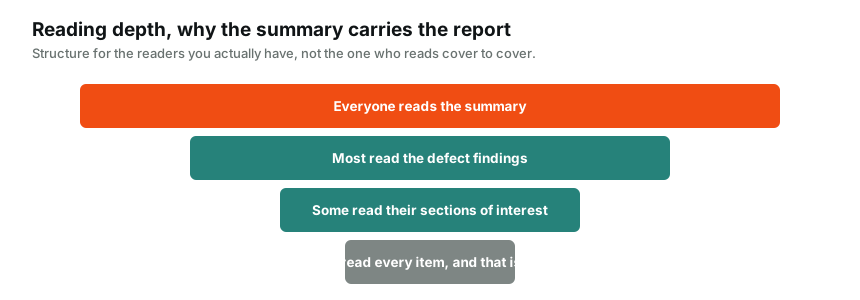
Design for three reading sessions. The three-minute read, buyer opens the link, reads the summary, understands the house. The fifteen-minute read, buyer or agent works through every finding with photos. And the two-minute retrieval, anyone, years later, finds one specific finding by section. A report that serves all three sessions is the right length by definition, whatever its page count, and the worked example shows the architecture that makes all three possible.
Web-first delivery changes this calculus in your favor, incidentally. A web report with a summary up top and sections below never feels long the way a PDF scroll does, because readers navigate rather than wade. Length anxieties are substantially a print-era inheritance.
Trimming an existing bloated template
Inspectors inheriting their own padded habits can shrink a report in one evening without touching thoroughness. Delete the repeated boilerplate blocks first, keeping one canonical statement of scope and limitations where readers can find it. Collapse the multi-angle photo habits to the two-shot rule prospectively, no need to re-edit history. Rewrite the five longest narratives in your library to the three-sentence shape, since the longest entries teach the worst habits to every future insert. And re-read one published report end to end asking of each element whether it informs, proves, or pads. The first two stay, the third goes, and most inspectors find the exercise removes a quarter of the scroll while sharpening everything that remains.
The condo and the farmhouse, length tracking reality
Two edge cases prove the rule. A clean 900-square-foot condo produces a short report, fewer systems, fewer items, and forcing it longer with padding insults everyone's time. The same template on a 1920s farmhouse with three outbuildings produces a long one honestly, more systems, more findings, more photographs earning their places. Both documents are correct, and both come from the same discipline applied to different houses. If your reports all land at the same length regardless of the property, the length is coming from your habits rather than the houses, and that is the tell worth investigating.
The length rules, compressed
Cover every item your standards require, one line minimum, no silent skips. Give every real finding its full three sentences and its evidence photos, never trimmed for slimness. Give every clean item its single line, never inflated for weight. Say the limitations once, clearly, where they apply. And let the total land where it lands.
A report built that way is exactly as long as the house demanded and not a scroll longer, which is the professional answer to a question that was never really about pages. It was about whether every word earned its place, and that standard, unlike page count, is fully in your control.
Common questions
What is a typical report length for a single-family home?
A standard residential template runs 40 to 60 items across a dozen sections. With photos, that publishes as a document a buyer reads deeply for ten minutes and references for years. Page counts vary wildly with photo formatting, which is why items and findings are the better measure.
Do longer reports protect me better legally?
Precision protects you. Padding does not. A report bloated with boilerplate and duplicate photos is harder to defend, not easier, because the signal your defense needs is buried in noise nobody can claim was read.
Clients say they want thorough. Does that not mean long?
Thorough means every system covered and every finding explained. Buyers experience thoroughness through the summary's clarity and the findings' completeness, not through scroll length. A tight report reads as more professional, not less.