Solo inspection business
Inspection report branding, the marketing you already paid for
Why the report is a solo inspector's main brand surface, the four touchpoints that matter, and what vendor logos in your reports quietly cost you.
By Owen Murray, founder of InspectorKit · Updated July 6, 2026
A solo inspector produces exactly one artifact the client keeps. Not the walkthrough, not the handshake, the report. It gets read twice before the deal closes, forwarded to parents and contractors, and rediscovered in a folder three years later when the house sells again. Every one of those encounters is a brand impression, and the only question is whose brand is collecting them.
That is the entire argument for report branding, and it is worth getting concrete about, because the execution costs almost nothing and the neglect compounds.
The four touchpoints, and what each one carries
Brand in a report is not decoration, it is a small set of specific placements doing specific jobs.
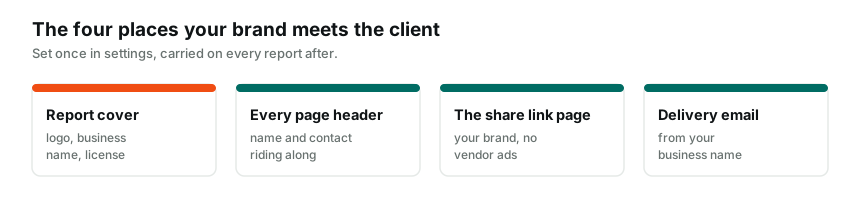
The cover is the handshake. Business name, logo or wordmark, license number, and contact details, composed once and carried on every report after. It is the page in screenshots when the report gets forwarded, and the page a future client sees when a past client digs the report out as a recommendation.
Page headers do quiet repetition. Your name riding on every page means every excerpt, every printed section, every photo page that travels alone still says who did the work.
The share link page is the modern front door, since most reports are opened as links on phones now, not as attachments. The page wrapping your report should carry your identity, not a vendor's interface with your name in small type somewhere.
And the delivery email is the first impression before any page loads. A report that arrives from your business name, with replies routing to your inbox, starts the whole reading experience inside your brand instead of a notification from a platform the client has never heard of.
The vendor-logo problem, named plainly
Here is the uncomfortable audit. Open one of your published reports as a client sees it and count the logos. On several mainstream platforms the answer includes the vendor's badge on the report page, the vendor's name in the delivery email, sometimes a powered-by footer, occasionally links inviting your client toward the vendor's other services.
Every one of those is your paid work carrying someone else's marketing to your client. The report you were hired to produce, circulating through the transaction with your reputation attached, is doing acquisition for a software company. Some tools even monetize the surface more aggressively, and the ads-in-reports problem covers how far that goes.
The fix is a purchasing criterion, not a workaround. Before committing to any report tool, publish a test report and look at exactly what the client will see, the page, the email, the footer. Your brand should be the only brand. InspectorKit takes that position across all four touchpoints, your logo, your business name on the email, no vendor badge on the client's page, because the report is your asset and it should be working for you.
Setting it up, the one-evening version
The mechanics are deliberately boring. Upload a logo, set brand details, confirm the accent handling, and every report after carries the identity automatically. The branding setup guide walks the InspectorKit version, and the whole task fits in an evening including the test report.
Two craft notes from watching many inspectors do this. Restraint reads as professional, one logo, one accent, clean type, while heavy decoration reads as a flyer. And a wordmark, your business name set plainly, beats an amateur logo every time, so do not let missing artwork delay the setup. Consistency is the asset. The artwork can upgrade later without changing anything structural.
Consistency, the part that compounds
A brand is mostly repetition. The same name, the same look, on the report, the email, the website, the invoice, and the magnetic sign on the truck. Any single instance is trivial. The accumulation is what makes an agent three transactions later say they always look professional without being able to say why.
The report is the anchor of that repetition because it is the artifact that travels furthest. The agents deciding who to recommend see more of your reports than any other marketing you produce, and they see them at the highest-stakes moments, circulating inside live deals. A branded, clean, consistent document in that context is not vanity. It is the most credible advertisement your business will ever run, and you already did the work it advertises.
The sample report as a sales page
One placement gets overlooked because it happens before any job exists. Prospective clients and agents evaluating inspectors increasingly ask to see a sample report, and the smart practices publish one on their website preemptively. That sample is a full brand experience, your cover, your headers, your writing, your photo discipline, doing the selling while you are on a roof somewhere. An inspector with a strong branded sample linked from their site converts the evaluation conversation before it starts, while the inspector who has to email a PDF exported from a vendor-labeled trial is auditioning with someone else's stationery. If your current tool cannot produce a sample you would proudly link, that is the audit result speaking.
The audit worth doing this week
Publish a test report in whatever tool you use today and walk it as the client. Whose name is on the email envelope. Whose identity wraps the share page. Whose logo is the largest graphic on the cover. What happens visually when the report is printed to PDF from the browser.
If the answers are not all you, the most-circulated document your business produces is leaking value on every job, and fixing the leak is either a settings page or, if the tool will not allow it, a reason to reconsider the tool. Either way, the audit costs twenty minutes and the answer decides who your next few hundred reports advertise.
Common questions
Does report branding really influence referrals?
Indirectly and reliably. Nobody hires an inspector for a logo. But the report circulates through five or more people per transaction, and a clean branded document reads as a professional operation while a generic vendor-labeled one reads as interchangeable. Over hundreds of circulated reports, that difference is a reputation.
What if I have no logo and no design skills?
A wordmark beats a bad logo. Your business name set cleanly, plus license number and contact details, looks deliberate and professional. Add a real logo when you get one made. The consistency matters far more than the artwork.
Whose brand is on the report matters that much?
Consider what the document is. It is the only artifact of your work the client keeps, forwards, and rereads. If it advertises the software vendor instead of your business, the most-circulated document you produce is marketing someone else.