Alternatives and comparisons
Home inspection software without a subscription, what exists and what to check
Why inspection platforms charge monthly, what subscription-free really means, and the checklist separating real ownership from a marketing label.
By Owen Murray, founder of InspectorKit · Updated July 6, 2026
Search for inspection software and every result wants a monthly relationship with your card. $89 here, $109 there, and the industry treats this as weather, just how things are. It was not always, and it does not have to be.
This guide covers what a subscription actually buys, where the model quietly works against a solo inspector, and how to evaluate the rare products that let you pay once.
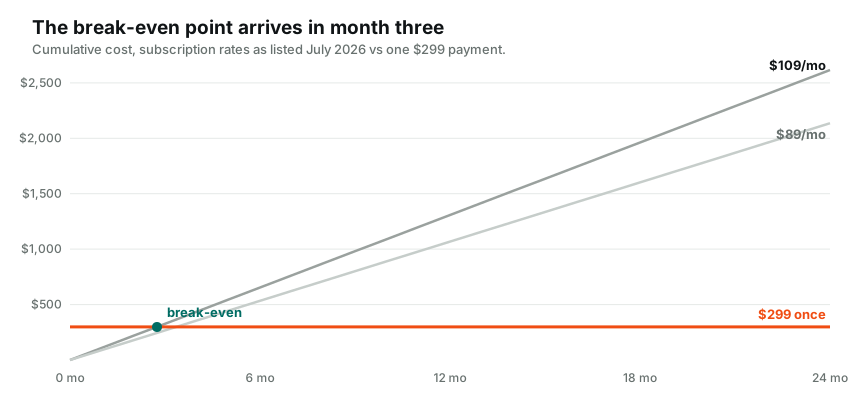
What your monthly fee really pays for
Some of a subscription is real cost. Servers store your reports, bandwidth serves them to clients, and someone answers support email. A vendor charging you something ongoing for genuinely ongoing services is not a scam.
But scale the real costs against the price. As of July 2026, the market's flagship platform lists $109 per month for one inspector. Hosting and delivering one inspector's reports costs a small fraction of that. The remainder funds sales teams, growth marketing, feature breadth you may never open, and the margin a recurring-revenue business exists to produce.
There is also a quieter cost. A platform whose revenue is your monthly fee has every incentive to make leaving inconvenient and to monetize the attention of the clients reading your reports. When you hear inspectors grumble about upsells appearing around their deliverables, that is the incentive expressing itself.
The math a solo inspector should run once
Take your current or quoted monthly price and multiply by 48. Four years is a fair horizon, since inspectors rarely switch tools more often than that.
At $89 monthly the four-year figure is $4,272. At $109 it is $5,232. Now write down what you would own at the end of those four years if you stopped paying. For a subscription, the honest answer is nothing, and sometimes not even convenient access to your own report archive.
That figure is the actual price of the software. The monthly number is just the installment plan, minus the part where you end up owning something.
What subscription-free has to mean, concretely
A one-time purchase only counts as ownership if four things hold. Use this as a literal checklist against any product, including the one whose website you are reading.
The tool must remain fully functional without further payment. Not a stripped mode, not a nag screen. The core job, building and delivering reports, works forever on the purchase you made.
Your data must export as ordinary files. Reports as PDFs, your template and comment library as documents you can open anywhere. Test the export before relying on the product, because an export you have not run is a rumor.
Genuinely recurring costs must be priced as optional add-ons, not buried in a too-good price that forces the vendor to squeeze later. AI features burn compute per use. An extra inspector consumes real resources. Honest one-time products charge for those separately and keep the core purchase clean.
And the vendor's survival plan has to make sense without your renewal. Ask how the business sustains itself. A straight answer is a good sign. A pivot to how you should not worry about it is the other kind of sign.
The third model, paying per report
Between subscriptions and ownership sits per-report pricing, where the software is cheap or free until you publish, and each published inspection carries a fee. The flagship platform's own Advanced add-on works this way at $4 per published inspection, as of July 2026. The model feels fair at low volume and quietly becomes the most expensive option at real volume. An inspector publishing 25 reports a month pays $100 monthly and $1,200 a year for that single add-on, which is four InspectorKit purchases, every year, forever. Per-use pricing rewards the vendor for your success in a way a one-time price never can.
Where InspectorKit sits in this picture
InspectorKit is my answer to this exact checklist. One payment of $299 buys the report builder, an editable template, a comment library with a field-tested starter pack, photo annotation, offline field work, and branded delivery by web link and PDF. It stays functional with no renewal, everything you build exports on demand, and the couple of genuinely recurring services, like a second team seat, are priced as plain add-ons you can ignore.
The trade-off is scope, and it is deliberate. There is no scheduling suite or payment processing, because the product is built for the solo inspector who wants the report done in the driveway rather than a business-management platform with a report writer inside it. The first report walkthrough shows the actual working loop in about ten minutes.
Whether that scope fits your business is a real question only you can answer. What is not in question is the arithmetic. $299 once against $4,000 to $5,000 every four years leaves a lot of room to be wrong and still come out ahead.
Try the model before trusting the argument
Any vendor can write a persuasive page about their own pricing model. The test that matters happens on a real inspection.
Look at a real published sample report first, since the deliverable is the product. Then get hands-on and run genuine jobs through the tool while your current subscription still runs. The 60-day money-back guarantee exists precisely so the decision can be made on evidence from your own work, and if the evidence disappoints, the refund is one email.
The subscription model spent a decade teaching inspectors that software is rent. It is worth one afternoon to check whether that lesson was true.
Common questions
Why is almost all inspection software subscription-based?
Because recurring revenue is worth more to a software company than one-time revenue, and investors price companies on it. The subscription serves the vendor's valuation first. Sometimes it also funds real ongoing value, and your job as the buyer is telling those situations apart.
Is subscription-free software worse by definition?
No, but it has to be structured honestly. Hosting and support cost the vendor real money over time, so a sustainable one-time product keeps those costs lean and prices genuinely expensive extras, like AI compute or extra team members, as optional add-ons rather than hiding them in everyone's price.
What is the single most important thing to verify?
The exit. Whatever you buy, confirm you can export your reports, template, and comment library as normal files today, not hypothetically. Ownership without an exit is just a longer lease.