Report writing craft
Report writing after dark, and how to get your evenings back
Why inspection reports migrate to 9 pm, what the evening session actually costs in accuracy and burnout, and the field workflow that ends it.
By Owen Murray, founder of InspectorKit · Updated July 6, 2026
There is a version of this job where the work ends when you leave the property, and there is the version most inspectors actually live, where a second shift starts after dinner. Same license, same houses, same findings. The difference is a workflow decision most people never consciously made.
The 9 pm report session feels like a personal failing, too slow at typing, too disorganized, should have taken notes better. It is none of those things. It is the predictable output of a specific system, and systems can be replaced.
How the report ends up at the kitchen table
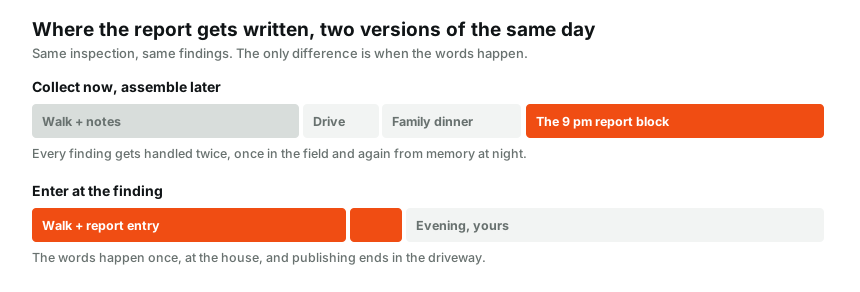
The evening session exists because of one habit, collecting during the walk and assembling after. Notes, photos, and memory go in a pile, and the pile becomes a document at night.
Assembly is not writing, it is reconstruction. Which bedroom had the dead outlet. Which of the six roof photos shows the flashing you meant. What that abbreviation in your notes was supposed to abbreviate. Every question is a small archaeology dig into your own day, conducted at the hour when your accuracy is worst and your family is around. The findings drift, the details soften, and the mistakes that cost inspectors get manufactured in bulk.
What the evening block actually costs
The hours are the visible cost. An hour and a half per report, five reports a week, and the second shift swallows seven or more hours that were nominally yours.
The invisible costs are worse. Accuracy decays with distance from the finding, so evening reports are reconstructed reports, and reconstructed reports are where wrong-bedroom errors and shrunken measurements come from. Turnaround stretches, since a report finished at 10 pm ships the next morning at best, and the agent who wanted it same-day noticed. And the burnout arithmetic is not subtle. A job that quietly costs seven evening hours a week is a job people leave, not because the inspections got harder but because the evenings never came back.
The inversion, writing where the findings are
The alternative system has one rule. Every finding gets entered when it is found, not collected for later.
Tap the item, set the condition, get the narrative in, attach and circle the photo, next. Thirty seconds at the finding, spent on information your eyes are currently holding. Multiply by the findings in a normal house and the entire report costs around twenty minutes of walk-time, spread invisibly through moments that already existed, the pause after shooting a photo, the walk between rooms, the wait while a slow faucet proves it drains.
The evening session does not get faster under this system. It gets deleted. There is nothing left to assemble, because the document was built while the building was in front of you.
What makes field entry actually work
Field entry lives or dies on friction, which makes it a tooling requirement before it is a discipline. Three things have to be true.
Entry must be faster than note-taking. One-tap conditions, a comment library one thumb away, and photos that land on the finding instead of in a camera roll. If entering a finding takes longer than scribbling it, the scribble wins and the evening returns. The builder walkthrough shows what the loop looks like when it is fast enough.
The clean items must be batchable. Most of a house is functional, and no field workflow survives tapping forty fine items individually. Record the findings, then mark the rest of the section functional in one move before leaving the room.
And the tool must not care about signal. Basements, crawlspaces, and rural properties are where inspections happen, so a builder that stalls without bars sends you right back to paper notes and evening assembly. Offline capability is not a luxury feature in this workflow, it is the floor.
The driveway close
The finish line moves from the kitchen table to the truck. Before starting the engine, sweep the progress counts for anything unset, read the summary once on the phone, fix the one line that needs it, and publish. Ten minutes, and the full sequence is covered in the driveway-finish guide.
Same-day delivery falls out of this for free, and same-day delivery is the thing agents remember. The report that used to ship at 10 the next morning now arrives while the buyer is still emotionally in the house. That is a referral engine disguised as a workflow change.
The two hard weeks
Honesty about the transition. The first few jobs on the new system feel slower, because the walk is now absorbing work the evening used to hide, and your rhythm fights the change. Somewhere around the fourth or fifth job, the first real driveway close happens, and the psychology flips. The evening block stops feeling saved and starts feeling like it never should have existed.
Give it two deliberate weeks. Keep the library growing with the save-back habit, batch honestly, and let the progress counts tell you when a house is done. The reports were always going to contain the same sentences. The only question this system answers is whether you write them once in daylight or twice, the second time from memory, after dark.
Common questions
Is evening report writing really avoidable on multi-inspection days?
The second and third inspections are exactly where field entry pays most. On a stacked day there is no evening buffer large enough for three reconstructions, so the reports either finish at each house or they collide at night. Inspectors running two a day are usually the strictest about the driveway close, not the loosest.
What about complex findings that need thought?
Flag them and move on. One or two findings per house genuinely benefit from a careful second look at the wording. The mistake is letting those two findings justify deferring the other forty, which need no thought at all, just entry.
How long does the transition to field writing take?
About two weeks of discomfort. The first few jobs feel slower because the walk is absorbing work the evening used to hide. Most inspectors report the crossover around job four or five, when the driveway close first happens and the evening stays empty.