Report writing craft
Building a comment library that writes half your report
How to build an inspection comment library from scratch, structure entries so they insert clean, and grow it into the asset that carries your business.
By Owen Murray, founder of InspectorKit · Updated July 6, 2026
Ask a fifteen-year inspector what they would grab if their business burned down and the honest ones name the comment library. Not the camera, not the client list. The library. It is the accumulated writing of every report they ever produced, distilled into entries they trust, and it is the difference between composing a report and assembling one.
The good news for everyone without fifteen years, a working library is not actually built by time. It is built by method, and the method compresses.
What a library entry actually is
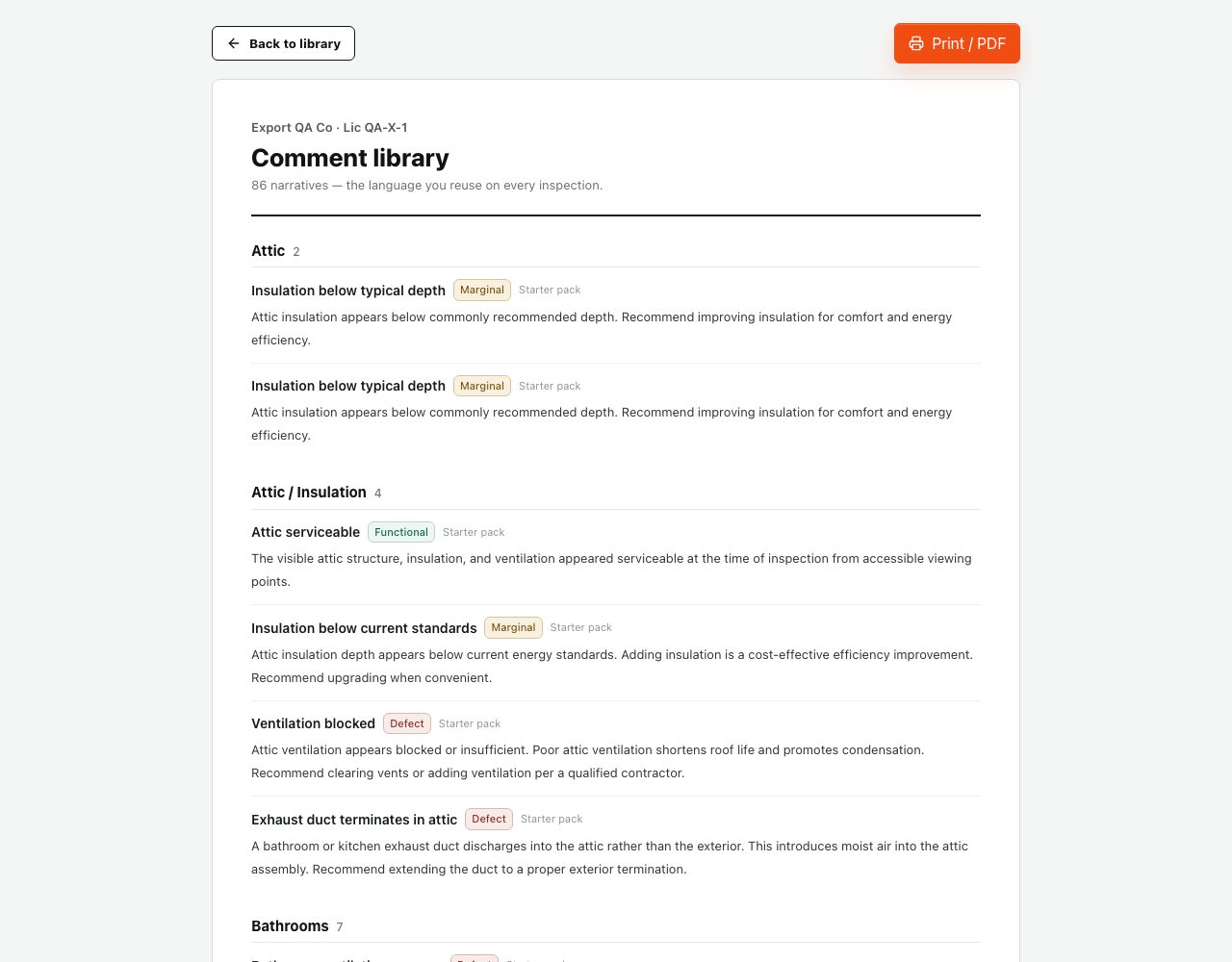
An entry is a reusable narrative with a handle. The handle is a title you can find under pressure, something like Damaged flashing or GFCI protection missing, plus a category that matches your report sections and a condition it typically pairs with. The body is the narrative itself, written in the three-part structure that survives every reader, an observation in past tense, the implication in plain language, and a recommendation routed to the right trade.
Entries written this way insert clean. You tap the title, the narrative lands in the report, you adjust the location detail, and the finding is done. Entries written as loose fragments insert dirty, and you end up rewriting at the exact moment the library was supposed to save you.
Seeding a library in one evening
Starting from zero is a single focused session, not a career.
Pull up your last ten reports, or your mentor's if you are brand new, and walk them finding by finding. Every narrative you wrote more than once is a library candidate. Write the best version of it, once, in the three-part shape. Most inspectors discover they have been writing the same forty narratives with small variations for years, which means the first evening produces the forty entries that cover the bulk of a normal house.
Organize as you go. Categories should mirror your template sections, roof, exterior, plumbing, electrical, and so on, because that is how you will look for them in the field. Resist clever taxonomies. The library is a tool you use standing in a crawlspace, and crawlspace-you wants the obvious grouping every time.
The save-back habit, where growth actually comes from
Seeding gets you to functional. The compounding comes from a single field habit, and it is the one that separates libraries that grow from libraries that stall.
When a house forces you to write a fresh narrative, something with no library match, write it properly at the finding, then save it back to the library before you leave the item. The job you are standing in paid for that writing. Every future job that meets the same condition collects the interest. In InspectorKit the save current comment button sits right under the narrative field for exactly this reason, because a save that requires leaving the builder is a save that never happens.
One narrative per week saved back is fifty entries a year. Two years of that habit and your library covers findings you see twice a season, which is the point where report writing stops involving composition almost entirely.
Pruning, the maintenance nobody does
Libraries rot in a specific way. Duplicates accumulate, near-identical entries split your muscle memory, and wording that felt right in year one reads wrong after your liability language matures.
Twice a year, scroll the whole library once. Merge duplicates into the strongest version. Delete entries you have not inserted in a year. Reread the top twenty for wording you have outgrown, and tighten any recommendation that names a fix instead of routing to a trade. The pass takes under an hour and keeps the library sharp enough that inserting from it never requires a second thought.
Structure that scales past a hundred entries
Somewhere around a hundred entries, scrolling stops working and structure starts mattering.
Three rules hold up. Keep titles front-loaded, the first two words should identify the finding, because that is what search and your eyes both match on. Keep one entry per distinct condition rather than one per house style, since location details belong in the edit after insertion, not in the library. And keep the condition pairing honest, an entry saved under Defect should read like a defect, so the calibration between marginal and defect stays consistent across every report you publish.
Portability, the rule that protects the asset
Everything above assumes the library remains yours. That assumption deserves checking before it matters.
A library is the most portable asset in your business or the least, depending entirely on the software holding it. Some platforms export comments cleanly, some bury them, and the difference decides whether switching tools costs you an evening or a decade of writing. The migration guide covers the mechanics, but the principle belongs here. Confirm the export exists before you build on any platform, and take a copy once a year regardless, the same way you back up photos.
If you can import comments in bulk, the reverse trip is equally cheap, paste the collection in, assign categories, and the asset that took years to write moves houses in minutes.
The library as the business
A mature library changes the economics of the work. Report time drops because composition drops. Consistency rises because the same finding gets the same vetted language every time, which is what a report that finishes in the driveway is actually built on. And the writing itself improves, because effort concentrates on the genuinely novel findings instead of re-typing the familiar ones.
Build it in an evening, grow it with one habit, prune it twice a year, and confirm you can take it with you. That is the entire discipline, and it pays every single job for the rest of your career.
Common questions
How many comments does a working library need?
Fewer than most inspectors think. Around 120 to 150 well-written entries cover the findings that repeat across ordinary residential work. Past 300, most additions are variations you could handle by editing a strong base entry after inserting it.
Should I buy a commercial comment set?
Purchased sets solve day one and create year three. The wording is generic, the liability posture is someone else's, and you will rewrite most entries anyway. Seeding from your own past reports takes one evening and produces language you actually stand behind.
Who owns my library if I switch software?
That depends entirely on the tool. Before committing to any platform, confirm you can export comments in a readable format. InspectorKit exports your full library as a printable document and plain data, because the library is yours, not the software's.