Switching and migration
Moving your comment library to new software, the complete method
Your narratives are the most valuable text you own. How to harvest them from any platform, structure them once, and land them in a new tool intact.
By Owen Murray, founder of InspectorKit · Updated July 6, 2026
Ask an inspector what keeps them on a platform they complain about and the answer is rarely a feature. It is the library, years of carefully worded narratives that feel fused to the software holding them. This guide is the defusing procedure, platform-agnostic, tested against the messiest real-world case, which is no export button at all.
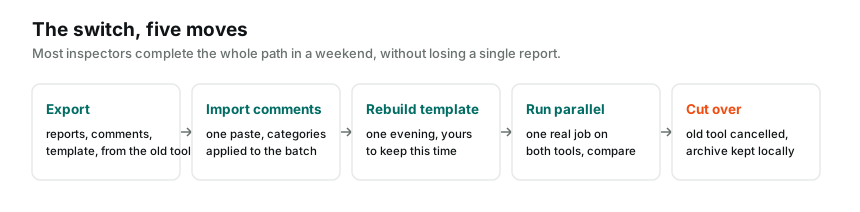
The reframe that makes it easy
Your comment library has always existed in two places, the platform's database and your published reports. The second copy is the one that matters, because it is the one you own, and it is complete by definition. Every narrative you actually use appears in your recent deliverables, exactly as refined as your practice refined it.
Which means the worst-case migration, a platform with no comments export whatsoever, is barely worse than the best case. The harvest just runs through PDFs instead of a settings page, per the Spectora-specific door map if that is your starting point.
Step one, harvest with a volume rule
Open your last fifteen to twenty reports and copy every narrative you recognize as yours, the phrasings you reach for without thinking. Skip anything you cannot remember using twice. The goal is your working vocabulary, not an archaeology project.
Expect the count to surprise you. Inspectors guessing they have four hundred comments routinely harvest sixty that do the real work, and the gap is the difference between a library and a junk drawer. Migration is the one moment pruning happens for free, since not copying is easier than deleting ever was.
Add one deliberate pass for the rare-but-critical entries, the safety language you use twice a year but must have exact. Federal Pacific panels, aluminum branch wiring, fuel-line clearance findings. Low frequency, high stakes, worth a targeted search through older reports.
What not to migrate, said explicitly
The harvest rule has a mirror image worth spelling out. Leave behind the duplicates that accumulated across years, the platform's stock language you never customized, since your next tool ships its own starter pack, the experiments that never earned reuse, and anything you would be embarrassed to insert in front of a client today. A migrated library should be the greatest-hits album, not the complete recordings. Sixty sharp entries beat four hundred stale ones every day of the week, and the builder's one-tap panel works best when everything in it deserves the tap.
Step two, structure once, in the universal format
Paste everything into one plain document with a shape any importer can eat. Title line, body lines, blank line between entries.
Water heater TPR discharge missing
The temperature and pressure relief valve discharge pipe was missing
or improperly terminated. Recommend correction by a qualified plumber.

Negative grading at foundation
Soil appears to slope toward the structure in one or more areas.
Recommend improving grading to direct water away from the foundation.
Two disciplines pay off here. Titles you can scan in two seconds while standing in a basement, specific and front-loaded, per the import guide's title advice. And a rough sort by condition as you go, defects together, safety together, marginal together, because batch imports assign conditions per batch and the sort saves per-entry editing later.
This document, incidentally, is now a permanent asset. Whatever software the future holds, your library exists as a file in your records folder, which is the data ownership end state every inspector should reach once.
Step three, land it
In InspectorKit, the Library page's bulk import takes your document in condition-sorted passes. Paste the defect batch with Defect selected, the safety batch with Safety selected, and so on, minutes per pass. Entries arrive with your titles and bodies intact, alongside the starter pack, and appear one tap away in the builder's comment panel on your next job.
Give the result a ten-minute review, fixing any title that reads wrong and any condition that landed off. Then run the practice house and feel the thing that makes this whole exercise worth it, your own language, one tap away, in a tool you own.
Growing it after the move
The migrated library is a foundation, not a monument, so plan its growth into your first month. Every time you edit an inserted comment to fit a real house and the edit reads better, save it back with one tap, and the library compounds job by job. Titles stay disciplined, conditions stay accurate, and a quarterly ten-minute prune keeps the collection sharp. Within a season the library stops being the thing you migrated and becomes the thing you built here, which is when the old platform's hold finally reads as what it was, just gravity, and gravity only works until you jump.
The zero-labor alternative
Every step above is also skippable. The Done-For-You setup accepts your raw materials in whatever state they exist, including nothing but PDF reports, and hands back an account with the library rebuilt, conditions assigned, and the whole thing checked by hand. The trade is money for an afternoon, and inspectors whose archives run deep or whose calendars run full make it routinely.
Either path ends the same way. The narratives that took a decade to refine, working for you in the next tool, and a text file in your own folder guaranteeing no platform ever holds them hostage again. The library was never the moat vendors needed it to be. It was just text, and text is the most portable thing you own.
Common questions
My old platform has no comments export. Is the library lost?
No, because your reports are the export. Every narrative you rely on appears verbatim in recent PDFs, and harvesting from fifteen reports recovers a working vocabulary in an afternoon. The platform held copies. The originals were always in your deliverables.
Should I migrate all several hundred comments?
Almost certainly not. Working vocabularies run far smaller than hoarded libraries, and migration is the natural pruning moment. Move what your last twenty reports actually used, plus the rare-but-critical safety language, and let the rest retire.
How long does the whole move really take?
Harvest and structuring, one afternoon for most solo inspectors. The paste import itself, minutes per condition batch. Or hand raw PDFs to the Done-For-You setup and the calendar cost rounds to zero.