Switching and migration
Done-For-You setup, explained for the inspector deciding on it
What DFY actually includes, who genuinely needs it versus who can skip it, what checked-by-hand means from a one-person company, and how to send materials in.
By Owen Murray, founder of InspectorKit · Updated July 6, 2026
Every switching guide on this site ends with the same fork. Do the migration yourself in a couple of evenings, or send your materials in and get a configured account back. This page is the long-form answer to what that second path actually involves, written plainly enough that half its readers should conclude they do not need it.
What DFY covers, concretely
Done-For-You setup takes whatever your old workflow produced and returns a working InspectorKit account. Four deliverables, specifically.
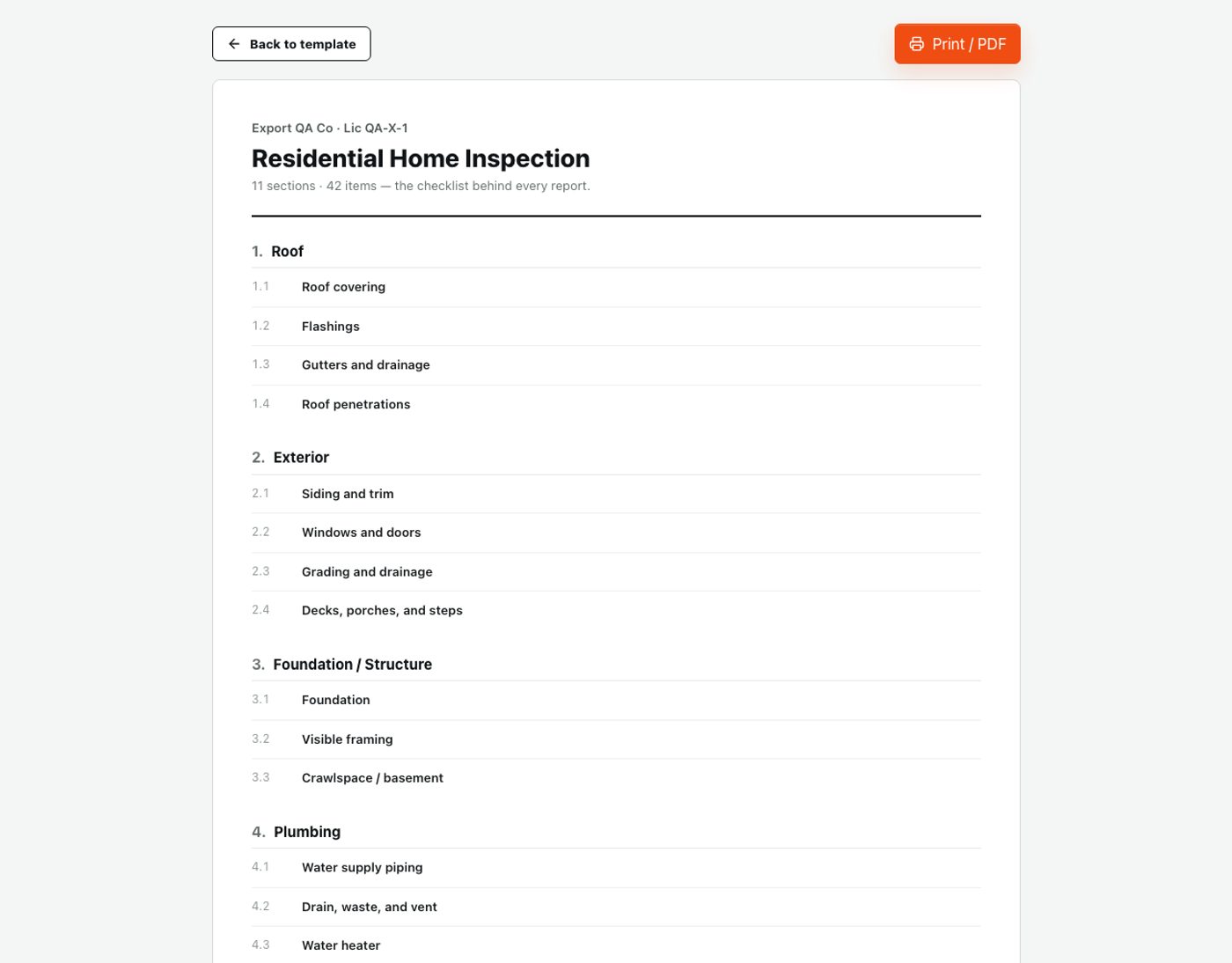
Your report structure, rebuilt in the template editor from your exports or reconstructed from your finished reports, walk order and coverage intact, fossils and workarounds left behind where they belong per the rebuild guide's philosophy.
Your comment library, harvested from whatever exists, a clean export, a messy document, or nothing but PDFs, then loaded with titles, bodies, categories, and conditions assigned, sitting alongside the starter pack.
Your branding, logo, business details, license, and report color, configured so your first published report carries your identity, not a default.
And a hand check of the whole thing before handoff, meaning someone actually creates a test inspection in your account, inserts your comments, and reads your template the way you will in the field. Not a migration script's exit code. Eyes.
What checked-by-hand means at a one-person company
The phrase deserves unpacking because it is the actual product. InspectorKit is built and run by one person, and DFY setups are part of that person's work, not a contractor pipeline or an offshore queue.
The practical consequences cut both ways, and honesty requires both. The person configuring your account knows every corner of the product, which is why odd requests, a nonstandard section, an unusual walk order, a bilingual comment set, get handled with judgment instead of a ticket escalation. The same person also has a finite calendar, so turnaround is stated honestly per job rather than promised universally, and a decade of PDFs takes longer than a clean export. You get told where things stand, which is a different experience from watching a status wheel, and some people genuinely prefer the wheel. Know yourself.
Who should skip DFY, said before the pitch
The self-serve path is genuinely quick for a specific profile, and if this is you, keep your money.
If your comment collection lives in one document, the paste importer lands it in minutes. If your template is simple or you have been meaning to redesign it anyway, an evening in the editor is honestly satisfying. If your archive is shallow, a first-year inspector switching early, there is little to migrate at all. The switching-cost math prices the self-serve path at roughly two evenings, and evenings are exactly what some people have.
DFY earns its price for the opposite profile. A decade-deep archive, exports in hostile formats or absent entirely, a template with real complexity, a calendar with no free evenings, or simply a strong preference for arriving at a made bed. It is a time purchase, priced like one, and the honest sales pitch is that it deletes the two labor evenings and the sorting, nothing more mystical than that.
How the handoff works
The mechanics run through your dashboard. After purchase, a setup banner appears with an intake form, and the help-side walkthrough covers it step by step. You send four things, your template or recent reports, your comment collection in any state, your logo at the largest size you have, and notes about anything unusual in how you inspect.
The notes matter more than people expect. One sentence like I always inspect irrigation and my old software never had a place for it becomes a proper template section instead of a discovered gap. Context in equals quality out.
Then the account comes back configured, you run the practice house plus one real job, and anything that landed wrong gets fixed on request, because the setup is not done until you can work.
What DFY deliberately does not include
Scope honesty prevents disappointment, so here are the edges. DFY configures your account, it does not archive your old platform, since exports require your login and belong in your hands per the archive doctrine. It rebuilds your template faithfully rather than redesigning your process, though obvious fossils get flagged, and the redesign remains your call. And it loads the library you send rather than authoring new narratives, because your language is the asset and inventing it would defeat the point. The work product is your workflow, transplanted and checked, not a consultant's opinion of what your workflow should be.
The decision, without the fog
Strip it to the essentials and the choice is clean. Both paths end at the same place, your language and structure working in a tool you own. Self-serve costs two evenings and teaches you the editor and importer along the way, which has its own value. DFY costs money, deletes the labor, and adds a hand check by the person who built the product.
Price your evenings honestly, count your archive's depth, and pick without agonizing, because this is the most reversible decision in the whole switch. The importer remains available to DFY buyers and the DFY option remains available to self-servers who get halfway through a pile of PDFs and reconsider. The only wrong move is letting the migration question delay the switch itself, which costs $1,300 a year in rent for every year the deciding takes.
Common questions
What exactly do I get back from a DFY setup?
A configured account. Your template rebuilt, your comment library loaded with conditions assigned, your branding and business details in place, all checked by hand before handoff. The measure of done is that you can run a real inspection the day you get it back.
What if my materials are a mess?
Mess is the expected input. Old PDF reports with no exports at all are routine source material, since your finished reports contain your template and your language verbatim. Send what exists and let the sorting be someone else's evening.
Who actually does the work?
The founder. InspectorKit is a one-person company, so the person rebuilding your template is the person who built the template editor, which is why the output gets checked instead of merely processed.