Switching and migration
The real cost of switching inspection software, quantified
Vendors need you to overestimate switching pain. The actual line items, what each one costs in hours and dollars, and which ones can be deleted outright.
By Owen Murray, founder of InspectorKit · Updated July 6, 2026
Every subscription's real retention department is not customer success. It is the vague dread of switching, an unpriced, unexamined weight that makes renewal feel like the prudent choice forever. Vendors do not have to create that dread, they only have to never dispel it. So this page dispels it with arithmetic, line item by line item.
The line items, priced
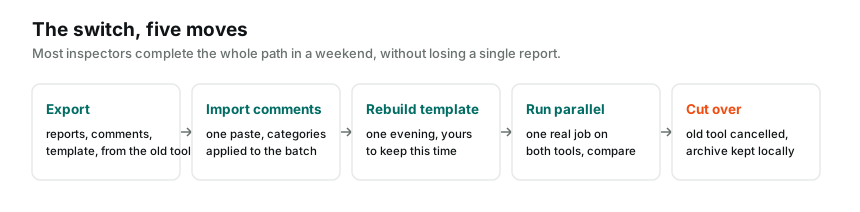
Switching inspection software decomposes into six costs. Here is each one, sized honestly for a solo inspector.
The overlap subscription is the cash cost, one extra month of the old platform while the new one proves itself, $79 to $109 at market rates. Bounded, known, and the cheapest insurance in this industry.
The archive session is an evening. Report PDFs, template, comment collection, exported while access is healthy per the switching playbook. You should be doing this annually anyway for data ownership reasons, which makes its marginal cost near zero.
The setup session is another evening. Branding, template first pass, library import. On InspectorKit the paste importer turns a comment document into a working library in minutes, and the practice house makes the first hour productive instead of exploratory.
The learning-curve jobs are the genuine cost, three or four inspections at maybe twenty minutes slower each while taps become reflexes. Call it ninety minutes of career total, concentrated in two weeks, and gone.
The template tuning trickles across a month, five minutes here and there as real jobs reveal what your structure needs. Trivial per instance, and honestly kind of satisfying.
And the psychological switching cost, the dread itself, which costs nothing once named and examined, and compounds silently forever when it is not.
Total, in round numbers, one subscription payment, two evenings, ninety minutes of field friction, and a month of mild attention. That is the entire moat.
What the moat protects, priced the other way
Now the asymmetry. The costs above are one-time. The costs they gate are annual and permanent.
Staying on the market's flagship at monthly billing runs $1,308 a year against a $299 owned alternative, a $1,000-plus difference in year one and roughly $1,300 every year after, before add-ons and before the price creep that subscription markets reliably deliver. Across the four years after a switch, the difference funds the overlap month two hundred times over.
Vendors understand this asymmetry perfectly, which is why the dread matters so much to them. A customer who prices the switch accurately is a customer whose renewal has to be earned on merit, every year, and merit is expensive.
A worked example, end to end
Numbers land better in a scenario. Take an inspector on the flagship platform at $109 monthly, fifteen jobs a month, considering the owned route. Their switch costs one overlap month at $109, two evenings they value at maybe $200 of leisure honestly priced, and four learning-curve jobs at twenty slow minutes each. Generously totaled, call it $400 of real cost. Their staying cost is $1,308 every year, growing with any price increase, minus the $299 they would have spent once. The switch pays for itself before the overlap month ends, and everything after is compounding in the right direction.
Deleting the deletable items
Two of the six line items can be removed outright, and one can be halved.
The Done-For-You setup deletes both evenings. Send whatever your archive contains, exports, documents, or plain old PDF reports, and the account comes back configured, template rebuilt, library loaded and checked, per the DFY overview. What remains for you is the archive step, which no vendor can do without your login, and the field jobs themselves.
The learning curve halves with a practice environment. Tapping through a pre-loaded inspection for twenty minutes before the first real job moves most of the fumbling somewhere consequence-free. The remaining friction on real jobs is real, bounded, and the last switching cost standing.
Which reframes the whole question. With the labor deleted and the curve halved, switching costs reduce to one overlap payment and a fortnight of mild attention, against a recurring annual difference in the four figures. The dread was carrying almost all of the weight, and the dread was never itemized.
The question that reprices everything
One prompt cuts through most switching paralysis. If you were starting your business today, with your current knowledge, would you sign up for what you currently pay? Not would you switch, would you choose it fresh. Inspectors who answer no but keep renewing are paying an inertia premium, the gap between the tool they would choose and the tool they have, billed monthly. Sizing that premium honestly is exactly what this page's line items are for, and for most solo operators the premium turns out to be the largest overpayment in their business.
Sunk costs, the last defender
One objection survives the arithmetic, usually phrased as years invested in the current platform. It deserves a direct answer.
The years built three things, your judgment, your language, and your process. All three are yours and all three move, as expertise, as importable text, and as template structure. What does not move is the platform's configuration, and that was never an investment, it was rent-adjacent setup for a rented space. Sunk cost reasoning asks you to keep paying because you have already paid. Businesses that outlive their software all learned to decline that argument once.
Price your own switch with the line items above, put the annual difference next to it, and the decision usually makes itself quietly. The dread was the product all along, and it was always free to stop buying it.
Common questions
What is the biggest real switching cost?
The learning-curve jobs, the three or four inspections where the new workflow runs slower than muscle memory. Everything else is either an evening of work or deletable with help. The learning curve is real, bounded, and over within two weeks.
What is the biggest imagined switching cost?
Losing the comment library. It feels like the moat because it took years to build, and it moves as plain text in an afternoon. The years built the judgment, not the file format, and judgment transfers for free.
Can switching costs actually reach zero?
Close to it. A Done-For-You setup deletes the labor items, the practice environment compresses the learning curve, and the archive step was always yours to do regardless. What remains is attention across one overlap month.