Report writing craft
The inspection report mistakes that actually cost you
The report-writing mistakes that generate callbacks, disputes, and lost referrals, and the durable fix for each one, from an inspector-facing founder.
By Owen Murray, founder of InspectorKit · Updated July 6, 2026
Most report mistakes are invisible on the day you make them. The report publishes, the client pays, and everything looks fine until the finding gets tested by a repair bid, a dispute, or a second opinion. That delay is what makes these patterns expensive, because by the time one costs you, it has been in every report you have written for years.
These are the mistakes worth hunting in your own writing, with the fix that holds up.
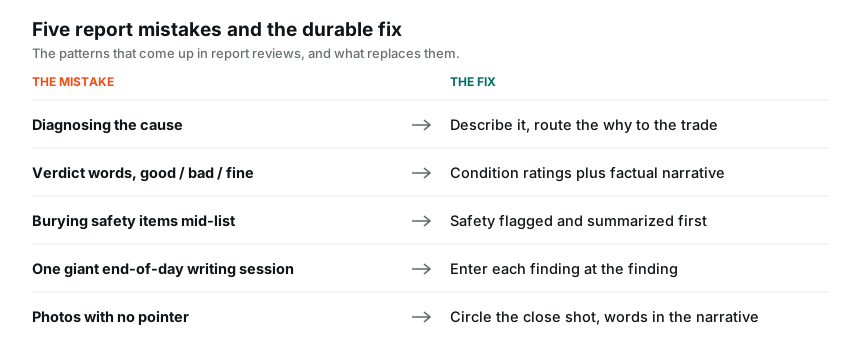
Diagnosing what you did not verify
The narrative says the stain is from a plumbing leak. You did not open the wall, you saw a stain. The difference between those two sentences is the difference between an observation and a claim, and claims from visual inspections are what disputes are made of.
The fix is the discipline every strong report runs on, describe what you observed, state why it matters, and route the diagnosis to the trade qualified to make it. Moisture staining was observed at the ceiling below the second-floor bathroom. This may indicate an active or past leak. Recommend evaluation by a qualified plumbing contractor. Nothing in that finding can be wrong later, which is the entire point. The three-part structure makes this shape automatic.
Verdict words doing the narrative's job
Good, bad, fine, terrible. Verdict words feel efficient and carry nothing. The condition rating already renders the verdict. The narrative exists to carry the facts underneath it, and when it just repeats the verdict in prose, the reader has one opinion where they needed one observation.
Worse, casual verdicts collide with your formal ratings. A narrative that calls something pretty bad while the rating says Marginal hands a future reader two conflicting judgments in one finding. Keep the calibration language in the ratings, keep the narrative factual, and the report speaks with one voice.
Safety findings buried in the scroll
A missing GFCI by the kitchen sink, item 41 of 63, formatted identically to a sticking door. Legally present, practically invisible. If the client never registers the safety item, the report technically disclosed it and functionally did not, and that gap is where the worst callbacks live.
Safety findings earn placement, not just presence. Flag them with their own condition, and surface them at the top of the summary page, which is the only part of the report every party reads. The buried safety item is the mistake with the highest stakes on this list, and it is also the cheapest to fix, since the fix is placement rather than writing.
The end-of-day writing session
Assembling the report at night from photos and memory is not a writing mistake exactly, it is the factory that produces them. Reconstructed findings drift. The outlet moves to the wrong bedroom, the stain shrinks, the crack loses its measurement, and every drifted detail is a small crack in the report's reliability.
Enter findings at the finding, while your eyes still hold the information. The driveway-finish workflow covers the full system, but the mistake-prevention core is just this, thirty seconds of entry at the item beats three minutes of reconstruction at the table, and it beats it on accuracy before it beats it on time.
Photos that point at nothing
A photo of a roof plane, no mark, narrative says damaged flashing. Which flashing? The reader cannot find it, the contractor bids blind, and the evidence value of the photo rounds to zero.
One circle on the close shot fixes it. The annotation discipline is genuinely eight seconds of work per finding, and it converts every photo from scenery into testimony. If the photo documents a finding, something in it should say exactly where to look.
Recommendations that name nobody
Recommend repair. By whom? Monitor this. For what, and how often? Open-ended recommendations feel cautious and read as incomplete, because the reader's next action is missing.
Every recommendation should route somewhere specific, a qualified electrical contractor, a licensed roofing contractor, further evaluation by a structural engineer. Routing does two jobs at once. It gives the client an actionable next step, and it formally hands the judgment to the party qualified to make it, which is where your liability posture wants that judgment to live.
The summary that got skipped
Some reports end at the last item, no summary at all, on the theory that everything is already in the body. Everything is, and nobody reads the body. The agent reads the summary between showings, the client reads it twice, and the negotiation is conducted from it. A report without one gets summarized anyway, by someone else, with less care.
Write the summary note at the finding, one line per item that deserves it, and the summary assembles itself by the time you reach the truck. It is the highest-leverage page in the document and the only one guaranteed an audience.
Running the audit on yourself
Every mistake on this list survives because published reports rarely get reread by their author. Pull three recent reports and read the defect narratives out loud. Diagnoses, verdicts, dead-end recommendations, and buried safety items all announce themselves within minutes when spoken.
Then fix the source, not the symptom. Most of these patterns live in your comment library entries, so one editing pass through the library corrects every future report at once. That is the quiet advantage of writing from a library in the first place, your mistakes are centralized, which means your fixes are too.
Common questions
What is the single most expensive report mistake?
Diagnosing causes you did not verify. A narrative that says the roof leaks because of hail damage has made an insurance-adjacent claim from a visual inspection. When the real cause turns out different, that sentence is what the dispute quotes. Describe what you observed and route the why to the qualified trade.
Do clients actually notice writing quality?
They notice its effects. A clear report generates fewer confused phone calls, faster repair quotes, and agents who trust your work enough to recommend it. A muddled one generates the 9 pm call asking what item 34 means, and that call is the quality review.
How do I audit my own reports for these mistakes?
Pull your last three published reports and read only the defect narratives, out loud. Verdict words, diagnoses, and vague recommendations announce themselves when spoken. Twenty minutes of reading catches the patterns years of writing normalized.