Solo inspection business
The solo home inspector software stack, four tools and no more
The complete software stack for a one-person inspection business, what each layer actually needs to do, and where inspectors overspend by default.
By Owen Murray, founder of InspectorKit · Updated July 6, 2026
Software advice for inspectors usually arrives written for inspection companies, and it shows. Team dashboards, lead routing, multi-inspector calendars, tiered seats. A one-person operation needs almost none of it, and the gap between what solo inspectors need and what they get sold is where a few thousand dollars a year quietly disappears.
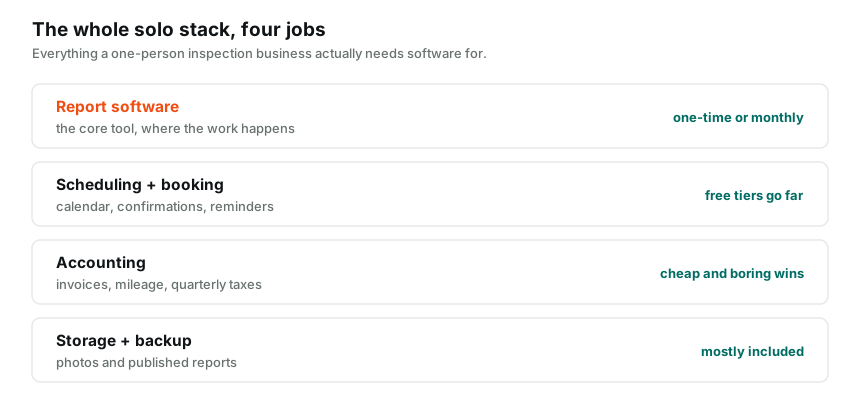
Here is the whole stack, all four layers of it, with the honest version of what each one has to do.
Layer one, report software, the tool that is the business
Everything else on this list is plumbing. The report tool is the product your client pays for, the document your liability lives in, and the surface you spend three hours a day touching. It deserves nearly all of your evaluation energy, and the solo-focused comparison walks the field in detail.
The requirements that matter for one person, in rough order. It must be fast in the field, because a builder that saves you twenty minutes per house is worth more than every other feature combined. It must work offline, since basements and rural properties are the job. It must produce a report that looks like your brand rather than the vendor's. And its pricing must make sense at your volume, which for most solo inspectors means being suspicious of per-month and per-report models, a suspicion the fee arithmetic justifies in detail. As of July 2026, mainstream subscription tools run $79 to $109 per month for a solo seat, which is $950 to $1,300 a year for software whose job does not change month to month. InspectorKit charges $299 once, and that difference is a business decision disguised as a software preference.
Layer two, scheduling, cheaper than it looks
Scheduling software is the most oversold layer. The actual job is a calendar that prevents double-booking, confirmations that reduce no-shows, and a reminder the day before. A shared Google or Apple calendar plus text confirmations handles a solo operation into the hundreds of jobs per year, and it handles it for free.
Online booking pages earn a place once agent volume arrives, because agents love booking without a phone call, and free tiers of the mainstream booking tools cover a single calendar fine. The threshold worth watching is simple. When scheduling phone calls start interrupting inspections, add the booking page. Before that, the calendar you already own is the correct tool, and every dollar spent past it is spent on a problem you do not have yet.
Layer three, accounting, boring on purpose
The accounting layer needs to invoice, track expenses and mileage, and produce clean numbers for quarterly taxes. That is the entire list. Any of the small-business accounting tools does this for a modest monthly fee, spreadsheets do it for free with more discipline, and your accountant has an opinion worth taking.
The mileage log is the piece solo inspectors most often skip and most regret skipping, since the drive between inspections is one of the larger deductions available to the business. Pick any approach you will actually maintain. Consistency beats sophistication everywhere in this layer, and no client will ever see it.
Layer four, storage and backup, mostly already solved
Published reports and their photos are business records with a long tail. Clients lose links years later, disputes reference old findings, and licensing boards have retention expectations that vary by state. The storage layer is wherever those records live and whatever backs them up.
The quiet question here is what your report software does on your behalf. A tool that hosts published reports durably, and lets you export your data whenever you want a local copy, covers most of this layer for free. The yearly habit worth having takes an hour, export the year's reports and your comment library to local storage, and the business survives any vendor, any subscription lapse, and any account mishap.
The overspend patterns, named
Three patterns account for most wasted software money in solo practices.
Buying team software alone. Multi-inspector features price at multi-inspector rates, and a solo inspector on a company plan is subsidizing capabilities nobody will use.
Duplicating layers. A report tool with delivery emails plus a separate email marketing tool, a booking page plus a CRM plus a calendar, the same job bought twice or three times. Each layer above should exist exactly once.
And renting what could be owned. Subscriptions are correct for tools whose ongoing costs are real. For tools that are software you use, ownership models exist, and the one-time-payment case is fundamentally a stack-cost argument. A stack whose biggest layer costs $299 once instead of $1,300 a year changes the economics of every slow month you will ever have.
The whole bill
Priced honestly, the solo stack is a one-time report tool purchase, free scheduling until volume forces the upgrade, a small accounting subscription or a disciplined spreadsheet, and storage that mostly rides along with the report software. Audit it once a year against the four jobs above, and anything on the statement that does not map to one of them is a candidate for cancellation. The full cost picture puts this next to insurance, licensing, and the truck, where software should be one of the smaller lines. In a business whose whole revenue engine is your time and your reputation, the stack's job is to stay out of the way and stay off the monthly bank statement, and four layers is all that takes.
Common questions
Do I need a CRM as a solo inspector?
Almost certainly not in year one, and probably not after. Your client relationships live in your calendar, your delivered reports, and your phone. A CRM earns its keep when a team shares leads. For one person it is a subscription that mostly stores what your email already knows.
What about scheduling software with online booking?
Online booking helps once agents start sending volume, and free tiers handle a solo calendar comfortably. Start with a shared calendar and confirmations by text. Add booking software when you find yourself declining jobs because scheduling calls interrupt inspections, which is a real threshold and a good problem.
Is there anything the stack deliberately leaves out?
Marketing suites, social schedulers, and analytics dashboards. A solo inspector's marketing is agent relationships and same-day reports, neither of which lives in software. The listed four layers cover the actual operations of the business.