Alternatives and comparisons
The best home inspection software for solo inspectors, by use case
No single winner, four honest ones. The best suite, the best desktop control, the best pay-per-report, and the best owned tool, matched to how you work.
By Owen Murray, founder of InspectorKit · Updated July 6, 2026
Best-of lists in this niche usually rank ten tools nobody uses past number four, score them on feature counts, and conclude with an affiliate link. This one works differently. Four categories of solo inspector, four honest winners, verified prices as of July 2026, and my own product wins exactly one of the four, the one it was built to win.
Best all-in-one suite, Spectora
If you want scheduling, agreements, payments, and the report writer under one login, Spectora is the category and the category leader. The agent-facing experience is the strongest in the market, the automation genuinely replaces admin time, and the ecosystem is where the industry's gravity currently sits.
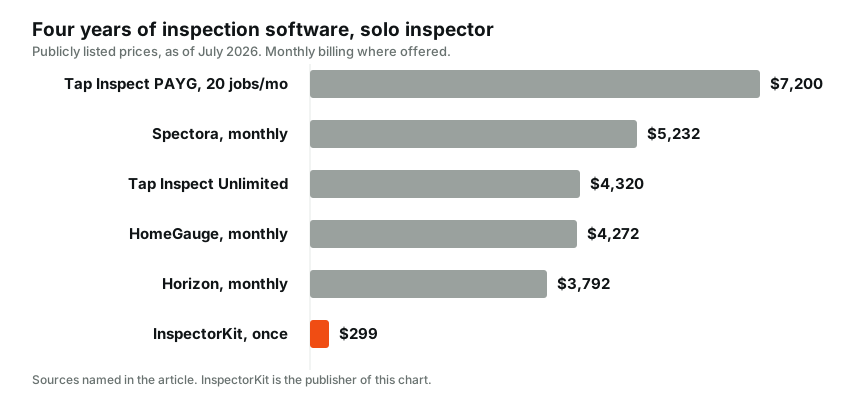
The price of the crown is the price. $109 monthly solo, $99 per extra seat, and a $4 per-inspection Advanced add-on, which lands a busy solo user around $2,000 to $2,500 a year. The full pricing decode runs the scenarios. Choose it knowingly for the suite, not accidentally for the report writer, because renting the whole platform to use one wing of it is the most common overspend in this industry.
Best deep template control on desktop, HomeGauge
The desktop veterans are still right about one thing, nothing matches a mature desktop writer for granular template surgery. HomeGauge at $89 monthly remains the pick for the inspector whose twenty-tab template took a decade to perfect and who finishes reports at a desk with two monitors.
Two caveats travel with the recommendation. HomeGauge now shares an owner with Spectora, which changes the long-run competitive story, covered in the vs comparison. And desktop-first means your workflow anchors to a machine, which the field increasingly punishes.
Best pay-per-report for true part-timers, Tap Inspect
For the inspector running a handful of jobs a season, genuinely unsure about next year, Tap Inspect's pay-as-you-go at $7.50 per report in blocks of 20 keeps the commitment near zero. Three jobs a month costs about $22.50 in fees, and no subscription meter runs while you decide if this career sticks.
The model has a cliff, and you should know its address. Around twelve reports a month, pay-as-you-go crosses the price of flat subscriptions, and at established-inspector volume it becomes the most expensive option in the industry. The per-report math marks the whole curve.
Best owned report tool, InspectorKit
This is my product and the category I built it to win. If the report is the job, the deliverable and the evenings are the metrics, and you would rather own your tool than rent it, InspectorKit is $299 once.
The purchase covers the field loop end to end. One-tap conditions, a comment library with a field-tested starter pack, photo annotation pinned to findings, a summary that assembles itself, an editable template, offline operation for basements, branded web and PDF delivery with client and agent sending, re-inspections, and exports for everything you build. Break-even against any subscription above lands inside four months, and the four-year gap runs three to five thousand dollars.
What it will not do is run your back office. No scheduling engine, no payment collection, no CRM. The bet is that a solo inspector's calendar and invoice app already handle those, and the report deserves a dedicated tool priced like a tool instead of a platform priced like a department.
What solo actually means for software
Worth naming, because vendors design for teams and bill solo inspectors for the privilege. A solo operation has no office manager rebuilding templates on a Tuesday, no dispatcher feeding a scheduling engine, and no tolerance for evening admin, since the evenings are where reports get finished or families get seen. Solo-fit software respects three constraints. It works one-handed on a phone in the field, it makes report language reusable so the writing compounds instead of repeating, and it fails gracefully in dead zones. Every recommendation above was filtered through those constraints before price entered the conversation.
The decision tree, compressed
Answer three questions and the list above collapses to one name.
Does bundled business management earn rent from you specifically, meaning you would pay for scheduling automation even if the report writer were free? Yes points to Spectora. Is your identity a desktop template you have tuned for a decade? That points to HomeGauge, eyes open about the ownership situation. Are you running fewer than ten jobs a month while deciding if inspection is your future? Tap Inspect's pay-as-you-go buys you the decision cheaply.
Everyone else, meaning the working solo inspector whose bottleneck is the report itself, is the person the owned model was built for. The cost landscape has every number, and the sample report is the deliverable judging itself.
The two numbers to write down before choosing
Whatever the list says, your decision compresses into two figures you already have. Your monthly inspection count, which prices every model above precisely. And your current minutes from last photo to sent report, which is the number a better tool has to beat on a real job. Write both down, run your finalist against them, and the software choice stops being a matter of opinion at all.
How to use any best-of list
Treat every list, including this one, as a shortlist generator, not a verdict. Pick your category winner, open its sample output next to your current reports, and run one real inspection through it in parallel. Ten minutes of first-report setup, one job site, and your own evening-count will out-argue every ranked list on the internet, which is exactly as it should be.
Common questions
Why does this page recommend competitors?
Because a best-of page that only ever concludes buy mine is an ad, and you would be right not to trust it. Different solo inspectors genuinely need different tools, and the honest matchups build more trust than a rigged bracket.
What matters most in the choice?
The deliverable and the evenings. Your report is what agents judge you by, and your report-writing time is where software either earns its price or does not. Rank tools by those two, then let price break ties.
How should I actually test a finalist?
One real paying inspection, run in parallel with your current tool. Every serious option has either a trial, a cheap first month, or a money-back guarantee, so the test costs time, not money. Trust the job site over every list, including this one.