Solo inspection business
How to deliver an inspection report the same day, every time
The last-mile mechanics of same-day report delivery, publish, send, and confirm from the driveway, plus what to do about corrections after.
By Owen Murray, founder of InspectorKit · Updated July 6, 2026
Same-day delivery has two halves. The first half is finishing the report at the house, which the on-site workflow guide covers in full. This piece is about the second half, the last mile, everything between a finished report and a client who actually has it, because a report that is done but undelivered is, from the deal's point of view, not done.
The last mile is short, mechanical, and worth standardizing until it runs without thought.
Publish, the moment the document becomes real
Publishing converts your working file into the fixed document the client receives, with a share link that opens in any browser, no account, no app, no login on their end. That frictionlessness matters more than it sounds, because every step you remove from the client's side is a support call you never get and a delay the option period never pays. The publish flow also gives you the preview, and the preview deserves its ninety seconds. Read the summary as the client, once, on your phone, because whatever you catch in the driveway costs one edit, and whatever you catch after sending costs a correction email.
Then publish. The report now has a permanent address, and everything after is distribution.
Send, both readers, one pass
From the published report, delivery to the client and the agent is one panel and one button in InspectorKit, with the two addresses prefilled from the inspection details.
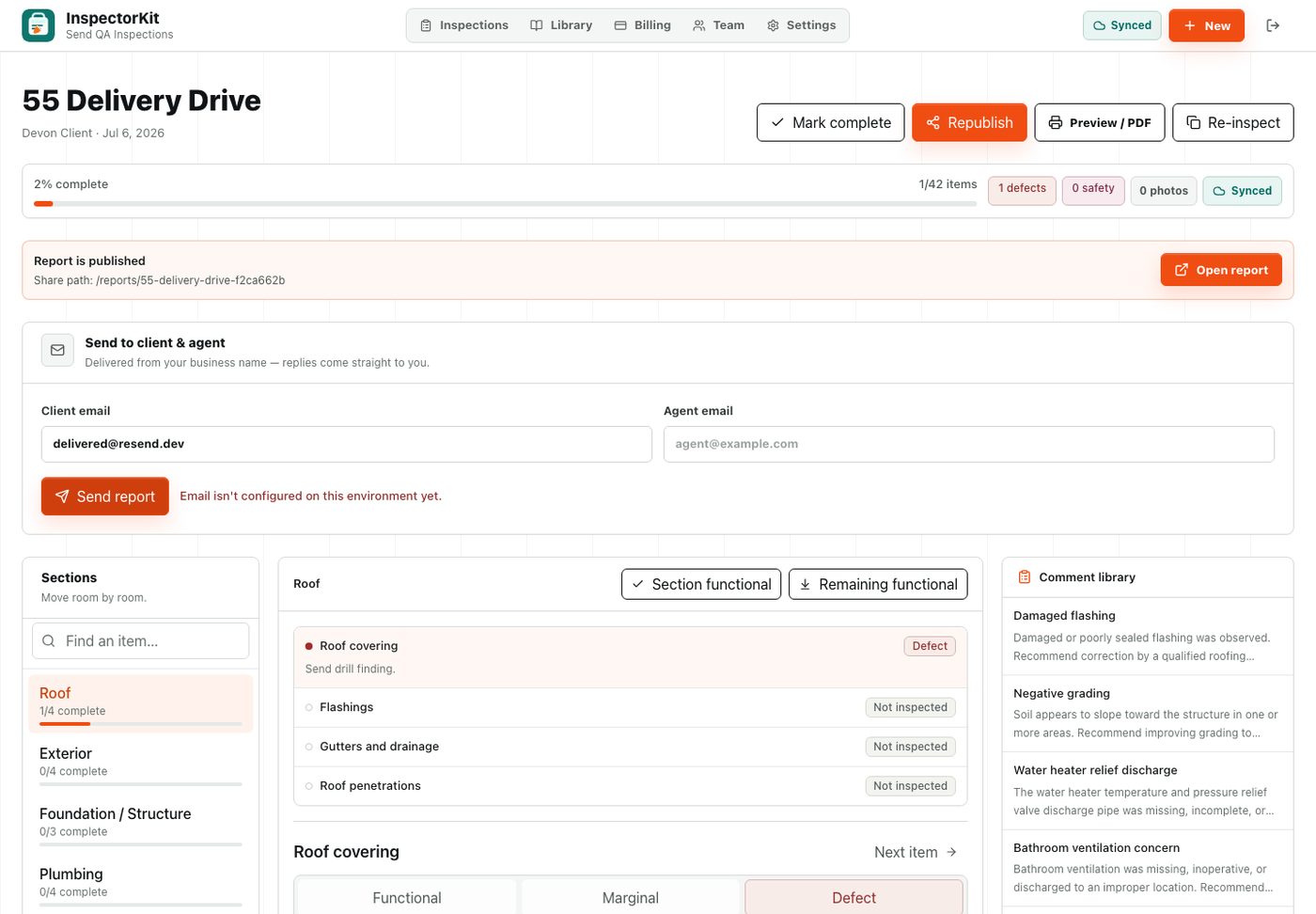
The panel sends each reader a version worded for them. The client's email reads like a note from you, with the report button and a line about the print option. The agent's is shorter and leads with the summary, since the summary is what agents work from. Both go out under your business name with replies routing to your inbox, which is a small branding decision that shapes how professional the whole delivery feels.
Two habits finish the send. Check the addresses against what the client actually gave you, transposed letters are the leading cause of the report that never arrived. And if the deal is moving fast, follow the email with a text of the share link, because email is the record but the text is what gets read in the next ten minutes.
Confirm, the step that closes the loop
Delivery is not done when you hit send, it is done when you know it landed. The delivery history under the send panel shows each send with its timestamp, which answers the did-it-go-out question before it gets asked. For the transaction-critical reports, a one-line text closes the loop entirely, report is in your inbox, call me with any questions. Ten words, and the client's evening anxiety and your inbox both get quieter.
When something does not arrive, the sequence is spam folder, address typo, then re-send or hand over the share link directly. The link is the report. Email is just one carrier for it, and the delivery troubleshooting guide walks the full checklist.
Corrections, the same-day objection answered
The standard argument against same-day delivery is the fear of shipping an error, and it deserves a straight answer. Errors are corrected by workflow, not by delay. A report assembled from memory at 10 pm is more likely to contain the wrong-bedroom error than a report written at the findings, so the same-day system is already the lower-error system. The driveway summary read catches most of what remains.
And for the residue, correct in the open. Fix the item, re-send to the same link, and say plainly what changed. Clients do not lose trust over a corrected item 12. They lose trust over reports that arrive Thursday for a Tuesday inspection, because that delay they can see, and the turnaround clock was always the visible metric.
The edge cases, handled once
Three situations test the ritual and each has a standing answer. The multi-visit inspection, where a specialist or a re-walk is pending, still publishes same-day with the pending item plainly marked as such, because a complete report about an incomplete situation beats silence. The late-afternoon job that ends at dusk still closes in the driveway, since the ritual costs seven minutes whether it is 2 pm or 7 pm, and the temptation to defer the evening job is exactly how the after-dark habit reinstalls itself. And the client with no email gets the share link by text plus a printed copy on request, the link being the report means no delivery channel is a blocker. Decide these once and the ritual survives contact with real weeks.
The whole ritual, timed
Standing in the driveway, the last mile runs like this. Sweep the progress counts for unset items, two minutes. Read the summary on the phone, two minutes. Fix the line that needs it, one minute. Publish, seconds. Send to client and agent from the panel, one minute. Text the client that it is in their inbox, thirty seconds.
Seven minutes total, and the job is fully delivered before the engine even starts, the agent's deadline math relaxes, and the report lands while the buyer is still emotionally standing in their future kitchen. Run it identically on every job and same-day stops being a service promise you strain to keep. It is just where the driveway ritual happens to end.
Common questions
What if I find an error after the report already went out?
Fix it and re-send with one line of plain acknowledgment, a correction to item 12, the updated report is at the same link. Same-day delivery with an honest correction beats a day of pre-send anxiety every time, and clients trust inspectors who correct openly more than inspectors they never see corrected.
Should the client or the agent get the report first?
Your client, always, and the agent with the client's consent, ideally in the same driveway session. The client paid for the inspection and the report is theirs. In practice both copies going out same-day is what makes the timeline work for everyone.
Is texting the report link acceptable?
As a supplement, absolutely. Email carries the formal delivery with its record, and a text with the link gets it read an hour sooner. For agents especially, the text is often the version that actually gets opened between showings.