Solo inspection business
Getting your evenings back, the inspector's time audit
What deferred report writing costs across a year, the arithmetic in hours and burnout, and what reclaiming the evening actually changes in a solo career.
By Owen Murray, founder of InspectorKit · Updated July 6, 2026
There is an accounting error running through most solo inspection businesses, and it hides in plain sight because no invoice ever states it. The job gets priced as the walk, three hours, maybe four. The report, another ninety minutes, gets paid in a currency that never appears in the books, weeknight evenings. Run the numbers once and the error stops being abstract.
The arithmetic, stated plainly
Ninety minutes of evening assembly per report is a normal figure for a collect-now-write-later workflow, between the photo sorting, the memory reconstruction, and the summary build. Five reports in a normal week makes it seven and a half hours, one full workday, donated to the business every week from the hours that belonged to dinner, kids, and being a person.
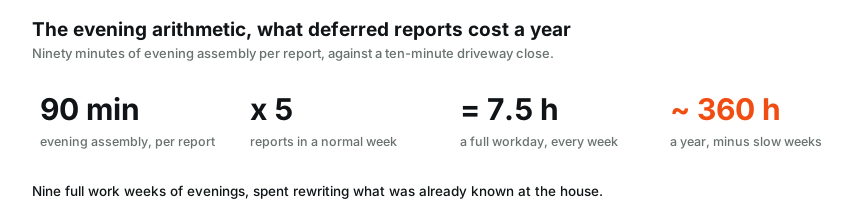
Across a working year with seasonal swing, that is on the order of 360 hours, nine full work weeks, spent rewriting information that was fully known at the house. Not inspecting, not selling, not resting. Transcribing your own recent past, at the hour of the day when accuracy is worst and the family is closest.
The after-dark workflow piece diagnoses how reports migrate to 9 pm. This piece is about what the migration costs, because the costs are what justify the fix.
The three currencies the evening pays in
Hours are the visible currency, and they are the least of it.
The second currency is accuracy. Evening reports are reconstructed reports, and reconstruction drifts, the outlet migrates to the wrong bedroom, the measurement softens, the third photo of the roof stops being distinguishable from the fourth. Every drifted detail is a small withdrawal from the report's reliability, and the report mistakes that cost inspectors are disproportionately manufactured between 9 and 11 pm.
The third currency is the career itself. Burnout in this trade rarely arrives as a dramatic event. It accumulates as a quiet resentment of the backlog, the report that sits between you and the couch, every night, for years. The inspectors who leave the profession mid-career cite the evenings more than the crawlspaces, and the ones who last decades are, with suspicious consistency, the ones who solved the report problem early. A sustainable business is not just priced and scheduled sustainably, it is one whose daily shape a human can inhabit for twenty years.
What the reclaimed hours are worth
Value the 360 hours honestly and the workflow decision prices itself.
At your inspection-hour rate, nine work weeks is tens of thousands of dollars of labor, currently spent producing zero additional revenue. Redirect even a fraction of it and the business changes, those are the hours that build the comment library, court the next three agents, add the pre-listing service line, or simply raise the ceiling on how many jobs a week the calendar can hold without borrowing from the weekend.
Or redirect none of it and take the evenings back as evenings. That is not the soft option, it is the longevity option, and longevity is the highest-return investment available to a business whose entire revenue engine is one person staying good at this for a long time.
The fix, compressed
The mechanics are covered in full by the driveway-finish system, and the compressed version fits in a sentence. Enter every finding at the finding, batch the clean items honestly, write the summary line at each item, and close in the driveway, ten minutes, engine off, report published and delivered.
The tooling has to hold its end, entry faster than note-taking, offline-proof in basements, delivery one tap from publish. Given that, the ninety evening minutes per report collapse to roughly ten daylight ones, and the collapse is permanent. Two adjustment weeks, then the new shape is just how the job works.
What changes downstream, beyond the hours
The reclaimed evening shows up in places the arithmetic does not capture. Turnaround becomes same-day by default, which feeds the agent referral channel without any additional effort. The quality of the next morning improves, because the inspector who slept without a backlog walks the first house sharper than the one who published at 11 pm. Stacked days stop being frightening, since two jobs no longer means two evening reports colliding. And the business gains a genuine hiring-avoidance option, because a solo operator with nine reclaimed work weeks a year can absorb growth that would otherwise force the second-inspector conversation early. None of these line up in a single number, and together they are worth more than the 360 hours that bought them.
The audit worth running tonight
Take last week's calendar and count honestly. How many evenings held report work, and how many hours total. Multiply by your working weeks. Then put that number next to what it buys, nothing the client sees, nothing the business keeps, findings slightly worse than the field version of themselves.
Run the same audit on a busy week and a slow one, because the busy week is where the collision pattern shows, two inspections deferring two reports into one exhausted evening.
That number is the strongest business case in inspection work, and it is sitting in your own calendar. The report was always going to get written. The only open question was whether it would be written once, in daylight, at the house, or twice, the second time from memory, in the hours that were supposed to be yours. Pick once, and the evenings come back for good.
Common questions
Is evening report work really the main burnout driver for inspectors?
It is the most consistently named one. The inspections themselves are physical but bounded, they end. The report backlog is unbounded, it follows you home, and a job that invisibly claims most weeknight evenings is a job people quietly start resenting. Ask former inspectors why they left and the evenings come up more than the crawlspaces.
I actually like writing at night when the house is quiet. Is that wrong?
Not wrong, expensive. The question is not whether you enjoy the quiet hours but whether the report needs them, because writing from memory produces measurably drifted findings. Keep the quiet hours, spend them on the business, the library, the next skill. The report just should not be the thing that needs them.
Does finishing on site shortchange the client somehow?
The opposite, and it is not close. The client gets the same-day report, and its findings were written while the inspector was looking at them instead of reconstructed hours later. Accuracy and speed both improve. The only thing shortchanged is the backlog.