Report writing craft
HVAC defect narratives, reporting comfort systems without playing technician
Furnaces, air conditioning, distribution, and venting. HVAC narratives that respect the operate-and-observe boundary while telling buyers what matters.
By Owen Murray, founder of InspectorKit · Updated July 6, 2026
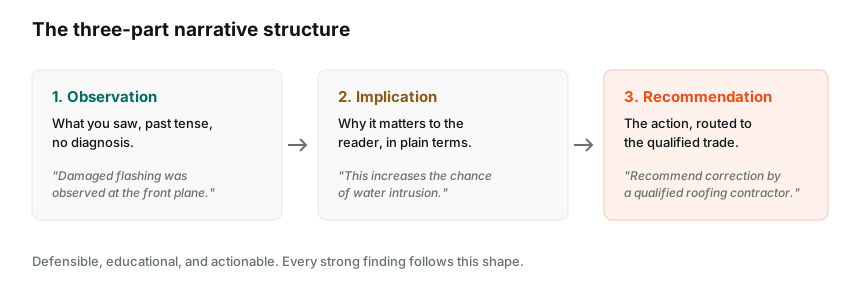
HVAC is where inspectors most often get pulled past their role. The equipment is complex, buyers ask technician questions, and the temptation is to answer them. The professional move is the opposite, operate the systems, observe precisely, report the facts, and route the diagnostics, all in the three-part discipline that keeps every section defensible. Here is that discipline applied across the comfort systems.
Heating, the operate-and-observe core
The affirmative baseline. The furnace responded to its thermostat and produced heat at the supply registers during operation. Equipment of this age and condition warrants routine servicing per the manufacturer's schedule. That second sentence quietly plants the maintenance expectation without inventing a problem.
Age with a working unit, calibrated. The furnace was operating at the time of inspection. Based on the data plate, the unit is near the typical end of its service range for this equipment type. Recommend budgeting for eventual replacement and maintaining regular service. Age is a fact, budgeting is a kindness, and the absence of a defect label on a working furnace is exactly the calibration honesty that keeps your severe findings credible.
Incomplete response, the honest defect. The furnace did not respond to the thermostat during testing. The system was not further evaluated. Recommend evaluation and repair by a qualified HVAC technician. Note what the narrative refuses to guess, no speculation about igniters or boards, just the observed non-response and the routing.
Short cycling. The furnace started and stopped repeatedly during a ten-minute observation period. Short cycling can indicate control, airflow, or sizing issues and increases equipment wear. Recommend evaluation by a qualified HVAC technician.
Visible condition findings. Corrosion was observed at the burner compartment and visible heat exchanger surfaces. Corrosion in these areas warrants professional assessment. Recommend evaluation by a qualified HVAC technician. The heat exchanger is the classic overreach trap, since a cracked exchanger is a serious call you usually cannot verify visually, and the narrative that reports corrosion observed while routing the assessment stays exactly inside what you saw.
Cooling, seasonal honesty included
Normal operation with a measurement. The air conditioning operated in response to the thermostat, with a measured temperature differential within the typical range at the supply and return. Observed and measured beats seemed cold.
The winter limitation. The air conditioning was not operated due to exterior temperatures below safe operating thresholds for the equipment. Recommend having the system evaluated during warmer weather, ideally before the applicable inspection contingency expires. That last clause is genuinely useful buyer guidance, and it converts a limitation into a scheduling task, the same move the seasonal water caveat makes.
Weak differential. The air conditioning operated, with a measured temperature differential below the typical range. Reduced differential can indicate refrigerant, airflow, or equipment issues. Recommend evaluation by a qualified HVAC technician.
The condenser's physical findings. The exterior condenser was out of level and the fins showed impact damage along one face. These conditions can affect operation and equipment life. Recommend leveling and evaluation by a qualified HVAC technician. Physical observations, physical language.
Distribution and venting, where houses talk back
Duct findings. Disconnected flexible ducting was observed in the crawlspace, discharging conditioned air into the crawlspace. Conditioned air lost to unconditioned space reduces system effectiveness and raises operating costs. Recommend reconnection and support by a qualified contractor. The consequence sentence translates the finding into the buyer's utility bill, which is the translation buyers actually retain.
Register response, room by room. Weak airflow was observed at the supply registers in the two north bedrooms. Uneven distribution can indicate duct restrictions or balancing issues. Recommend evaluation by a qualified HVAC technician.
Flue and combustion venting, safety territory. The vent connector at the furnace showed disconnection at one joint, with visible gaps. Compromised combustion venting can permit exhaust gases to enter the living space. Recommend correction by a qualified professional before continued use. This is a safety finding with its mechanism named, per the mechanism test the electrical guide formalizes, and before continued use is the urgency phrasing that separates it from routine defects.
Filter and maintenance signals. The air filter was significantly soiled, and the interior blower compartment showed dust accumulation. Restricted airflow reduces efficiency and can shorten equipment life. Recommend replacing the filter and adopting a regular maintenance schedule. Marginal, maintenance, and the narrative that teaches a habit.
Thermostats and controls, the five-second findings
Controls generate quick entries worth standardizing. A non-responsive thermostat, the thermostat display was blank and did not respond, recommend verifying power and replacement as needed. A significantly unlevel mercury-era stat still on the wall, dated control equipment was observed, recommend upgrading to a modern thermostat during any service visit. And the mismatched setup, the thermostat location receives direct afternoon sun, which can cause short cycling, recommend relocation or shading. Each is one observation and one routed suggestion, and each is the kind of small competence that reads as thoroughness without padding.
The section's quiet rules
Report the method every time, operated by thermostat, observed at registers, measured at supply and return, because HVAC findings without methods invite the question of how you know. Keep the trade title consistent, a qualified HVAC technician, and let it absorb every diagnostic question the buyer will ask you at the house. And write the affirmative findings, systems that ran properly, in one clean line each, since comfort systems are exactly where buyers most want to hear what worked.
Then load the set into your library, conditions attached, and the section with the most technician-bait in the whole house becomes the one where your role's boundaries are most visibly professional.
Common questions
What does operate-and-observe actually mean for HVAC?
You run the system with its normal controls and report what it did, temperatures, response, sounds, visible condition. You do not open sealed equipment, measure refrigerant, or diagnose internals. The boundary protects you and correctly routes the technical work.
How do I handle equipment I cannot run, like AC in winter?
Document the limitation and its reason plainly. The air conditioning was not operated due to exterior temperature below safe operating thresholds. An honest limitation is a finding, and the buyer learns to schedule a seasonal check.
Should I report equipment age?
Data plate age is a fact worth reporting with a budgeting frame. Predicting failure from age alone is prophecy. The furnace running fine at year eighteen gets an age note and a budget suggestion, not a defect.