Templates and resources
Sample inspection report teardown, why every piece is where it is
A guided teardown of InspectorKit's public sample report, what each element does for the client, the agent, and the inspector who published it.
By Owen Murray, founder of InspectorKit · Updated July 6, 2026
Reading about report structure is one thing. Walking a real one with a guide is faster, so this is a teardown of the public sample report, element by element, with the reasoning behind each piece. The sample is a fixture, a realistic house with realistic findings, published through the exact pipeline every real InspectorKit report uses, which makes it an honest specimen.
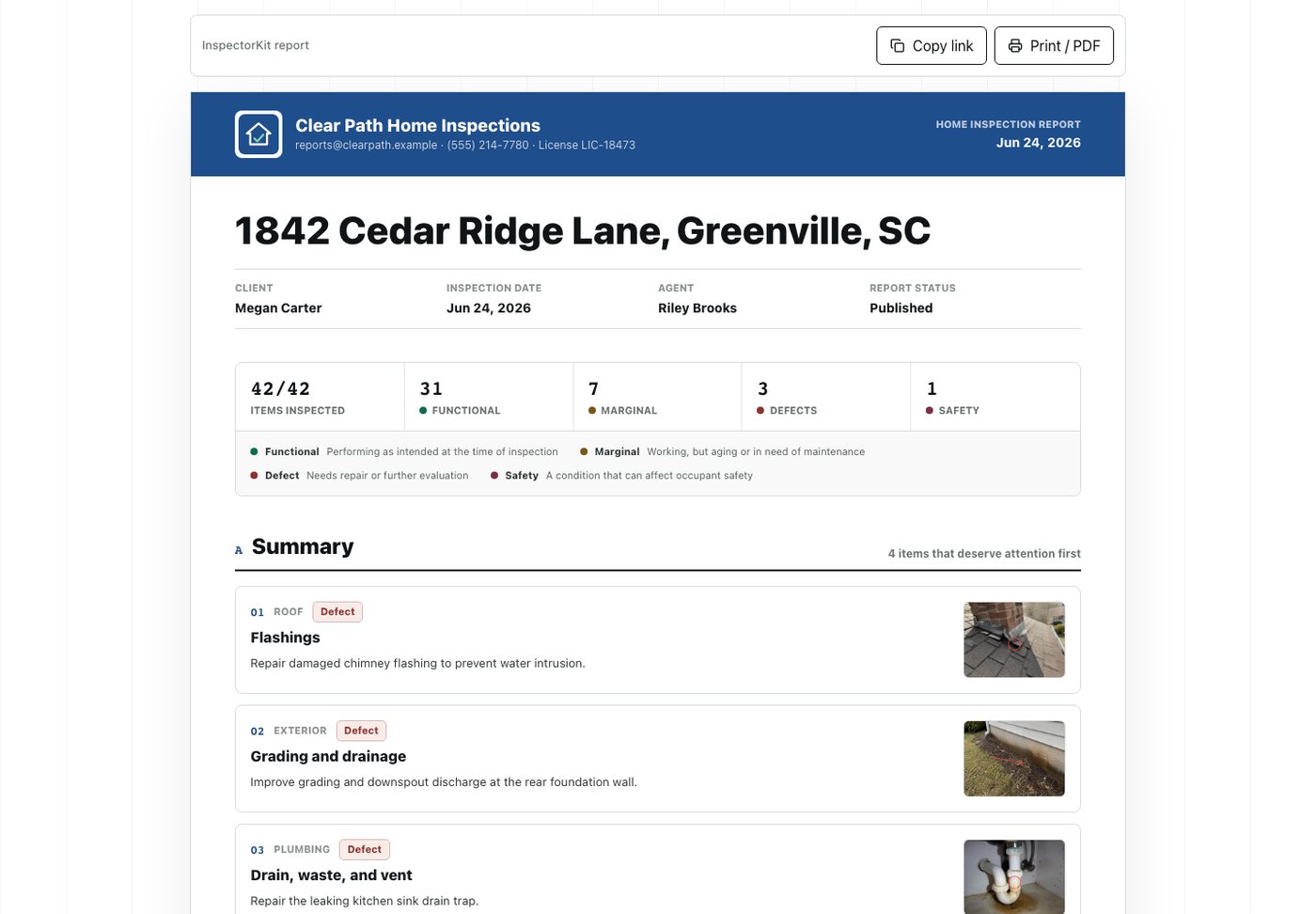
The frame, before the report begins
The page opens inside a quiet toolbar, a copy-link button and Print / PDF, and nothing else. That restraint is deliberate. The client's tools are the two things a client actually does with a report, share it and file it, and the web-versus-PDF question is answered here by offering both without making either a project.
What is absent matters as much. No vendor logo competing for the header, no account prompt, no app download. The report opens like a document, because it is one.
The branded header, the inspector's handshake
The colored band at the top belongs to the inspector, business name, email, phone, and license number, with the report date on the right. Every question a reader might need answered about provenance, who did this, are they licensed, how do I reach them, is settled in the first two inches, and it is settled in the inspector's brand rather than the software's, which is the entire report branding argument compressed into one band.
The property block and the stats band
The address renders as the page's headline because the property is what everyone came to read about, with the client, inspection date, agent, and report status in a clean strip beneath it.
Then the piece most reports bury or skip, the stats band. Forty-two of forty-two items inspected, thirty-one functional, seven marginal, three defects, one safety, each count sitting above a legend that defines the terms in plain words, functional means performing as intended, marginal means working but aging, defect needs repair or further evaluation, safety can affect occupants.
The band does two jobs at once. It gives every reader the shape of the house in five seconds, and it calibrates them before they meet a single finding, so the word defect arrives pre-defined instead of terrifying. Transparency does the third job quietly, the 42-of-42 line tells the reader nothing was skipped, and when something is genuinely inaccessible, that shows too rather than disappearing.
The summary, four items that deserve attention first
The summary opens with its own honest subtitle, the items that deserve attention first, and delivers them as numbered cards, section label, severity chip, a plain-language line, and a thumbnail of the evidence photo.
Notice the writing on the cards. Repair damaged chimney flashing to prevent water intrusion. Improve grading and downspout discharge at the rear foundation wall. Action-first phrasing, a reason attached, no jargon, because the summary's readers include the buyer's parents and the listing agent's assistant. This is summary-first structure working as designed, the one page everyone reads, doing the whole document's heavy lifting, with the body waiting underneath for anyone who wants depth.
The thumbnails earn their pixels too. Every summary item carries its photo, so the reader connects the sentence to the physical reality before scrolling anywhere, and the photo discipline pays off at the exact moment of highest attention.
The findings body, depth without disorder
Below the summary, the full report runs section by section in walk order, roof to garage, every item with its condition, narrative, and photos attached to the finding they document. The reading experience is built for the partial reader, clear section headings for the person hunting one system, one finding per item so nothing hides inside a paragraph, and severity chips that keep the calibration visible throughout.
The narratives themselves follow the three-part discipline, observation, implication, routed recommendation, which you can verify by reading any defect item in the sample against the pattern. A sample report is also a writing sample, and this one is meant to be graded.
The mobile read, the version most clients get
Open the same sample on a phone, because that is where most clients meet their report, and the teardown continues. The header compresses without losing the license line, the stats band stacks into a scrollable strip, the summary cards go full-width with their thumbnails intact, and the body sections collapse into a tappable outline. Nothing requires pinching, nothing requires an app, and the Print / PDF path rides along for the reader who wants the fixed copy. The phone experience is not a degraded version of the desktop report, it is the primary design target, since the buyer opening the link in a parking lot is the modal reading event, and the web-format decision is what makes that possible.
What the teardown teaches, for your own reports
Three transferable lessons. Structure is service, every element above exists for a specific reader doing a specific thing, and decoration is absent. Calibration must be visible, the legend and the chips keep severity meaning constant from cover to final item. And the summary is the product, the body is the proof.
If you publish your own sample from a practice inspection, hold it to this teardown, would a stranger know who you are in two inches, understand the house in five seconds, and find the four things that matter in thirty. The sample that passes those three reads is the strongest pre-hire marketing an inspector can put on a website, and it costs one practice house to make.
Common questions
Is the sample report a real inspection?
It is a realistic fixture, a composite house with findings assembled from the kinds of conditions ordinary residential work produces, published through the same pipeline as any real report. The structure, the photos-on-findings, and the reading experience are exactly what a paying client receives.
Can I show the sample report to clients or agents?
That is half of what it exists for. Anyone evaluating your work before hiring you wants to see what they will receive, and a public sample answers the question without ceremony. Inspectors on InspectorKit typically publish their own sample from a practice inspection for exactly this use.
How closely will my reports match the sample?
Structurally, completely, cover, stats band, summary, findings body all come standard. Visually, it carries your branding instead, your logo, your business name, your license line. The sample shows the bones. Your reports wear your identity on them.