Templates and resources
Inspection report sections, what a complete report contains
The five parts every complete inspection report needs, what each one does for which reader, and the ordering logic that serves them all at once.
By Owen Murray, founder of InspectorKit · Updated July 6, 2026
Every complete inspection report is answering five different questions for five different readers, who did this, what shape is the house in, what matters most, what exactly did you find, and what were the limits of the look. Map one section to each question and the structure of a professional report falls out almost automatically. Miss one and a specific reader, somewhere downstream, gets stranded.
Here are the five, in the order they should appear, with what each is quietly doing.
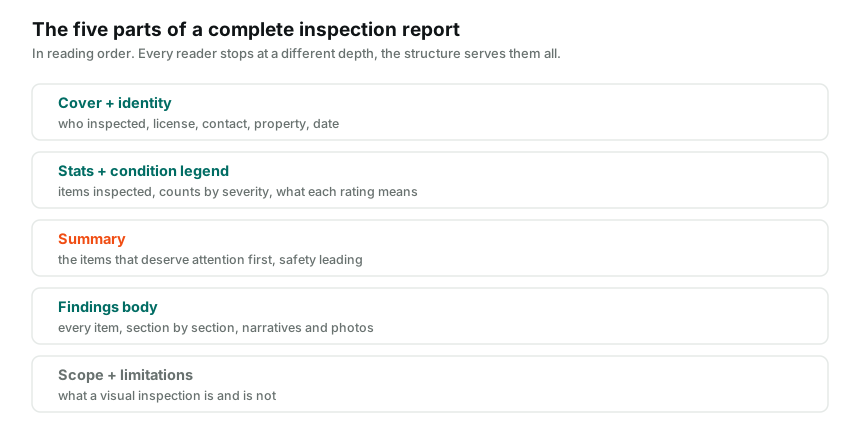
Cover and identity, the provenance section
Before a single finding, the report establishes who stands behind it, business name, license number, contact details, the property, the client, the date. This is not ceremony. The report will be read by people who never met you, forwarded to people who never will, and consulted years after the transaction closed, and every one of those readers needs provenance settled in the first screen.
The identity block is also where the branding stakes live, since whoever's name sits in that band collects the credibility of everything below it. It should be yours.
The stats band and condition legend, the calibration section
Second, the shape of the house in numbers, items inspected, counts by severity, with the legend defining each condition in plain words. The sample report renders this as a single band, forty-two of forty-two inspected, thirty-one functional, and definitions like marginal means working but aging.
The section's real function is calibration. Severity words mean nothing until defined, and defining them before the findings means every chip in the body arrives pre-translated. The items-inspected count adds the transparency layer, nothing was skipped, and what could not be accessed says so. Thirty seconds of reading, and the whole document is now legible.
The summary, the priority section
Third, and the structural argument deserves its own piece, the items that deserve attention first, safety leading, each with its severity, a plain-language line, and its photo. This is the only section every party in the transaction is guaranteed to read, which makes it the section that must be able to stand alone. Written well, it briefs the buyer, arms the agent's repair request, and frames every conversation that follows. Written thin, the negotiation runs on someone else's summary of your work.
The findings body, the evidence section
Fourth, the full walk, section by section in walking order, every item carrying its condition, narrative, and photos. The body serves the deep readers, the contractor pricing a repair, the buyer obsessing over the roof, the second inspector years later, and its virtues are boring ones, one finding per item, three-part narratives, photos attached to the finding they document rather than pooled in an appendix.
The body is also where consistency gets graded across hundreds of items, the same marginal-versus-defect calibration from the first item to the last, because the one reader who checks everything, the dispute reader, is checking exactly that.
Scope and limitations, the boundary section
Last, the section nobody reads until it matters enormously, what a visual inspection is, what was inaccessible, what the report does not claim to be. It sits at the end not because it is unimportant but because it is reference material, consulted when a question arises rather than read for pleasure.
The wording here is doing permanent liability work. A clear statement that the inspection was visual and non-invasive, that concealed conditions are outside its reach, and that specific areas were inaccessible on the day, converts most someday disputes into short conversations. Every finding in the body implicitly leans on this section, which is why it belongs in the template rather than being re-improvised per report.
What complete reports leave out
The five parts are also a boundary, and the professional report is defined by its omissions as much as its contents. No repair cost estimates, which belong to contractors and convert observation documents into negotiation exhibits. No marketing inserts or service upsells riding inside a paid deliverable, the vendor-ads problem in its most self-inflicted form. No editorializing about the house's worth, the sellers' housekeeping, or the neighborhood. And no unrouted alarm, every concerning finding carries its next step, because a report that frightens without directing has done half a job. The discipline of the five sections is partly the discipline of refusing a sixth.
The re-inspection variant, the same five parts compressed
The structure scales down gracefully, which is worth seeing once. A re-inspection report keeps all five parts in miniature, the same identity band, a stats line for the repair list rather than the whole house, a summary of verified versus remaining items, a short body with before-and-after evidence per item, and the same scope boundary stating that only the listed repairs were examined. Ten items instead of forty-two, one page of body instead of twelve, and a reader who knows the full-report structure navigates the small one instantly. Structure that compresses without breaking is the sign it was carrying real logic rather than convention.
The ordering logic, one principle
Identity, calibration, priorities, evidence, boundaries. The order is a funnel matched to reading depth, because every reader stops somewhere, and the structure's job is to have served them fully by the time they do. The five-second reader leaves with provenance and the verdict. The five-minute reader adds the priorities. The deep readers get everything, and the someday-dispute reader finds the boundaries exactly where a careful document keeps them.
Templates make the whole thing free after the first setup. The standard residential template carries this structure into every report automatically, the stats and legend assemble themselves from your condition tapping, and the summary builds from the notes you write at each finding. Structure, done once, becomes the part of report quality that no tired Thursday can degrade.
Common questions
Does section order really matter that much?
It decides whether readers find what they need before they stop reading, and every reader stops. Identity first, verdict second, priorities third, depth fourth, boundaries last serves the five-second reader and the fifty-minute reader with the same document. Orders that bury the summary or lead with boilerplate lose the reader exactly where the stakes are highest.
Where do repair cost estimates go?
Nowhere in the report, for most inspectors. Costs are the contractor's answer and the fastest way to convert an observation document into a negotiation exhibit. The recommendation lines route each finding to the trade that prices it, which serves the reader better than a guess that will be quoted against you.
Is a glossary section worth including?
A short one earns its place, especially for first-time buyers. The condition legend handles the severity words, and a dozen plain-language definitions of the terms your narratives use most, GFCI, flashing, grading, covers the rest. Past that, plain writing in the narratives beats a long glossary nobody visits.