Templates and resources
The starter comment pack, a guided tour
What ships in InspectorKit's field-tested starter comments, how each entry is built, and how to grow the pack into a library that is unmistakably yours.
By Owen Murray, founder of InspectorKit · Updated July 6, 2026
Every new InspectorKit account arrives with a comment library already stocked, a starter pack of field-tested narratives covering the findings that repeat across ordinary residential work. It exists because the blank library is the coldest start in inspection software, and because well-built example entries teach report writing faster than any style guide. This is the tour, what is in the pack, how the entries are constructed, and how the pack becomes the seed of a library that is unmistakably yours.
What ships, by neighborhood
The pack concentrates where findings actually concentrate. Roof and exterior entries cover the flashing damage, covering wear, and the negative grading finding whose narrative you will insert more than nearly any other. Plumbing brings the water heater cluster, including the relief valve discharge entry, and the drainage observations. Electrical carries the GFCI protection narratives and panel-adjacent findings, the safety-rated core of the pack. Bathrooms and interior round it out with the ventilation concern, moisture-evidence language, and the surface findings every lived-in house serves up.
Each entry files under its category with a condition it typically pairs with, so the Damaged flashing entry surfaces in the library sidebar already sorted where roof work happens, one tap from the narrative field it belongs in.
The anatomy, why the entries look the way they do
Every starter comment is built to the same skeleton, and the skeleton is the actual product.
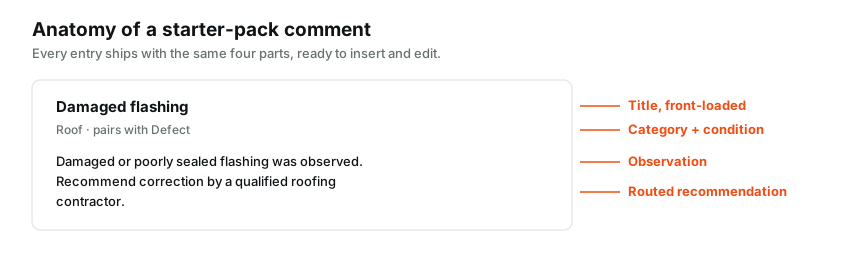
The title is front-loaded, Damaged flashing, Negative grading, so the first word identifies the finding for a thumb scrolling a sidebar in the field. The body opens with an observation in past tense, damaged or poorly sealed flashing was observed, no diagnosis, no cause claimed. And it closes with a recommendation routed to a qualified trade, which hands the judgment to the party licensed to make it.
That shape is the three-part discipline with the middle beat, the implication, kept lean enough to survive any house, since the implication is often the part that most wants a location-specific sentence from you. The entries are deliberately house-agnostic, they describe the condition, and the ten seconds you spend after inserting, adding at the north foundation wall or at the master bath, is what marries the vetted language to this property.
What the entries never contain is equally deliberate, no verdict words, no cause diagnosis, no cost talk, no warranty phrasing, because anything in the library gets multiplied across every future report, and the liability posture has to be built in at the template level, not patched job by job.
Using the pack in the field
The working loop is three beats. Tap the item, find the entry in the sidebar, insert, then edit for location and specifics. On most findings the whole exchange costs under thirty seconds, which is the speed that makes finishing on site arithmetic work.
Two field habits get the most out of the pack early. Read an entry fully the first time you insert it, once, so you know exactly what your report is saying under your name. And when a house demands a variation, edit in place for the report, then decide whether the variation deserves saving as its own entry, which is the growth mechanism the next section is about.
From starter pack to your library
The pack is a seed, not a ceiling, and the library-building method covers the full arc. The compressed version, every fresh narrative a house forces you to write gets saved back to the library before you leave the item, one tap on Save current comment, and the collection compounds at the rate the work actually generates novelty.
Within a season the pack's entries sit alongside dozens of yours, within a couple of years the collection reads like you and covers findings you meet twice a season. Editing the starter entries themselves is encouraged too, tune the phrasing to your voice, tighten the routing to your market's trade names, and the pack stops being ours and becomes the oldest layer of yours.
The whole collection stays portable throughout, exportable as a printable document and plain data through the export path, because a library you spend years growing should never be a hostage.
Pruning and merging, keeping the pack sharp
Growth needs an occasional counterweight, and the pack benefits from the same twice-yearly pruning pass the library method prescribes. Duplicates accumulate wherever the save-back habit is healthy, two near-identical flashing entries split your muscle memory, and the merge, keep the stronger wording, delete the twin, takes seconds in the library manager. The starter entries themselves are candidates too, once your edited version of an entry has fully replaced the original in practice, delete the original rather than scrolling past it forever. A library that only ever adds becomes a warehouse. The prune is what keeps it a toolbox.
The quiet pedagogy
The starter pack's second job is the one nobody lists on a feature page. New inspectors learn report writing from the entries themselves, the shape of an observation, the sound of a routed recommendation, the absence of the verdict words that feel natural and read as liability. Forty examples of the pattern, met in the field at the moment of need, teach more than any course module on narrative writing.
So use the pack as a working tool and read it as a style guide, because it is both. The entries carry the pattern, the pattern carries the protection, and the library that grows from it carries your accumulated judgment to every report you will ever publish.
Common questions
Are starter comments safe to use word for word?
They are written to be, observation-based, routed to trades, free of diagnosis and warranty language. The location details are yours to add after inserting, and any entry you edit for your voice should keep those structural properties intact. The shape is the safety.
Why ship dozens of comments instead of thousands?
Because a library you can know beats a warehouse you search. A focused pack covers the high-frequency findings and teaches the pattern, and your own save-back habit grows it toward the few hundred entries a mature practice actually uses. Ten thousand generic entries mostly teach scrolling.
Can I import comments I already have from another tool?
Yes, the bulk import takes pasted text in blocks, first line the title, the rest the body, with category and condition applied to the batch. An evening moves most libraries. The starter pack and your history merge into one collection you own.