Switching and migration
When to switch inspection software, the signals and the false alarms
Six signals that say the time is now, three that say it is not, and a decision framework for the inspector who has been circling the question for a year.
By Owen Murray, founder of InspectorKit · Updated July 6, 2026
Nobody switches inspection software on a whim. The question arrives, gets circled for a season, gets shelved during the busy months, and returns with every renewal email. This guide exists to end the circling, in either direction, by sorting the real signals from the false alarms and attaching a decision method that takes three weeks instead of another year.
The six real signals
Signal one, the price moved and the value did not. A rate increase lands, or a feature you relied on migrates to a higher tier. Repricing is the vendor reopening the deal, which makes it the natural moment to reopen your side, per the fee-creep audit.
Signal two, your vendor got acquired or merged. Ownership changes rewrite roadmaps, support priorities, and pricing discipline, on the buyer's schedule, not yours. The industry's consolidation is exactly this signal at market scale, and it is why the alternatives conversation moved outside the big-platform family.
Signal three, something appeared around your reports that you did not put there. Provider offers, estimate upsells, portal promotions riding on your deliverable. The whose-report-is-it audit takes five minutes, and what it finds is a values question wearing a settings toggle.
Signal four, support stopped being people. Response times stretched, answers went scripted, the forum replaced the inbox. Support quality is a leading indicator, it decays before products do, and you are sampling your future claim-day experience every time you ask a routine question.
Signal five, your volume crossed a pricing threshold. Per-report fees passing the flat-rate line, seat fees arriving with a hire, an add-on's percentage quietly becoming your biggest software cost. Pricing models have break points, and the cost table locates yours in one read.
Signal six, the evenings stopped coming back. The honest one. If report assembly still eats your nights despite years of tool fluency, the workflow itself is the problem, and no renewal fixes a workflow.
The three false alarms
Alarm one, a shiny feature demo. A competitor ships something clever, the video is slick, and suddenly your faithful tool feels old. Features demo better than they field, and a single capability almost never outweighs workflow fluency. Wait a quarter, and if the envy survives contact with your actual needs, treat it as a real signal.
Alarm two, one bad day. An outage, a lost hour, a support miss. Every platform has them, and switching in anger trades a known tool's bad day for an unknown tool's bad month. Log the incident, watch for a pattern, and let patterns decide, not spikes.
Alarm three, forum weather. Communities amplify grievance, and every platform's user group reads like a mutiny if you scroll long enough. Other people's workflows are not yours. Your scorecard beats their threads.
The compound signal, when several fire at once
Signals rarely arrive alone, and their combinations read differently than their parts. A price increase during an acquisition year is the market testing what consolidation allows. Support decay plus new monetization around your reports suggests the roadmap's center of gravity moved away from inspectors. Volume threshold plus evening erosion means you outgrew the tool in two directions simultaneously. One signal justifies an evaluation. Two or more firing in the same season justify scheduling it this month, because compound signals describe a trajectory, and trajectories do not fix themselves while you circle.
The framework, three questions in order
When a real signal fires, run three questions before any evaluation.
Would I choose my current platform today, fresh, at its current price? The repricing question from the switching-costs guide, and a no here is load-bearing. Is the alternative structurally different, or just differently decorated? Same-model switches, subscription to subscription, buy new paint for old rent, while model changes, rented to owned, bundled to modular, move actual ground. And can I test without risk? If the answer involves a parallel month, a practice environment, and a money-back guarantee, the test is free and the only cost of certainty is attention.
Three yeses mean book the evaluation. Any no means stay, contentedly, with the circling formally closed for the year.
The renewal email, rewritten as a checklist
Since the circling usually restarts when the renewal email lands, end with the sixty-second version to run right then. Open your archive folder and confirm it is current, which the quarterly ritual should have handled. Reread your one-hour lock-in audit numbers if you have run it, or note that you have not, which is itself the finding. Ask the fresh-choice question, would I sign up today at this price. And check the calendar for a normal-volume month inside the notice window. Four checks, one minute, and the renewal either earns its year on merit or books its replacement's evaluation. Either way, the email stops being a recurring anxiety and becomes what it should have been all along, an annual invoice from a vendor who works for you.
From signal to settled, the three-week close
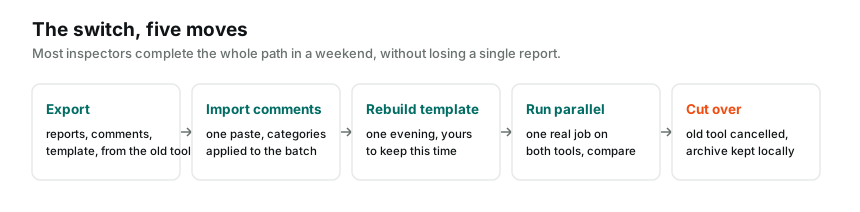
The evaluation itself is the parallel testing protocol, new tool primary on real jobs, scorecard running, old platform as the net. It ends the question with evidence, in either direction, inside a month.
And either ending is a win. A switch that survives the protocol pays its difference every year after, roughly $1,300 annually against the flagship's monthly rate. A stay that survives the protocol converts grudging renewal into a decision you actually made, which changes how the next renewal email reads. The only losing move is the one most inspectors are making when they land on this page, circling a question that a three-week test answers, while the meter runs on the circling itself.
The signals are above. If one of them is yours, the calendar is the only thing left to consult.
Common questions
Is there a best season to switch?
A normal-volume month beats both extremes. Enough jobs to test on, enough slack to absorb a learning curve. Annual-plan holders should count backwards from renewal and decide with two weeks of margin, never under the countdown.
How long should I tolerate circling the decision?
One evaluation, run properly, ends the circling in three weeks. Circling without evaluating has no natural end and costs the subscription difference every year it continues. Book the test, whichever way it comes out.
What if I switch and regret it?
The parallel method makes regret nearly impossible to reach, since the old platform stays live until the new one proves itself on your own jobs. A guarantee-backed purchase plus a verified archive means every path stays reversible for a month.