Alternatives and comparisons
Horizon inspection software alternatives, an honest evaluation
Carson Dunlop's Horizon is respected and subscription-priced. What it costs over time, who it fits, and what an ownership-model alternative looks like.
By Owen Murray, founder of InspectorKit · Updated July 6, 2026
Horizon occupies a particular place in inspection software. It comes from Carson Dunlop, a company that trained a meaningful share of the inspectors using it, and that pedigree shows in how the product thinks about reports. Inspectors who use it tend to like it. This guide exists for the ones doing the math anyway.
The subscription arithmetic
As of July 2026, Horizon's public pricing lists $79 per month, or $799 per year, which works out to about $67 monthly when billed annually. All-in pricing, one tier, no feature gates. That structure is genuinely more honest than most of the industry.
Honest structure, same model. Paying monthly, four years of Horizon costs $3,792. Annually, four years runs $3,196. At the end of either number you own nothing, and year five starts the meter again at whatever the price has become by then.
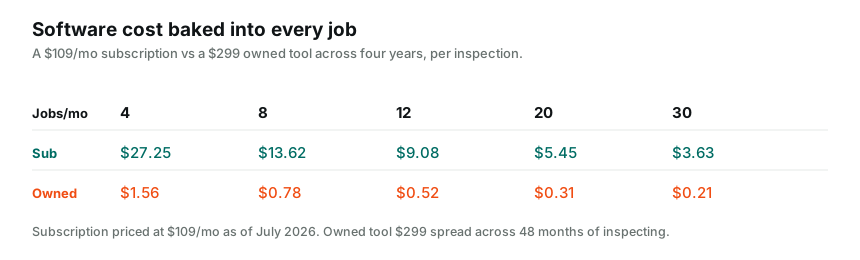
Compare the shape of that spend to a one-time purchase and the question stops being about features for a moment. $299 once, against roughly $3,200 to $3,800 per four-year cycle, is a gap wide enough to fund a lot of ladders, mileage, and marketing. The one-time payment buyer's guide runs this break-even logic in detail with a table, and the crossover point lands inside the first quarter.
What Horizon users would actually miss
Switching costs are real, so name them honestly.
Horizon's strength is its integrated approach and its inspection-education DNA. The reporting system reflects decades of thinking about how findings should be communicated. An inspector who leaves gets to keep none of the platform, which is exactly the problem with rented software, but the habits and structure they built are portable. Templates are ideas, and ideas move.
The workflow transition is the real cost. Any new tool means two or three inspections of feeling slower before muscle memory rebuilds. The way to pay that cost safely is parallel running, one more month of the subscription you already pay, with real jobs going through both tools. The first report walkthrough is genuinely ten minutes, and by the third real inspection the comparison writes itself.
The training-company advantage, and its limit
Horizon's real moat is pedagogical. Carson Dunlop wrote curriculum before it wrote software, and the product's report structure teaches good habits to inspectors who came up through their courses. That is worth respect, and worth naming as the thing you would be leaving.
It is also separable from the pricing model. The habits are yours now. A well-structured template, summary-first reporting, and careful narrative language all travel with the inspector, not the subscription. InspectorKit's starter pack was written to the same observation-implication-recommendation discipline, and your own refinements move over with the comment importer in an afternoon.
What the ownership model offers instead
InspectorKit is a $299 one-time purchase built around a narrower and deeper promise. The report gets built in the driveway, published under your brand, and delivered before you leave, and the tool costs nothing further for as long as you inspect.
The purchase covers the report builder with one-tap conditions, an editable template you can reshape to your region and habits, a comment library seeded with a field-tested starter pack, photo annotation that pins your markup to the exact finding, offline operation for basements and dead zones, and delivery by branded web link and PDF with sending built in.
What it deliberately does not include is the business-suite layer. No scheduling engine, no agreements module, no payment processing. Solo inspectors mostly have those solved with a calendar and an invoice app, and the ones who want them integrated should weigh that against the subscription price that funds it.
The evaluation that actually settles it
Feature lists are marketing. Three tests are not.
Open the sample report next to one of your own recent reports and judge the deliverable cold, the way an agent flipping through on a phone would. The summary structure, the photo placement, the professionalism of the whole document. If the sample does not clear your bar, stop reading vendors' pages, including this one.
Then check the exit before the entrance. InspectorKit publishes its export paths for reports, templates, and comment libraries, and holds that up as the standard every platform should meet. Whatever you evaluate next, ask what leaves with you when you go, and notice how the answer feels.
Last, run real jobs through it. Not the demo, paying inspections, with the 60-day money-back guarantee underneath. Software proves itself in a crawlspace at 4 pm, not on a pricing page. If the reports do not come out sharper and the evenings do not come back, the refund is one email.
Questions worth asking before renewing anything
Whether you stay or go, put three questions to any vendor at renewal time. What happens to my report archive if I cancel, specifically and in writing. What has the price done over the past three years, because history is the best predictor of your future invoices. And what portion of the features I pay for did I actually use this year. Vendors with good answers deserve renewals. Vendors who redirect to a features tour have answered differently than they think.
Timing the move
Horizon's annual billing makes the calendar part simple. Renewal minus two months is your evaluation window. Run the parallel test then, decide before the charge, and either renew with confidence or step off the subscription treadmill with your archive downloaded and your language already moved.
Inspectors rarely regret the month they spent testing. The regret that shows up in my inbox is about the years of fees paid past the point when someone already knew.
Common questions
Is Horizon a bad product?
No, and this page will not pretend otherwise. It comes from a company with deep inspection roots and inspectors generally respect it. The question this guide answers is about the pricing model and fit, not about whether the software works.
Can I bring my Horizon report structure to InspectorKit?
Yes. Rebuild it yourself in the template editor in an evening, paste your narrative language into the importer, or send recent reports to the Done-For-You setup and get a configured account back without doing the labor.
What does InspectorKit not do that Horizon does?
Horizon bundles business management features around the report writer. InspectorKit is deliberately a report tool only, built for solo inspectors who run scheduling and payments elsewhere and want the report itself done faster.