Alternatives and comparisons
Inspection software for part-time inspectors, priced for your real volume
Running four jobs a month changes every software equation. The models compared at part-time volume, and the workflow that keeps weekends from disappearing.
By Owen Murray, founder of InspectorKit · Updated July 6, 2026
Part-time inspection is a different business with the same deliverable. Your Saturday client gets the same quality bar as a full-timer's Tuesday client, but your economics run on four to eight jobs a month instead of twenty five, and software pricing built for full-timers treats your smaller revenue like a rounding error. This guide runs every model at part-time volume and lays out the workflow that protects the scarcest part-time resource, which is the weekend itself.
The fixed-cost problem
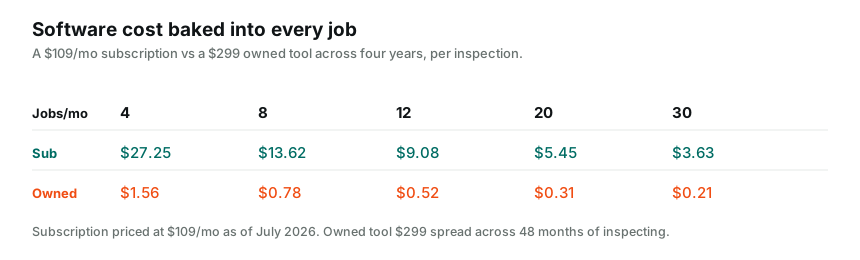
Subscriptions ignore volume, which flatters heavy users and quietly taxes light ones. At $79 to $109 monthly across the major platforms, a part-timer running five jobs pays $16 to $22 of software per inspection. The full-timer next door pays $4 to $5 per inspection on the same plan. Same software, quadruple the unit cost, purely because the subscription meter does not care that your Tuesday belongs to another employer.
Over a year that is $948 to $1,308 of fixed rent against maybe sixty jobs. Real money for a side business, and it renews forever, through your slow winters and your family vacations, whether you inspected or not.
Per-report pricing, the part-timer's honest friend, briefly
Pay-as-you-go was invented for exactly you, and at genuinely low volume it delivers. Tap Inspect's $7.50 per report runs $30 a month at four jobs, far under any subscription, with the mechanics and block-purchase details covered in the full breakdown.
Two catches keep it from being the final answer. The crossover arrives early, around twelve monthly jobs the fees match a flat subscription, and successful part-timers drift toward that line faster than expected, since referrals do not know you are part-time. And the meter never converts into anything owned. Three years of steady side work at six jobs a month is roughly $1,600 in fees, with nothing at the end but the habit of paying.
The ownership math at part-time volume
One-time pricing changes character at low volume, in an underappreciated direction. The common intuition says ownership suits heavy users, and the arithmetic says otherwise.
$299 once, at four jobs a month, crosses per-report fees in about ten months and every subscription inside four months. From that point the part-timer owns the identical tool a full-timer owns, at zero marginal cost, through every slow season. The three-definitions cheapest guide ranks the whole market this way, and the owned line wins the career-length definition at every volume above hobbyist.
There is a psychological dividend too, one part-timers mention unprompted. A tool you own never nags your margins during a slow month. The side business stays fun when its fixed costs are zero, and staying fun is half of why the side business survives.
The weekend workflow, engineered
Part-time inspection lives or dies on turnaround discipline, because Monday morning belongs to the day job. The workflow that works fits in one sentence, the report finishes at the house.
InspectorKit was built around that sentence. One-tap conditions and a comment library keep the writing to taps in the field loop. Photos pin to findings with markup, so nothing waits for a sorting session. The summary assembles itself from your findings. And publishing plus sending to the client and agent happens from the driveway, under your business name, before you drive home to the rest of your Saturday.
The alternative pattern, notes and photos all day then assembly all evening, is precisely the tax a part-timer cannot pay. Your hourly rate on Saturday night is infinite, because that hour was never for sale.
Looking part-time without reading part-time
The quiet fear of every part-timer is the report that betrays the schedule, and it is worth addressing directly. Agents cannot see your calendar. They see the document, and the document is entirely controllable.
Your reports carry your branding and license exactly like any established firm's. The starter comment pack keeps narrative language professional from job one. The published web report reads identically whether its author inspects four houses or forty. Judge the ceiling yourself against the sample report, because that page is what your Saturday client's agent would receive, and it does not mention weekends anywhere.
The two-hats calendar problem
Part-timers juggle a day job's hours against inspection requests, and the software angle is smaller than vendors pretend. You do not need a scheduling engine for four bookings a month, you need a calendar you already own and fast confirmation habits. Where software genuinely helps the two-hats life is turnaround certainty, since a report finished at the house never collides with Monday's meetings, and a re-inspection that clones itself in one tap turns a follow-up visit into a lunch-break-sized job instead of a second weekend commitment.
Insurance, licensing, and the paper trail
A side note the software pages skip. Part-timers carry the same E&O and licensing obligations as full-timers, and documentation discipline is what protects a business you cannot afford to let injure your primary income. Owned exports help here in a specific way. Your reports, template, and comment library export as ordinary files, so your records folder stays complete regardless of any platform's fate, and a coverage question three years from now gets answered from your own drawer rather than a vendor's retention policy.
The part-timer's decision, compressed
Count your realistic monthly jobs and your honest trajectory. At one or two jobs with no growth ambitions, per-report pricing defends itself. At three or more, or on any trajectory toward more, the owned tool crosses everything inside a year, protects your weekends by design, and scales to full-time for free if the side business ever wins the argument with your day job.
Then test it the part-time way, on real Saturday inspections, with the ten-minute first report setup done Friday night and a 60-day guarantee holding the risk at zero. The best software decision for a part-timer is the one you make once, and stop paying for.
Common questions
Is professional software overkill at four jobs a month?
The deliverable does not know your volume. The agent reading your report compares it against full-timers' reports, so the quality bar is identical. What changes at part-time volume is the pricing math, not the professionalism requirement.
Should a part-timer pay monthly, per report, or once?
At four jobs a month, per-report runs about $30 monthly and subscriptions run $79 to $109 regardless. A one-time purchase crosses both inside its first year and then costs nothing while your day job pays the bills. The math favors ownership sooner than most part-timers expect.
What if I go full-time later?
That is the strongest argument for owning your tool now. Volume growth makes rentals and per-report pricing more expensive while an owned tool's cost stays spent. Your software decision should survive your success.